
Author Name: Bruce Zheng
Author Role: Co-Founder and Valve Engineer at NTGD Valve
Author Bio: Bruce Zheng is Co-Founder and Valve Engineer at NTGD Valve, focusing on industrial valve selection, application, and technical content for global B2B buyers.
Last Updated: June 16, 2026
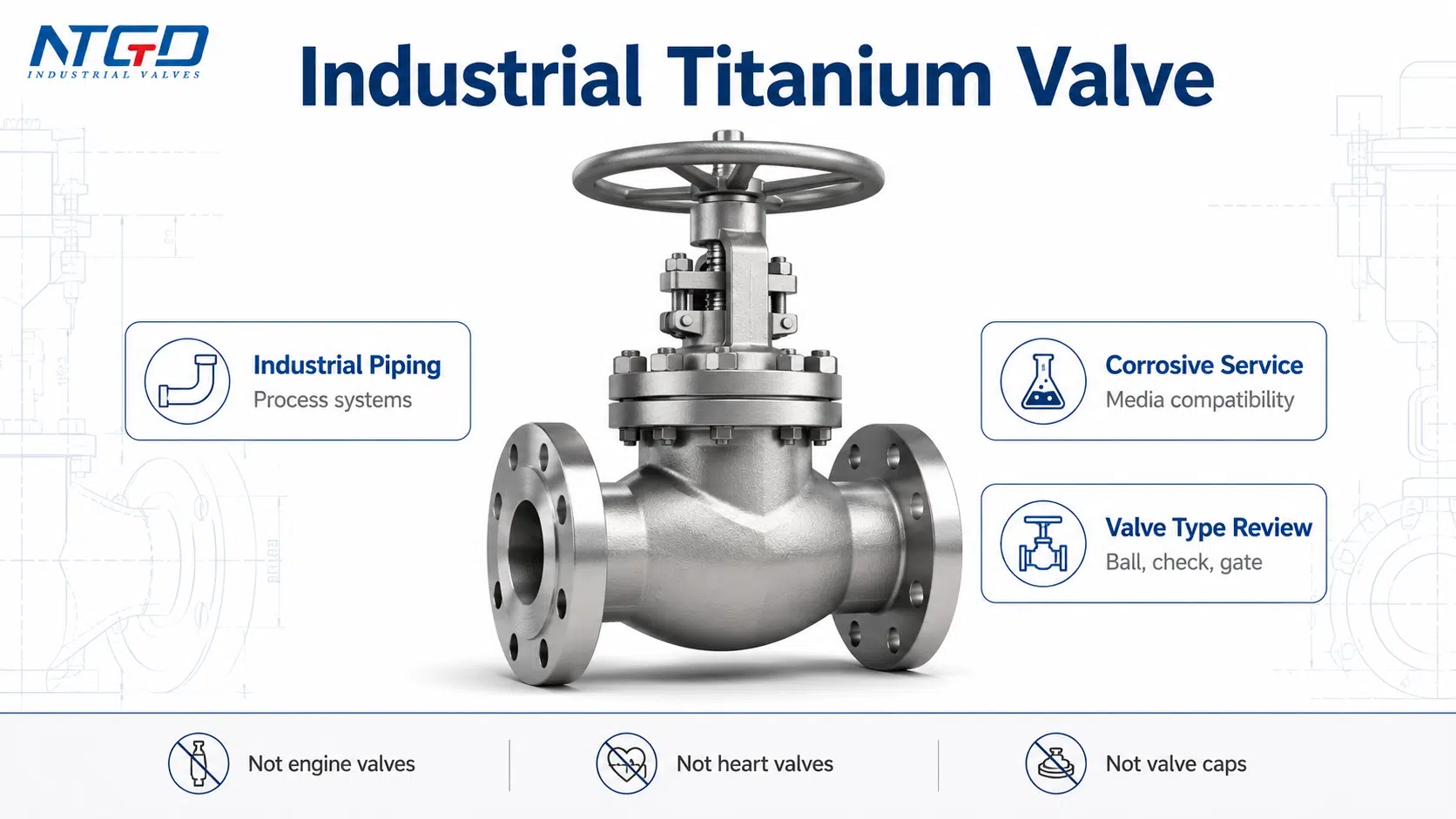
An industrial titanium valve is a piping valve specified for corrosive service, using titanium or titanium alloy for the valve body, trim, or other wetted parts exposed to process media. In industrial piping systems, titanium valves are mainly reviewed when corrosion resistance, weight reduction, material compatibility, or service reliability make common carbon steel, stainless steel, bronze, or brass valves unsuitable.
This article discusses industrial titanium valves for corrosive service, including titanium ball valves, check valves, gate valves, globe valves, and butterfly valves. It does not cover automotive engine titanium valves, medical heart valves, tire valve caps, or unrelated titanium hydraulic valve components.
For B2B valve selection, the useful question is not whether titanium is a strong material in general. The useful question is whether the project service conditions justify titanium when media, pressure, temperature, valve type, titanium grade, seat material, and corrosion risk are reviewed together.
When standard materials already meet the corrosion, pressure, temperature, and weight requirements, a titanium valve may add unnecessary cost, lead time, and documentation complexity. When the service conditions justify titanium, the valve type, material grade, end connection, seat and seal materials, operating method, and required documentation should be reviewed together before RFQ.
What Is an Industrial Titanium Valve?
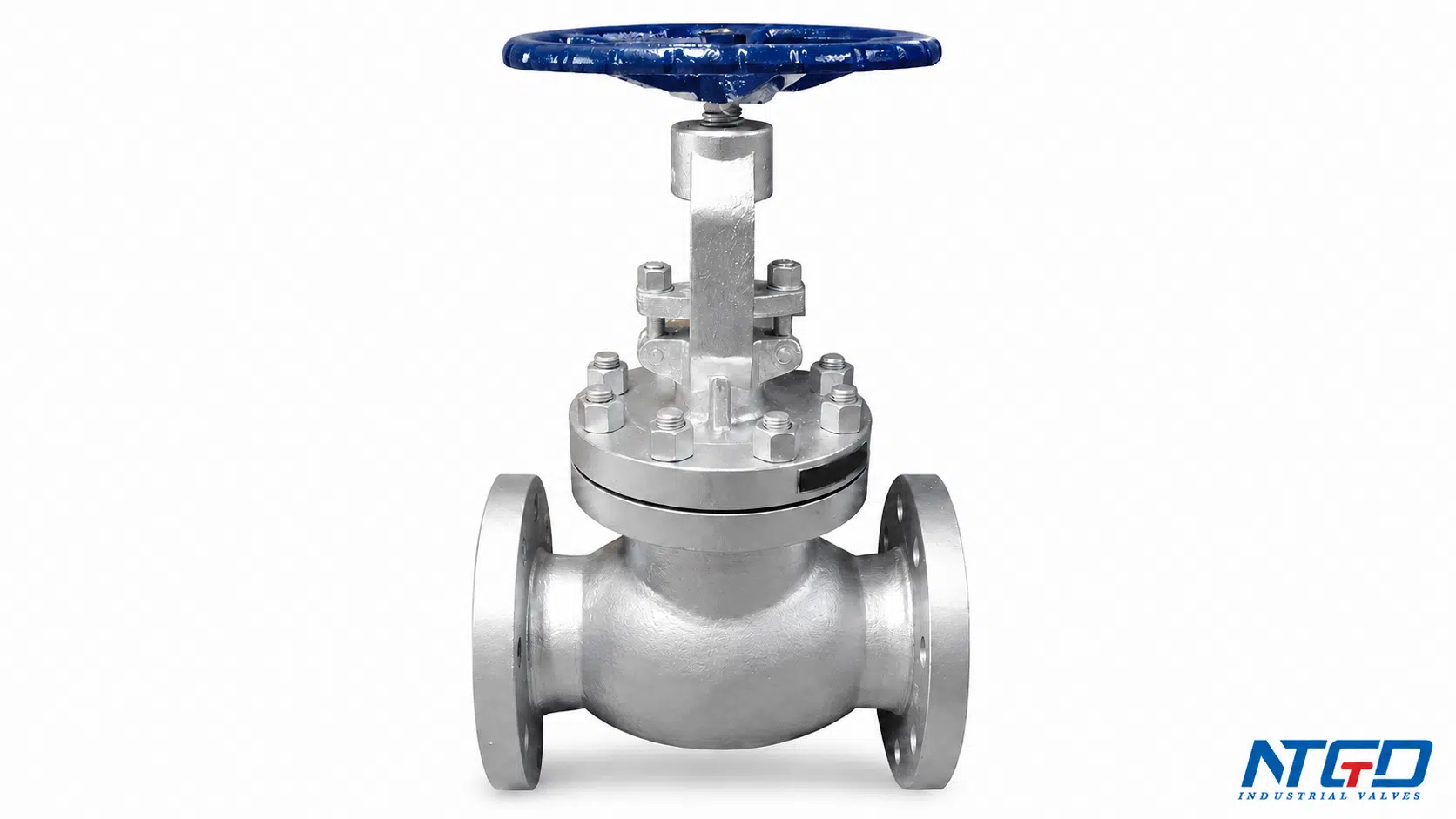
An industrial titanium valve is a piping valve made fully or partly from titanium-based material. Depending on the design, titanium may be used for the body, bonnet, disc, ball, stem, seat contact area, trim, or other parts that contact the fluid.
Titanium is a material choice, not a valve mechanism. It does not define how the valve opens, closes, regulates flow, or prevents reverse flow. A titanium ball valve, titanium gate valve, and titanium check valve do not work the same way simply because they use titanium material.
In industrial procurement language, a titanium valve may refer to:
- a titanium ball valve for quarter-turn shutoff;
- a titanium check valve for preventing reverse flow;
- a titanium gate valve for full-open / full-closed isolation;
- a titanium globe valve for shutoff or throttling;
- a titanium butterfly valve for compact quarter-turn flow control;
- other titanium valve types such as plug valves or control valves where the service requires titanium wetted parts.
Titanium as a Valve Material, Not a Valve Mechanism
A valve’s operating principle is determined by its design. Titanium changes the material review, not the basic valve motion.
| Valve design | Main operating principle | What titanium affects |
|---|---|---|
| Ball valve | A rotating ball opens or closes the flow path | Wetted material compatibility, corrosion resistance, body / trim selection |
| Check valve | A disc, plate, piston, or poppet opens with forward flow and closes against reverse flow | Body, trim, disc, spring, and seat compatibility with corrosive fluid |
| Gate valve | A gate or wedge moves linearly into or out of the flow path | Body, wedge, stem, seat surface, corrosion resistance, and operating reliability |
| Globe valve | A disc moves against a seat to stop or regulate flow | Body, disc, seat, trim material compatibility, and throttling suitability |
| Butterfly valve | A rotating disc controls flow through the pipe bore | Disc, stem, body, seat interface, and sealing material compatibility |
This distinction matters because a titanium valve should not be selected only by material name. The project still needs the correct valve type for the required function.
What This Article Covers and Does Not Cover
This article focuses on titanium valves for industrial pipelines, chemical processing, seawater service, marine systems, desalination, petrochemical service, fertilizer plants, water treatment, and other corrosive or demanding process applications.
It does not cover automotive titanium intake or exhaust valves, titanium valve springs, titanium valve retainers, titanium valve stem caps, titanium heart valves, or unrelated hydraulic component searches. Those are different products with different selection criteria.
How Titanium Valves Work Depends on the Valve Type
A titanium valve works according to the valve type it belongs to. Titanium does not create a special valve motion. Instead, titanium changes whether the wetted parts are suitable for the service media and project conditions.
A titanium ball valve still uses a quarter-turn ball to open or close the flow path. A titanium check valve still opens with forward flow and closes to help prevent reverse flow. A titanium gate valve still uses a gate or wedge for fully open or fully closed isolation.
A practical industrial valve selection guide should normally follow this sequence:
- Confirm the required valve function.
- Choose the valve type.
- Confirm the service media, pressure, and temperature.
- Select the titanium grade and compatible seat / seal materials.
- Verify standards, testing, and project documentation.
Skipping the service-condition review and selecting a titanium grade too early can lead to later problems with seat, seal, trim, or wetted-part compatibility.
Ball, Gate, Check, Globe and Butterfly Valves Operate Differently
Different titanium valve types solve different process problems.
A titanium ball valve is usually selected for quick shutoff in corrosive service. A titanium gate valve is more suitable for isolation where the valve is normally fully open or fully closed. A titanium check valve is selected when the line needs protection against reverse flow. A titanium globe valve may be reviewed where throttling or flow regulation is required. A titanium butterfly valve may be selected where compact size, lower weight, and quarter-turn operation are important.
Treating these valve types as interchangeable can lead to poor service performance. For example, using a gate valve for throttling can damage the gate and seat area. Using a check valve without confirming flow direction, cracking pressure, or orientation can cause chatter, reverse flow, or water hammer risk. Selecting a ball valve without checking the seat and seal material can create leakage or chemical compatibility problems even if the body material is titanium.
What Titanium Changes in Valve Selection
Titanium mainly changes the material review. It can improve corrosion resistance in selected services, reduce weight compared with some steel valve constructions, and improve service suitability where the process media is not compatible with standard valve materials.
However, titanium does not remove the need to confirm:
- seat and seal compatibility;
- pressure and temperature limits;
- valve design and wall thickness;
- end connection and face-to-face requirements;
- operating torque or actuator sizing;
- flow direction and installation orientation;
- inspection, testing, and material documentation.
A titanium valve can still fail if the valve type is wrong, the grade is unsuitable, or the soft parts are incompatible with the media.
Why Titanium Is Used in Industrial Valves
Titanium is used in industrial valves when common valve materials may not provide enough corrosion resistance, weight advantage, or service compatibility. It is most often considered for corrosive media rather than general-purpose utility service.
The decision should be based on the actual service conditions, not on material prestige. Titanium can be a strong material solution, but it is also more expensive and may require more procurement review than common valve materials.
Corrosion Resistance in Aggressive Media
One of the main reasons buyers consider titanium valves is corrosion resistance: titanium forms a protective oxide film in many suitable environments, which helps protect the metal surface under the right service conditions.
This is why titanium valves are often reviewed for services involving seawater, chloride-containing media, chemical processing, desalination, marine systems, and selected process applications.
The exact suitability still depends on the media concentration, temperature, pressure, oxygen content, flow condition, crevice conditions, and titanium grade. A material that works in one chemical service may not be suitable in another service that appears similar at first glance.
For high-risk or unfamiliar media, the valve material should be verified against the project specification, material compatibility data, valve corrosion prevention logic, and the manufacturer’s valve design.
Wrong grade selection, ignored crevice conditions, or incomplete media data may increase corrosion risk, leakage risk, maintenance cost, or project acceptance risk.
Strength-to-Weight Ratio and Service Durability
Titanium has a favorable strength-to-weight ratio compared with many conventional valve materials. This can be useful where weight matters, such as marine systems, offshore piping, compact process skids, or applications where handling and installation weight affect the project design.
Titanium may also support longer service life in corrosive environments when the material, valve design, and media are correctly matched. However, service durability is not determined by titanium alone. Seat wear, trim design, sealing material, process cleanliness, operating frequency, and installation conditions can all affect final valve performance.
When Titanium Is Not Automatically the Best Choice
Titanium is not always the best valve material.
A titanium valve may be unnecessary when standard stainless steel, duplex stainless steel, alloy steel, or lined valves already meet the corrosion and pressure requirements. Titanium may also create procurement challenges if casting, forging, machining, welding, lead time, or documentation requirements are not confirmed early.
Before selecting a titanium valve, buyers should confirm:
| Selection question | Why it matters |
|---|---|
| Is the media actually incompatible with standard materials? | Titanium may not be needed if a common material is sufficient. |
| Is the correct titanium grade specified? | Different grades can behave differently in corrosive service. |
| Are the seat and seal materials compatible? | A titanium body does not protect incompatible soft parts. |
| Is the valve type suitable for the function? | Material cannot correct a wrong valve design. |
| Can the supplier provide documentation? | Material certificates and testing records may be required. |
| Is lead time acceptable? | Titanium valves may not be as readily available as common steel valves. |
A practical titanium valve decision should compare the corrosion risk, downtime consequence, material availability, documentation requirements, and total project impact, not only the base material name.
Common Types of Titanium Valves
Titanium valves are not one single valve design. They are a material family used across different valve types. The most common industrial categories include titanium ball valves, titanium check valves, titanium gate valves, titanium globe valves, and titanium butterfly valves.
The table below compares common titanium valve types from a buyer-side selection perspective.
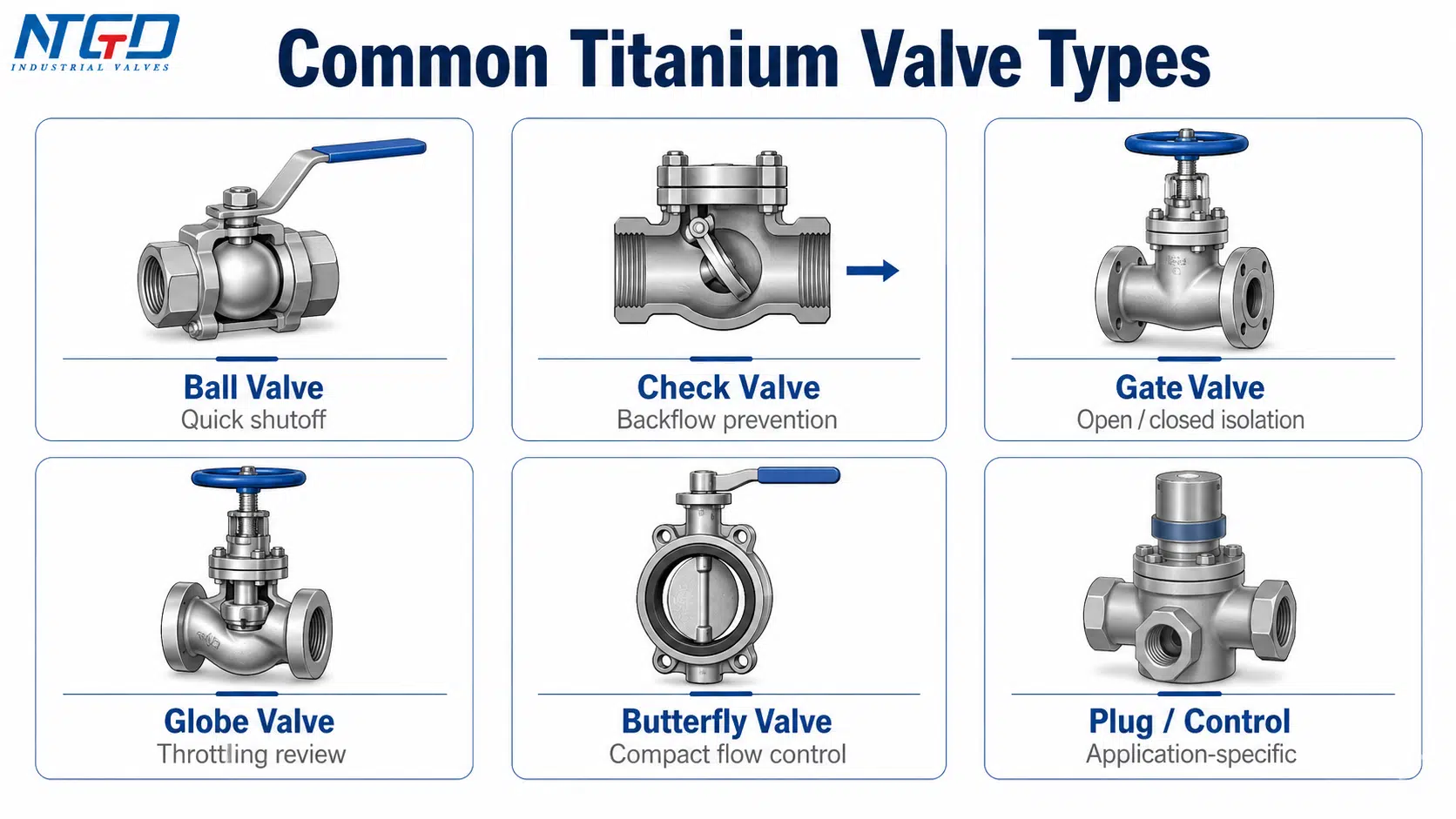
| Valve type | Main function | Best-fit service | Key selection notes | Typical selection boundary |
|---|---|---|---|---|
| Titanium ball valve | Quick on/off shutoff | Corrosive chemical lines, process isolation, compact shutoff service | Confirm quarter-turn shutoff duty, seat / seal material, pressure class, end connection, bore type, and operating torque | Full-port vs reduced-port affects flow and pressure drop; soft parts must match the media and temperature. |
| Titanium check valve | Prevent reverse flow | Pump discharge, one-way process flow, backflow prevention in corrosive media | Confirm flow direction, cracking pressure, installation orientation, swing / lift / dual plate / spring-assisted design, and water hammer risk | The check-valve design must match flow rate, differential pressure, orientation, and closing behavior. |
| Titanium gate valve | Full-open / full-closed isolation | Larger pipelines, isolation service, low pressure drop requirements | Not for throttling; check wedge design, stem, seat, actuation, and operating torque | Long-term partial opening may damage the gate and seat and reduce shutoff reliability. |
| Titanium globe valve | Shutoff and throttling | Services needing flow regulation or tighter control than gate valves | Higher pressure drop; check trim design, flow direction, throttling duty, and operating torque | Better for throttling than gate valves, but not always needed for simple shutoff. |
| Titanium butterfly valve | Compact quarter-turn control or isolation | Larger lines where weight and space matter | Check seat design, disc material, shaft design, pressure / temperature limits, sealing performance, and throttling duty | Throttling service may require review of cavitation, vibration, and seat wear. |
| Titanium plug valve | Quarter-turn isolation or flow diversion | Selected corrosive services where plug design fits the process | Check sleeve / lining / sealing design and torque | Application-specific; not a default replacement for ball valves. |
| Titanium control valve | Modulating process control | Corrosive service requiring automatic control | Requires actuator, trim, control characteristics, and detailed sizing review | Must be sized and specified as a control package, not only as a titanium body. |
Titanium Ball Valve
A titanium ball valve uses a rotating ball with a bore through the center. When the bore is aligned with the pipeline, the valve is open. When the ball is turned 90 degrees, the flow path is blocked.
Titanium ball valves are commonly reviewed for corrosive shutoff service because they provide quick operation, relatively compact design, and good isolation when the seat and sealing materials are correctly selected. They may be manually operated or supplied with pneumatic, electric, or other actuators depending on the project.
For procurement, a titanium ball valve should not be specified by material alone. Buyers should confirm whether the valve is full-port or reduced-port, floating or trunnion-mounted, soft-seated or metal-seated, threaded, flanged, butt-welded, or socket-welded, and whether the seat material is compatible with the media and temperature.
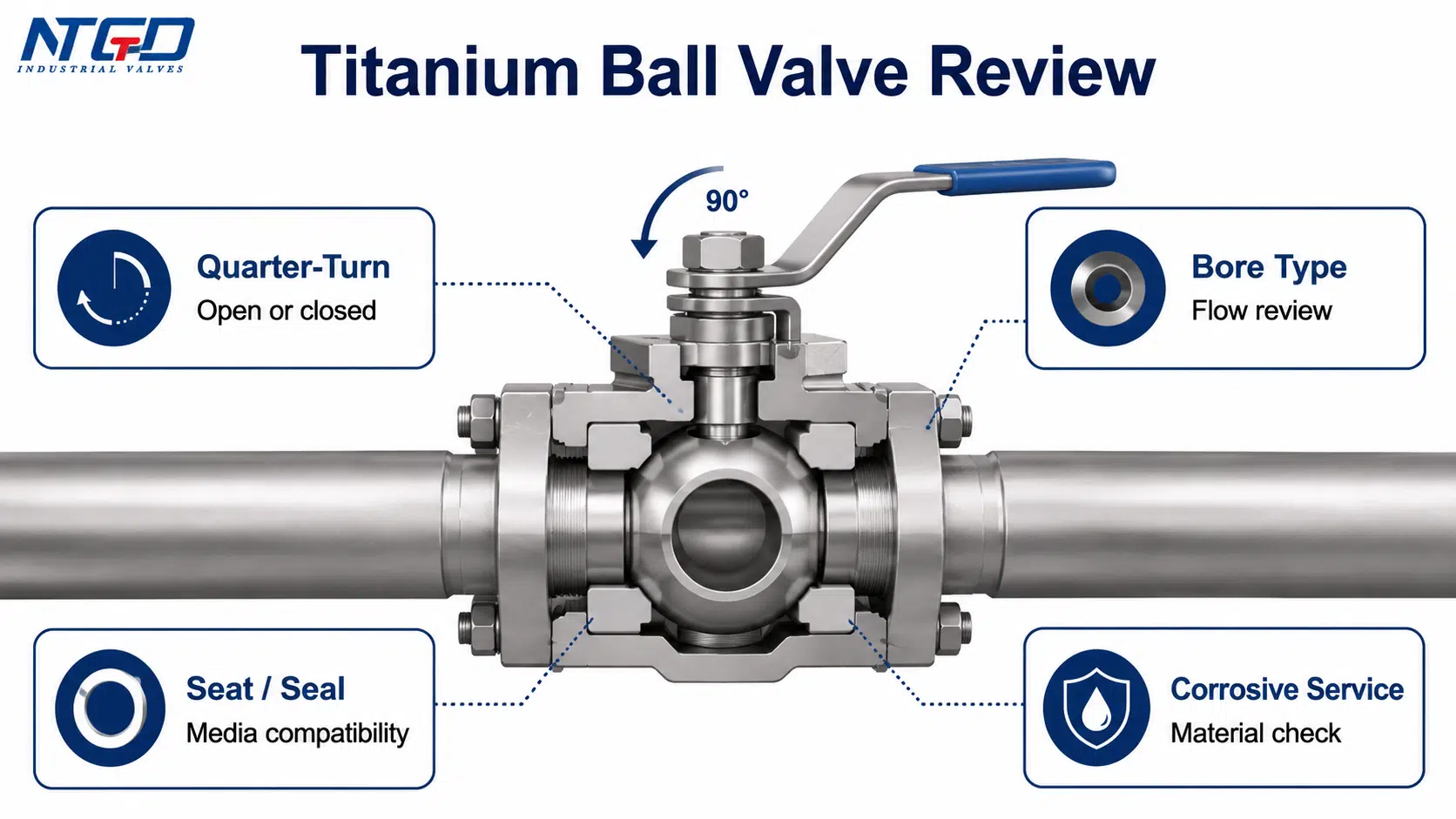
This overview covers the basic selection logic for titanium ball valves. Deeper technical review should confirm bore type, seat material, pressure-temperature limits, actuation method, end connection, torque requirements, and documentation needs before final specification.
Titanium Check Valve
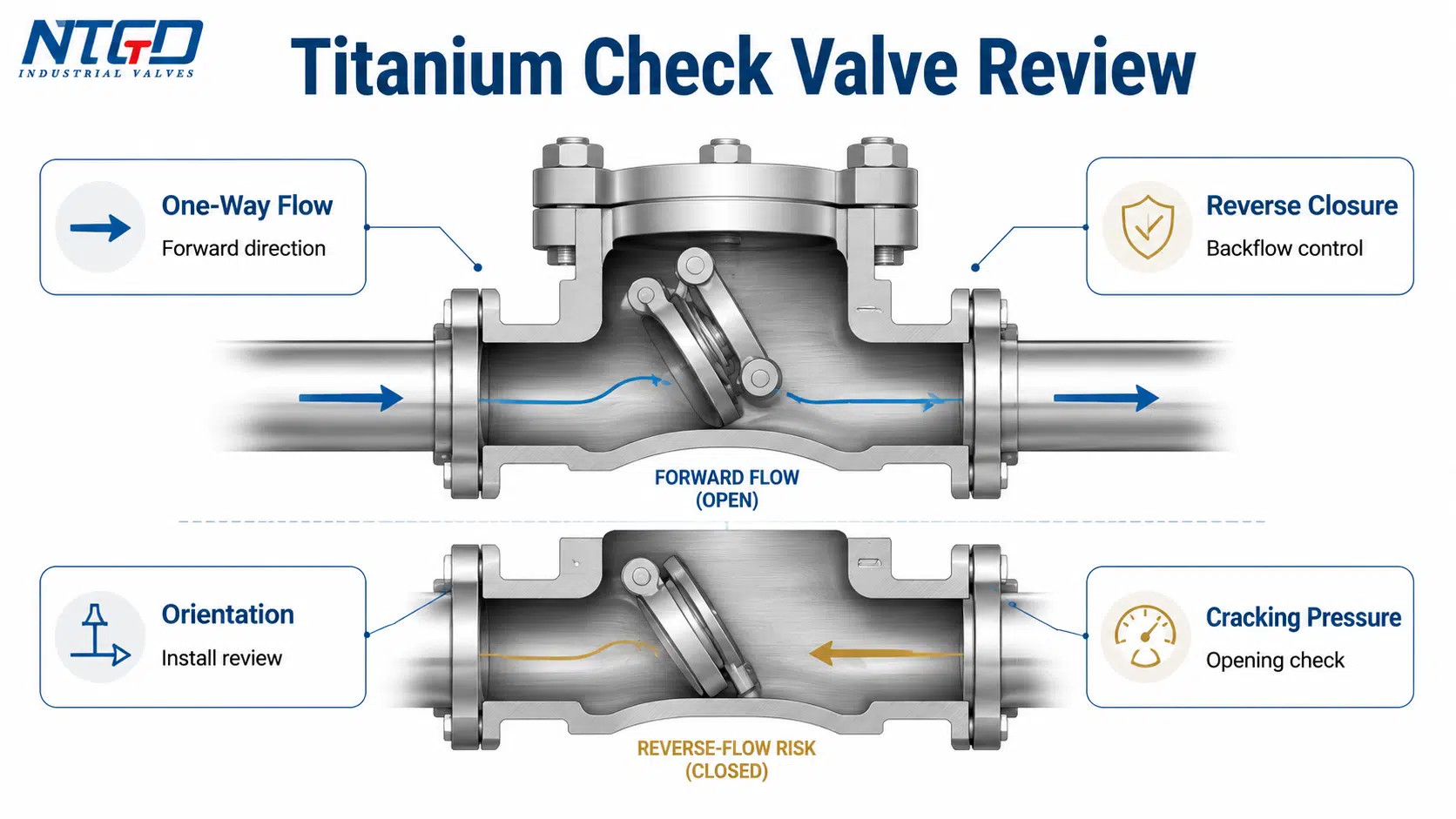
A titanium check valve follows the same basic check valve working principle: it allows flow in one direction and closes when reverse flow occurs.
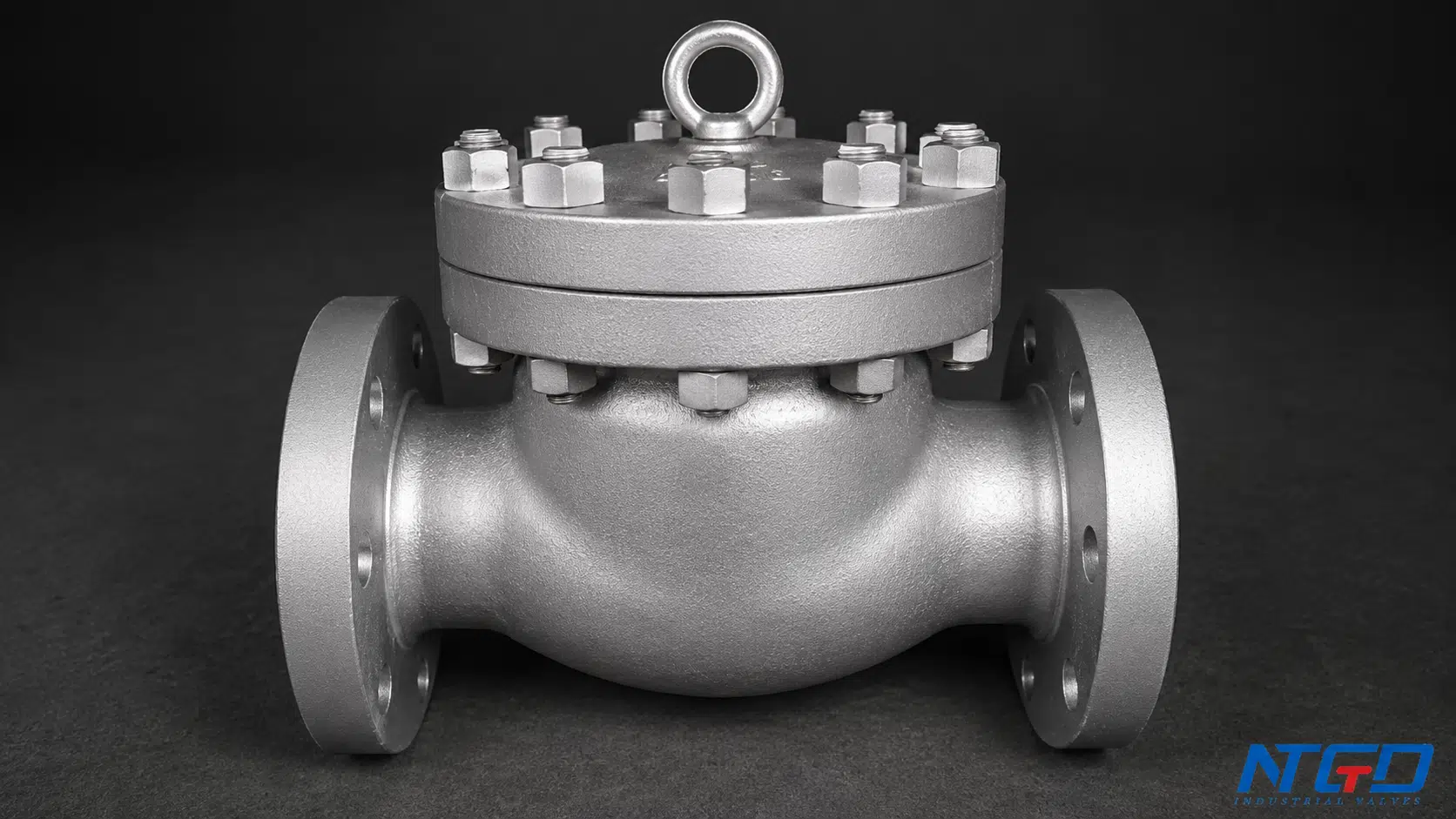
The internal closing element may be a swing disc, lift disc, piston, dual plate, spring-assisted disc, or other check-valve design.
In corrosive service, titanium check valves are used when the line needs backflow prevention and the wetted parts must resist the media. They may be considered in pump discharge lines, chemical systems, seawater systems, desalination service, or process lines where reverse flow could damage equipment or contaminate upstream media.
For titanium check valves, commonly overlooked selection factors include installation orientation, cracking pressure, and design-specific closing behavior. A check valve may perform differently in horizontal flow, vertical upward flow, low differential pressure, or fast pump-stop conditions.
Selection should confirm:
- flow direction;
- installation orientation;
- swing, lift, dual plate, piston, or spring-assisted design;
- cracking pressure;
- pressure drop;
- spring material if used;
- water hammer and slam risk;
- compatibility of body, disc, seat, and seal materials.
A titanium body does not automatically make the check valve suitable for every installation. The internal check-valve design must match the flow rate, pressure condition, and installation orientation.
Titanium Gate Valve
A titanium gate valve uses the same basic gate valve working principle: a gate or wedge moves linearly into or out of the flow path.
It is mainly used for isolation service where the valve is either fully open or fully closed.
Titanium gate valves may be reviewed for larger corrosive-service pipelines where low pressure drop is important during fully open operation. They are not normally selected for throttling. Using a gate valve partially open for long periods can increase erosion, vibration, seat damage, and operating problems.
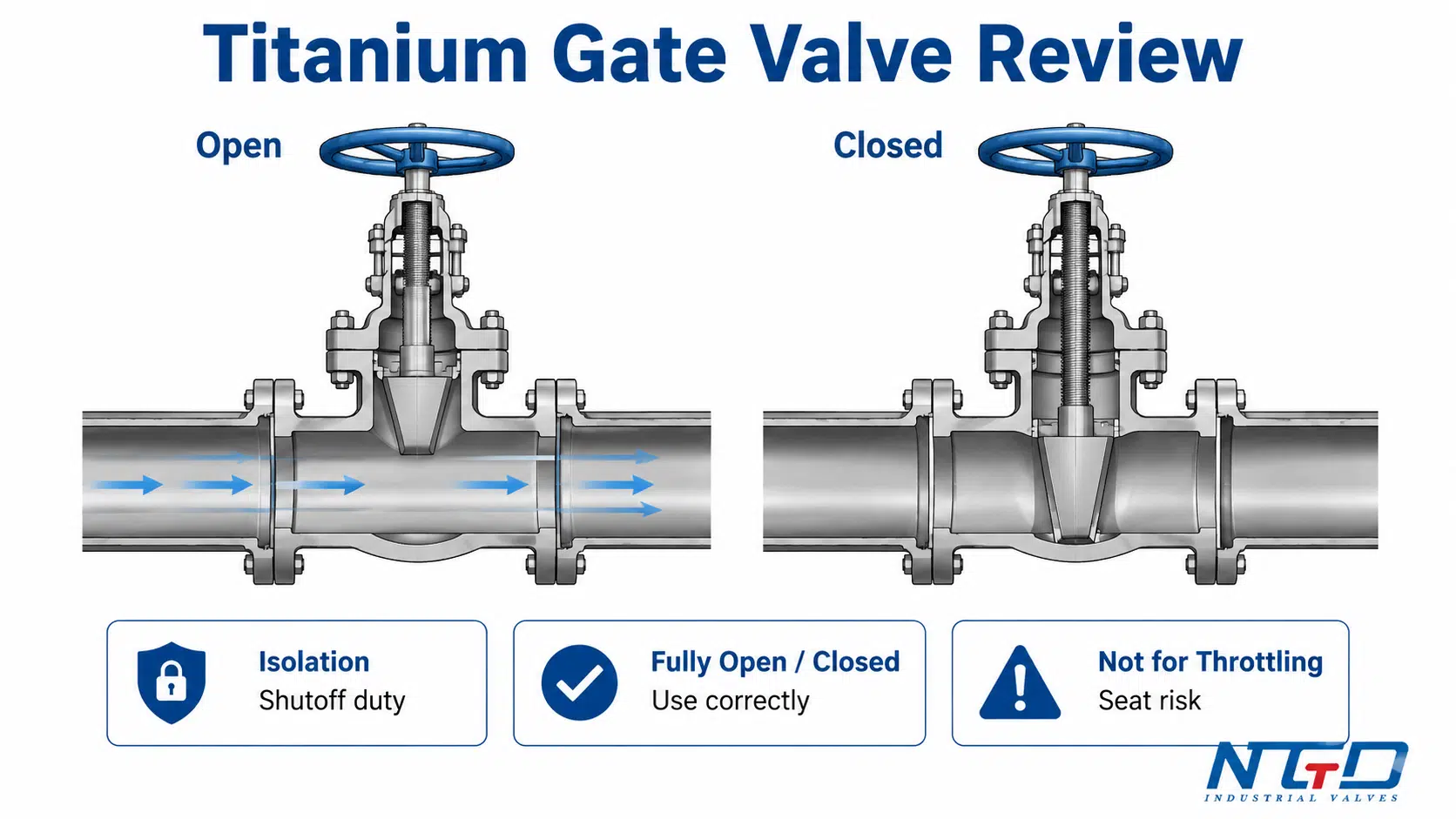
Important selection points include:
- wedge type;
- confirmation that the valve will be used for fully open or fully closed service;
- seat design;
- stem design;
- body and bonnet material;
- operating torque;
- manual or actuated operation;
- pressure class;
- end connection;
- installation access.
Long-term partial opening may damage the gate and seat surfaces, increase vibration, increase operating torque, and reduce shutoff performance over time.
For high-value corrosive service, the gate, stem, and seat area should be reviewed carefully because corrosion or wear at these parts can affect isolation performance.
Titanium Globe Valve
A titanium globe valve uses a disc moving against a seat to stop, start, or regulate flow. Compared with a gate valve, a globe valve is generally better suited for throttling and flow adjustment, but it usually creates higher pressure drop.
Titanium globe valves may be reviewed when the media is corrosive and the process requires regulation rather than only open / closed isolation. The trim design, seat material, flow direction, pressure drop, and operating torque should be checked before selection.
Flow direction through the valve body can affect trim performance, pressure drop, and shutoff behavior, so it should be confirmed against the datasheet and project specification.
This valve type is useful where throttling is needed, but it should not be chosen only because titanium is available. The process should justify both the globe valve design and the titanium material.
Titanium Butterfly Valve
A titanium butterfly valve uses a rotating disc to open, close, or partially control flow. The valve is compact and can be useful in larger pipe sizes where weight and space are important.
Titanium butterfly valves may be used in corrosive service when the body, disc, stem, and seat materials match the media. They can be supplied in wafer, lug, or flanged configurations depending on the system design.
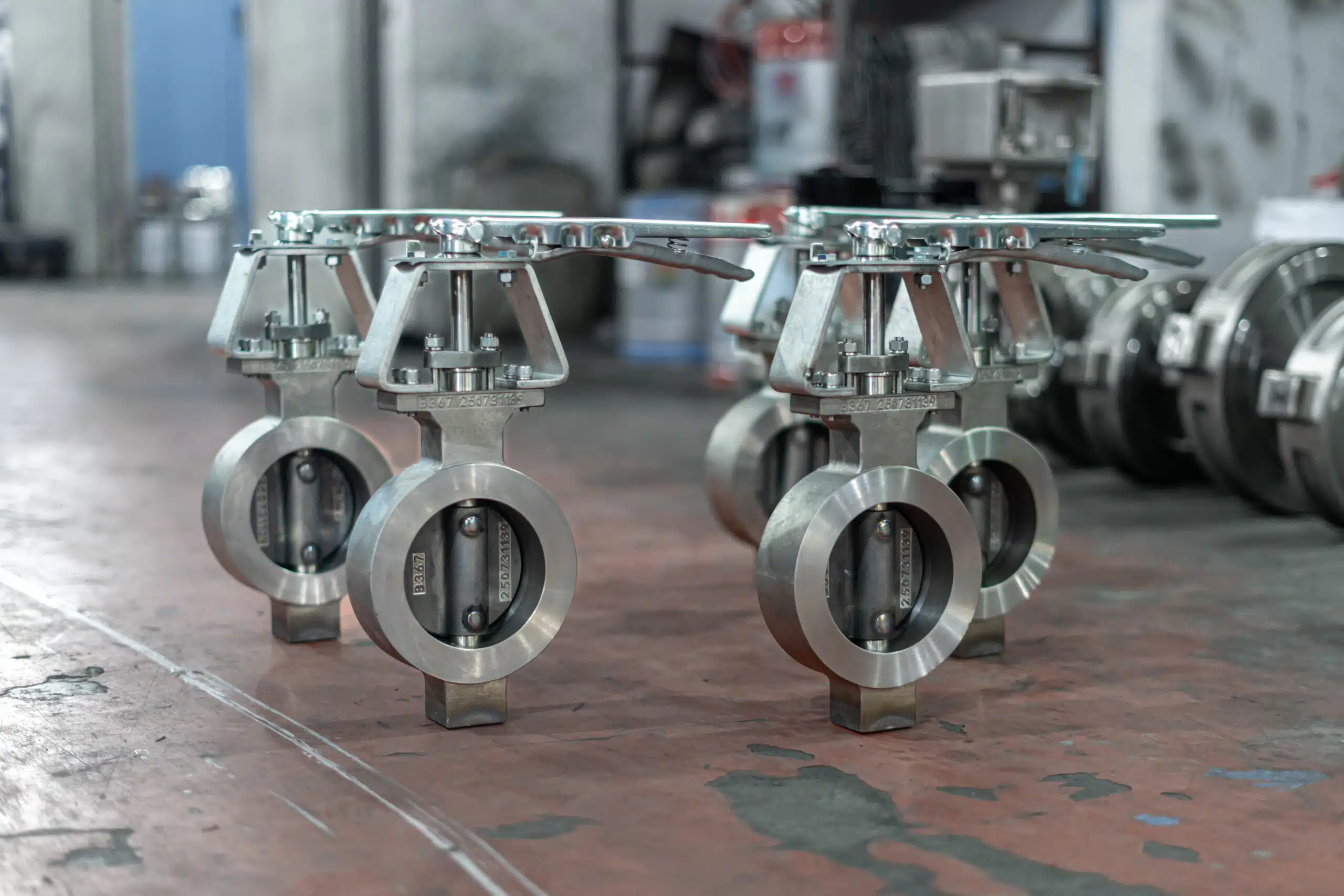
Key checks include seat material, disc coating or material, pressure / temperature rating, sealing performance, shaft design, and whether the valve will be used for isolation or throttling. In demanding throttling service, cavitation, vibration, and seat wear should be reviewed.
Other Titanium Valve Types: Plug and Control Valves
Other titanium valve designs may be considered when the application requires them. A titanium plug valve may be used for selected quarter-turn isolation or flow diversion duties. A titanium control valve may be required when the process needs modulating control in corrosive service.
These types should be reviewed as application-specific designs. Detailed sizing, trim selection, actuator selection, and control characteristics normally require a dedicated technical review.
Titanium Valve Materials, Grades and Standards
Titanium valve selection often requires more material review than standard steel valve selection. Buyers should identify the titanium grade, product form, pressure class, applicable standard, and material certificate requirements before ordering.
The material grade should be matched to the service conditions. The valve manufacturer’s datasheet and project specifications should also be checked because casting, forging, machining, and sealing design can affect what is actually available.
Common Titanium Grades Used in Industrial Valves
Common titanium grades may include commercially pure titanium and titanium alloys. The exact grade must be confirmed with the project specification and supplier documentation.
| Titanium grade | General description | Typical selection note | RFQ reminder |
|---|---|---|---|
| Grade 2 | Commercially pure titanium | Often reviewed for seawater, chemical, and general corrosive industrial service where commercially pure titanium is suitable | Confirm media, concentration, pressure, temperature, casting / forging form, and certification |
| Grade 5 | Ti-6Al-4V titanium alloy | Higher-strength alloy, but corrosion suitability still needs verification for the actual media | Do not specify only for strength without checking chemical compatibility and fabrication requirements |
| Grade 7 | Palladium-containing titanium grade | May be reviewed for selected demanding corrosion conditions when project requirements justify it | Confirm whether the grade is required by media compatibility data or project specification |
| Grade 12 | Titanium alloy with nickel and molybdenum additions | May be considered for selected chemical services where improved corrosion resistance is required | Verify availability, welding / fabrication requirements, and documentation package |
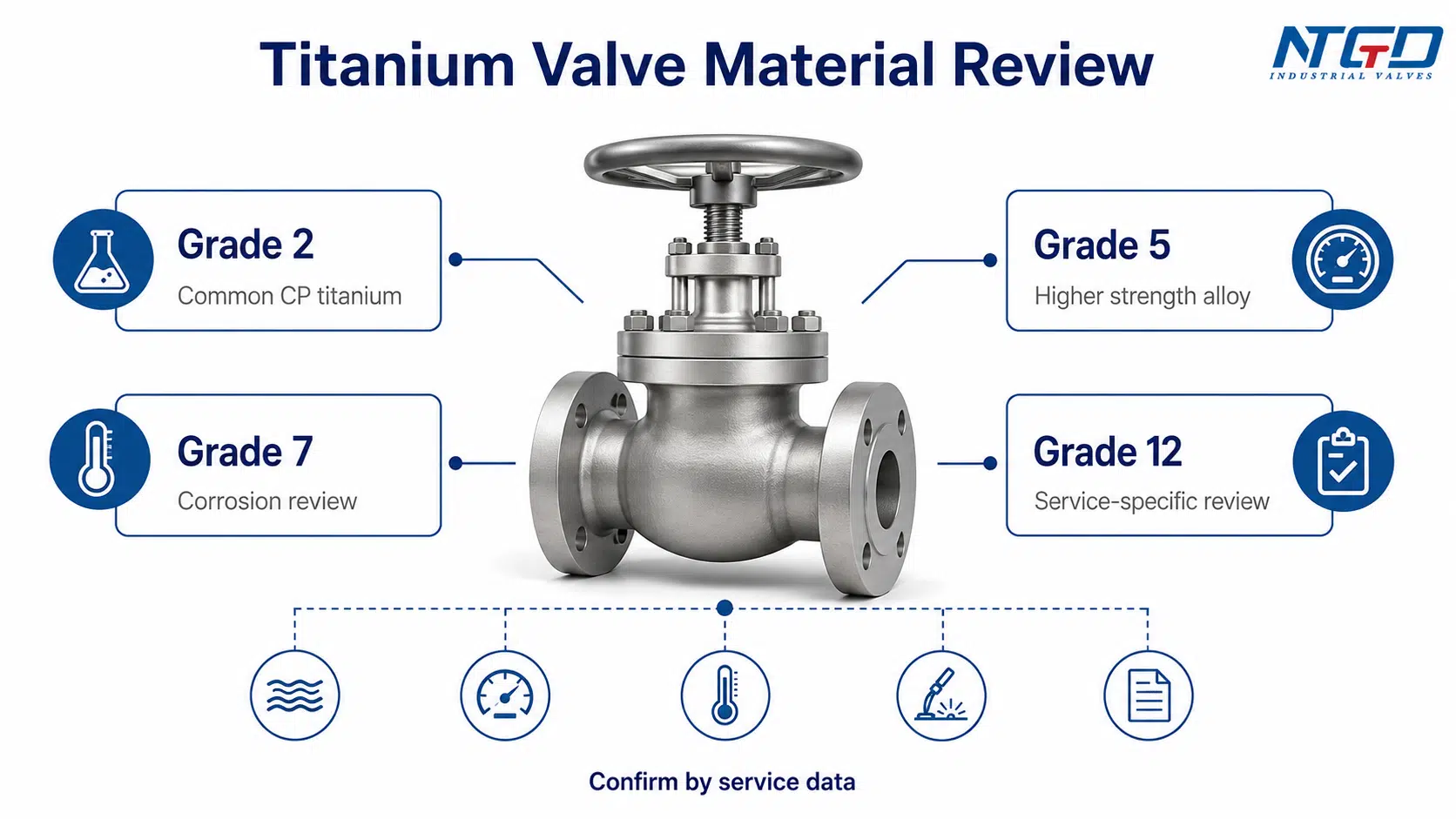
This table is not a universal compatibility chart. Final grade selection should be based on media compatibility, temperature, pressure, product form, fabrication method, documentation requirements, and the actual valve design.
Castings, Forgings and Bar Stock in RFQ Language
In valve procurement, titanium material is not only described by grade. The product form also matters.
A cast titanium valve body may be specified differently from a forged body or a machined bar-stock component.
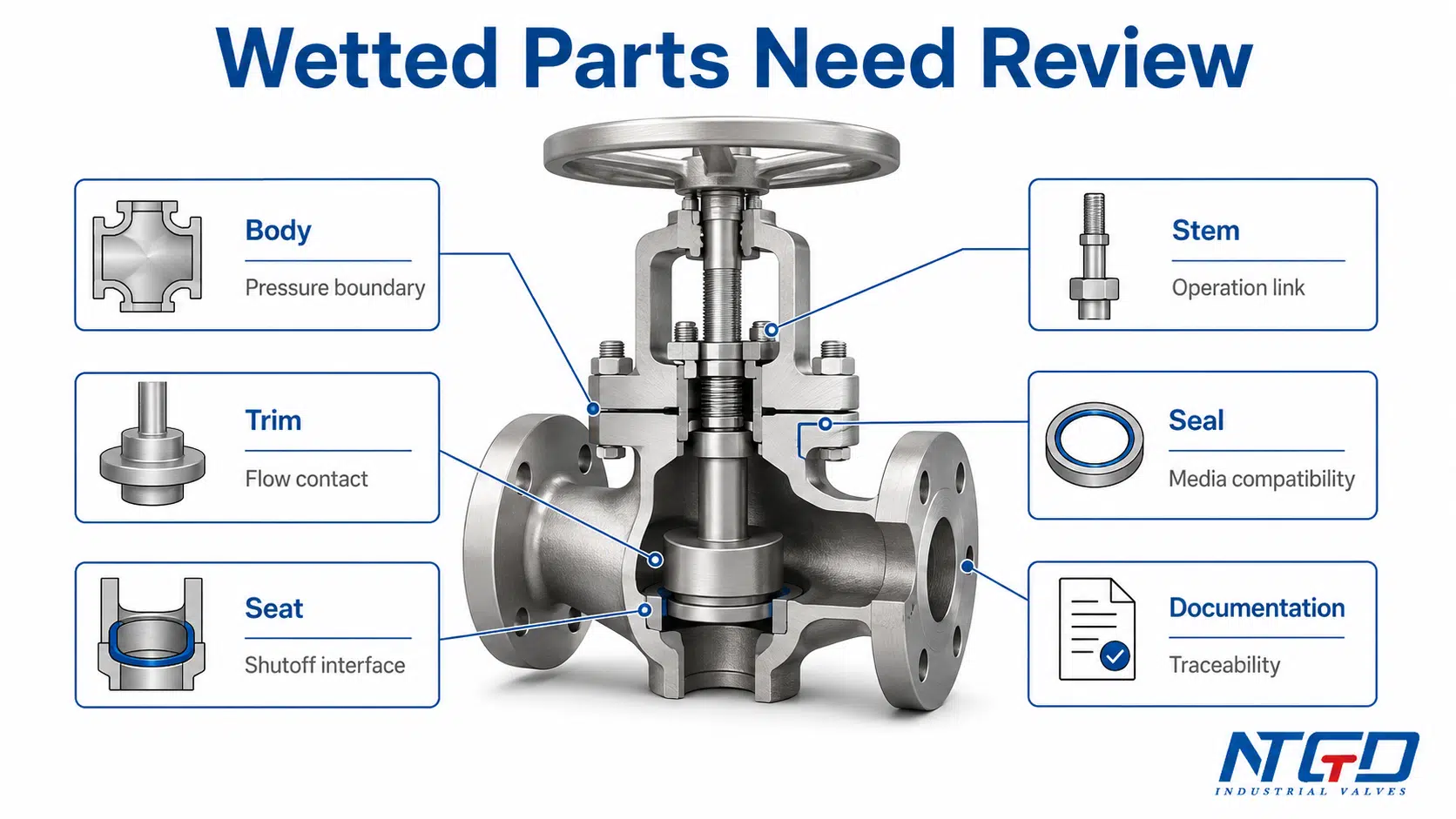
Body, bonnet, ball, disc, stem, seat ring, and trim components may use different material forms depending on design.
For RFQ clarity, buyers should confirm:
| Item | Why it matters |
|---|---|
| Body material and grade | Determines the main pressure-containing material |
| Bonnet / cover material | Must match pressure boundary and corrosion requirements |
| Trim material | Affects flow contact, shutoff, wear, and corrosion resistance |
| Stem material | Important for operation, strength, and corrosion exposure |
| Seat and seal material | Critical for leakage control and chemical compatibility |
| Material certificate requirement | Supports traceability and project acceptance |
ASTM B367, ASTM B381 and Related Material Notes
Titanium valve projects may refer to material standards such as ASTM B367 for castings, ASTM B381 for forgings, or ASTM B348 for bars and billets.
These references should be treated as material documentation points, not as a complete valve specification by themselves.
A complete valve specification may still need pressure class, valve design standard, end connection standard, inspection and testing requirements, face-to-face dimensions, operation method, and project-specific documentation.
In other words, a phrase such as “ASTM B367 titanium valve” may help identify the casting material requirement, but it does not fully define the valve.
Applications and Media Compatibility for Titanium Valves
Titanium valves are usually considered where the service environment makes common valve materials less suitable. The most common drivers are corrosive media, chloride-containing environments, seawater, chemical processing, and selected process applications where material failure would create high downtime or safety risk.
For titanium valve applications, the service condition should drive both material selection and valve type selection. The table below maps common service conditions to titanium valve review points.
| Service condition | Why titanium may be considered | Valve types often reviewed | Key checks before selection |
|---|---|---|---|
| Chemical processing | Corrosive media may attack common metals | Ball, check, globe, gate, control valves | Verify media concentration, temperature, pressure, and seat / seal material; avoid gate valves if throttling is required. |
| Chloride-containing media | Chlorides may create corrosion risk for some materials | Ball, butterfly, check, globe valves | Review grade selection, crevice conditions, oxygen level, and wetted-part compatibility; do not rely on material name alone. |
| Marine and seawater service | Saltwater exposure may require corrosion-resistant wetted parts | Butterfly, ball, check, gate valves | Check seawater condition, fouling risk, galvanic compatibility, check valve slam risk, and butterfly valve seat material. |
| Desalination systems | High-chloride water and process chemicals may affect valve materials | Butterfly, check, ball, control valves | Confirm pressure, cleaning chemicals, seat material, installation position, and check-valve orientation where applicable. |
| Petrochemical service | Corrosive or mixed process media may require special materials | Ball, gate, globe, check valves | Review media data sheet, temperature, pressure, trim compatibility, and testing requirements if applicable. |
| Fertilizer and process plants | Acidic or aggressive process streams may need upgraded materials | Ball, check, gate, globe valves | Confirm the specific acid, concentration, pressure, temperature, valve function, and trim compatibility. |
| Water treatment | Chemicals and treated water may influence material selection | Butterfly, ball, check valves | Check chemical dosing, flow rate, seat material, maintenance access, and whether a lined or alloy valve is sufficient. |
| Power and utility systems | Selected auxiliary systems may need corrosion resistance | Gate, globe, check valves | Confirm pressure / temperature, flow direction, testing, documentation, and whether titanium is justified over common materials. |
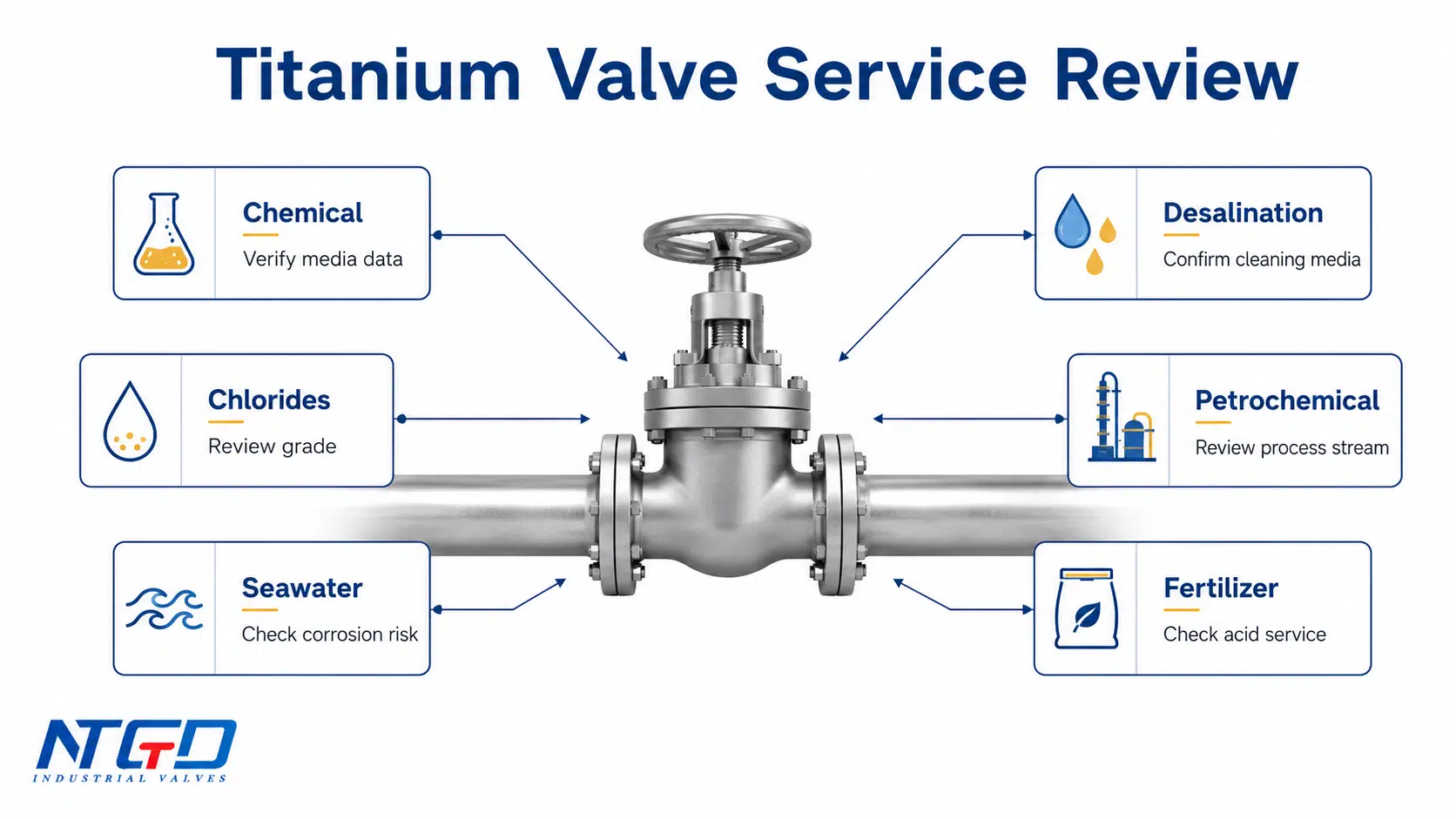
If stainless steel, duplex stainless steel, alloy valves, or lined valves can meet the corrosion and service requirements, titanium may not be the most economical selection. The selection should be justified by the actual corrosion risk, project consequence, documentation requirement, and lifecycle need.
Chemical Processing and Chloride-Containing Media
Chemical processing is one of the most common reasons to review titanium valves. The media may include acids, chlorides, oxidizing chemicals, or mixed process streams. The valve body may need titanium, but the trim, stem, seat, gasket, and sealing materials must also be reviewed.
For chemical service, the buyer should provide the media name, concentration, temperature, pressure, solids content, and whether the service is continuous or intermittent. Without these details, it is difficult to judge whether titanium is suitable or whether another alloy or lined valve may be more appropriate.
Marine, Seawater and Desalination Service
Marine and seawater applications often involve chloride exposure, saltwater corrosion, fouling, and installation constraints. Titanium valves may be reviewed in seawater intake systems, desalination plants, offshore piping, and marine process systems.
Selection should consider galvanic compatibility, seat material, operating frequency, external corrosion protection, and maintenance access. For check valves, flow direction and slam risk should also be reviewed. For butterfly valves, seat and disc materials are especially important.
Petrochemical, Fertilizer and Process Applications
Petrochemical and fertilizer plants may use titanium valves where process media are corrosive or where material compatibility is critical. Titanium ball valves may be used for shutoff, titanium check valves for backflow prevention, titanium gate valves for isolation, and titanium globe valves or control valves where regulation is needed.
The project should not select titanium only because the service sounds “corrosive.” The exact process media, temperature, pressure, cleaning condition, valve function, and soft-part compatibility should be reviewed before final material selection.
High-Temperature or Oxidizing Service: Verify Before Selection
Titanium has useful material properties, but temperature and chemical environment can change the selection result. A titanium valve may be suitable in one corrosive service and unsuitable in another because the media, concentration, temperature, and oxygen condition are different.
For high-temperature or oxidizing service, buyers should verify the valve material, trim, seat, gasket, and testing requirements against the project specification. Avoid using a general statement such as “titanium is suitable for all corrosive media.”
Advantages and Limitations of Titanium Valves
Titanium valves can offer strong advantages in the right service, but they also have limitations. A credible selection process should compare the benefit and the risk for each project condition.
| Aspect | Advantage | Limitation / Risk |
|---|---|---|
| Corrosion resistance | Helps protect wetted parts in selected aggressive media | Not universal; suitability depends on media, temperature, grade, and crevice conditions. |
| Weight | Favorable strength-to-weight ratio for marine, offshore, skid-mounted, or weight-sensitive systems | Weight reduction may not justify the cost in non-weight-sensitive systems. |
| Service durability | May reduce corrosion-related replacement when correctly specified | Seat wear, trim erosion, sealing material, and installation conditions still affect life. |
| Severe-service material option | Provides an alternative when common steels, brasses, or bronzes are unsuitable | Other alloys or lined valves may be more economical in some services. |
| Valve type flexibility | Can be used in ball, check, gate, globe, butterfly, plug, and control valve designs | Each valve type still has its own functional limits and selection risks. |
| Process reliability | Helps reduce corrosion-related leakage or failure risk when material is correctly matched | Wrong grade, wrong valve type, or incompatible soft parts can still cause failure. |
| Procurement and documentation | Material certificates and test records can support project acceptance | Titanium materials and documentation packages may require earlier planning. |
| Availability | Useful for selected demanding services | Not every size, pressure class, end connection, or design is readily available in titanium. |
The main advantage of titanium is not that it is always better. Titanium becomes an engineering choice when corrosion failure, downtime risk, safety consequence, or project acceptance risk outweighs the additional cost, availability, and documentation burden.
Selection Risks by Valve Type and Service Condition
Many titanium valve problems are not caused by titanium itself. They are caused by incomplete service data, wrong valve type selection, wrong material grade, incompatible soft parts, or installation conditions that were not reviewed.
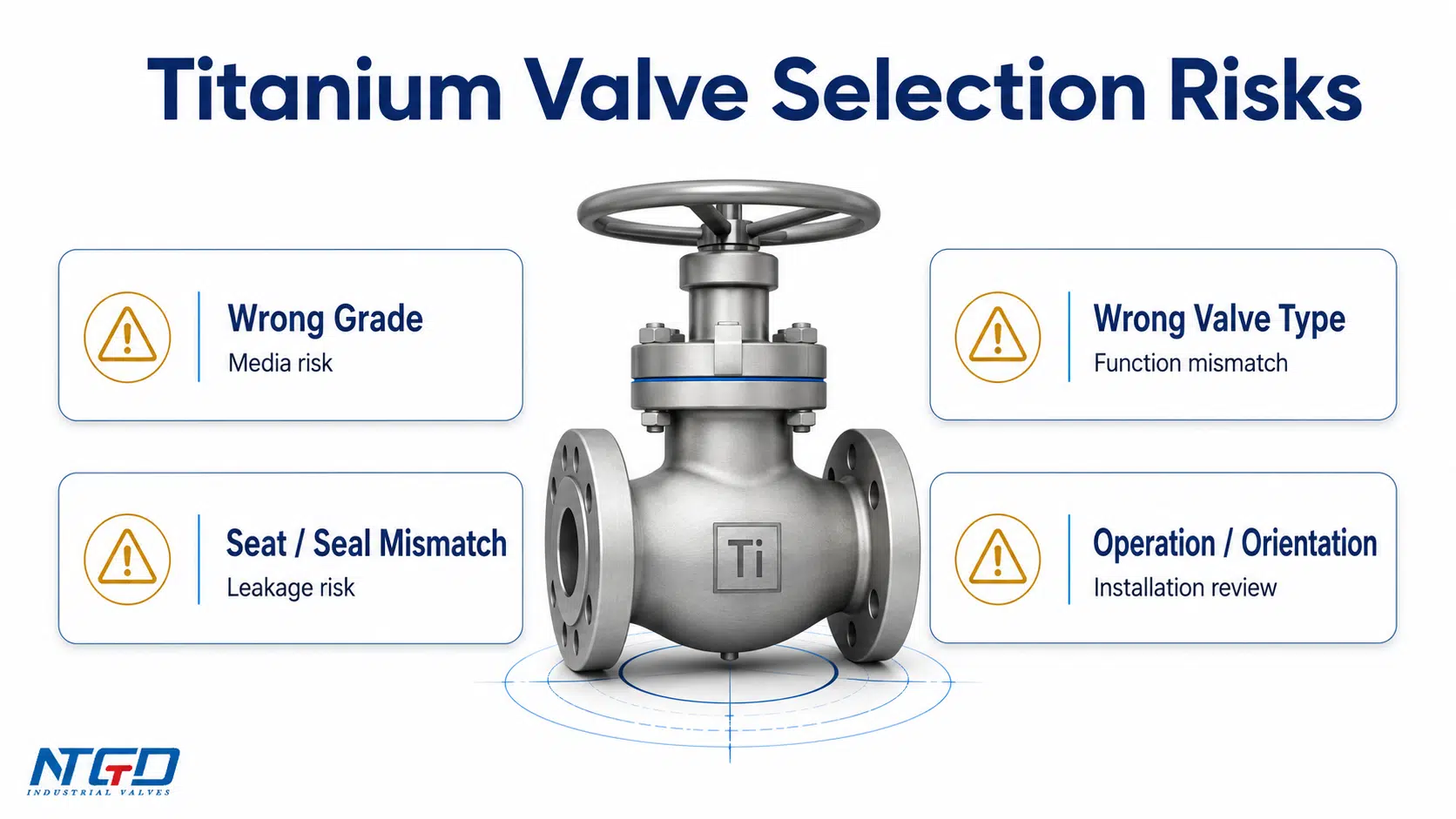
The four common selection mistakes are wrong grade, wrong valve type, incompatible seat / seal / trim materials, and overlooked installation or operation requirements. Each can usually be reduced during specification if the RFQ data is complete.
The old troubleshooting view can be reframed as a selection risk view. Instead of waiting for no flow, leakage, difficult operation, or incomplete closure after installation, the better approach is to prevent these issues during specification.
Choosing the Wrong Titanium Grade
A titanium grade should not be selected only by name. Different grades may be reviewed for different corrosion, strength, fabrication, and documentation requirements.
Many titanium valve failure risks come from mismatch between grade, service condition, wetted parts, soft parts, and project documentation, not from titanium as a material category.
| Selection mistake | Possible consequence |
|---|---|
| Specifying “titanium” without grade | Supplier ambiguity and inconsistent material offer |
| Choosing grade only by strength | Chemical compatibility may be overlooked |
| Ignoring material certificates | Acceptance risk during project inspection |
| Using general compatibility assumptions | Corrosion risk if media conditions differ from assumptions |
For critical service, the RFQ should identify the required grade or request a material recommendation based on detailed service data.
Choosing the Wrong Valve Type for the Function
Titanium material cannot correct a wrong valve type.
A titanium gate valve may be unsuitable for throttling even if the material is corrosion resistant. A titanium check valve cannot replace a shutoff valve. A titanium ball valve may not be the best option for continuous throttling. A titanium globe valve may create more pressure drop than expected.
| Required function | Better valve-type review |
|---|---|
| Quick shutoff | Ball valve or butterfly valve |
| Full-open / full-closed isolation | Gate valve or ball valve |
| Backflow prevention | Check valve |
| Throttling or regulation | Globe valve or control valve |
| Large-size compact service | Butterfly valve |
| Corrosive service with automatic control | Control valve with suitable trim and actuator |
Ignoring Seat, Seal and Trim Compatibility
A titanium valve body does not make every internal part suitable for corrosive media. Seat, seal, gasket, trim, and stem materials can become the weak points.
For soft-seated ball valves or butterfly valves, seat material is especially important. For globe valves and control valves, trim material and flow erosion should be reviewed. For check valves, internal spring, hinge, disc, or piston materials may affect service life.
Buyers should confirm the complete wetted material list, not only the body material.
Overlooking Operation, Orientation and Maintenance Access
Installation and operation also affect performance.
A titanium check valve may require a specific flow direction or orientation. A gate valve may need enough space for handwheel operation or actuator access. A butterfly valve may require clearance for disc rotation. An actuated titanium valve may need torque review and mounting space.
Common operation-related checks include:
- flow direction;
- horizontal or vertical installation;
- operating torque;
- actuator sizing;
- maintenance access;
- pipe support;
- gasket and bolting compatibility;
- cleaning and flushing requirements.
If these details are ignored, the valve may be difficult to operate, leak at connections, fail to close fully, or experience internal wear.
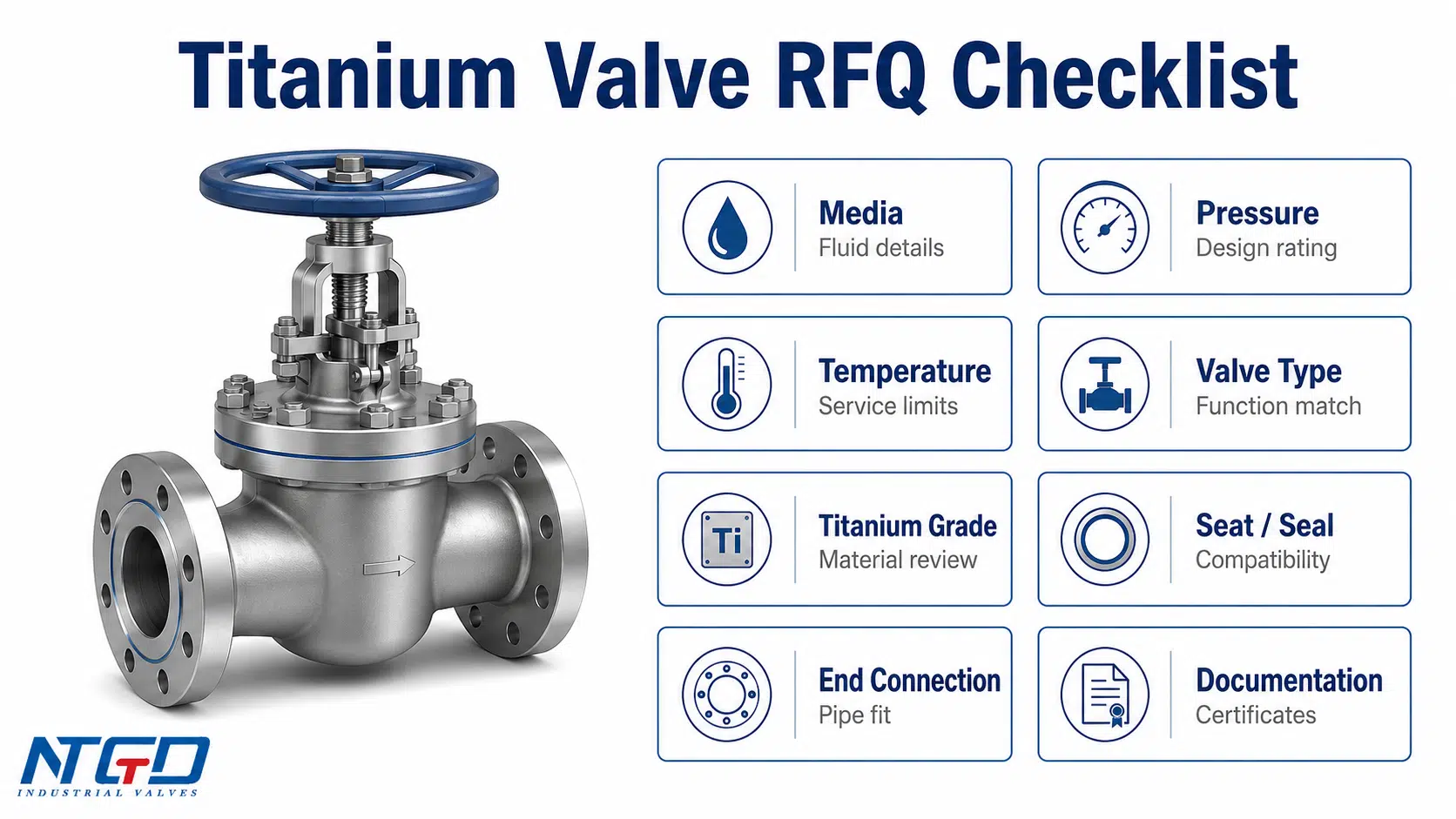
Titanium Valve RFQ and Specification Checklist
A good titanium valve RFQ should provide enough information for the supplier to review both material and valve design. A short request such as “Need titanium valve price” is usually not enough for an accurate technical offer.
Some RFQ fields are interdependent. Media and temperature influence grade selection. Valve type and operation method affect torque or actuator review. Pressure class and end connection affect body design, face-to-face requirements, and documentation.
The checklist below can help buyers prepare a clearer specification.
| RFQ item | What to confirm | Why it matters |
|---|---|---|
| Media | Fluid name, concentration, solids, corrosive components | Drives material and seat / seal selection |
| Pressure | Design pressure, operating pressure, pressure class | Affects body design and rating |
| Temperature | Normal and maximum service temperature | Affects material, seat, gasket, and seal selection |
| Valve type | Ball, check, gate, globe, butterfly, plug, or control valve | Determines working principle and suitability |
| Titanium grade | Grade 2, Grade 5, Grade 7, Grade 12, or project-specified grade | Prevents ambiguous material offers |
| Body / trim / wetted parts | Full wetted material list and product form where required | Avoids hidden compatibility issues |
| Seat / seal / gasket | PTFE, metal seat, elastomer, graphite, or other materials | Critical for leakage and chemical compatibility |
| End connection | Flanged, threaded, butt-weld, socket-weld, wafer, lug, etc. | Ensures pipe fit |
| Operation | Lever, gear, handwheel, pneumatic actuator, electric actuator | Affects torque and control method |
| Flow direction / orientation | Required direction and installation position | Especially important for check and globe valves |
| Standards / testing | Applicable design, material, inspection, and testing requirements | Supports project acceptance |
| Documentation | Material certificates, test reports, drawings, data sheets, traceability records, PMI if required | Needed for quality control and project approval |
Service Conditions to Confirm
The service data should include more than the industry name. “Chemical service” or “seawater service” is not enough by itself. The supplier needs the media composition, concentration, pressure, temperature, and operating conditions.
For severe or unusual media, buyers should also provide cleaning procedures, intermittent operation details, solids content, and whether the line may experience vacuum, pulsation, or reverse flow.
Valve Type and Design Details
The RFQ should specify the valve type and major design expectations. For example:
- titanium ball valve: full-port or reduced-port, floating or trunnion, seat material, end connection;
- titanium check valve: swing, lift, piston, dual plate, spring-assisted, flow direction, installation orientation;
- titanium gate valve: wedge type, stem type, operation method, pressure class;
- titanium globe valve: flow direction, trim design, throttling duty;
- titanium butterfly valve: wafer / lug / flanged, seat type, disc and stem material.
This helps avoid receiving offers for technically different valve designs.
Material Grade, Standards and Documentation
The material section should identify the titanium grade and documentation requirements. If the project requires ASTM material references, inspection reports, PMI, pressure testing, or special certificates, these should be stated early.
The RFQ should also clarify whether the project requires cast, forged titanium parts, or machined titanium parts, material traceability, certified material test reports, or other documentation as part of the supply package.
Do not assume all titanium valve manufacturers will quote the same material form or documentation package unless the RFQ is clear.
End Connection, Operation and Testing Requirements
End connection and testing requirements affect both cost and lead time. A flanged titanium valve, butt-weld titanium valve, threaded titanium valve, and wafer titanium valve may have different manufacturing and documentation requirements.
The same applies to manual and actuated valves. Actuation requires torque review, mounting interface checks, power supply or air supply confirmation, and control signal requirements if automation is involved.
FAQ About Titanium Valves
What is a titanium valve?
A titanium valve is an industrial valve that uses titanium or titanium alloy for the valve body, trim, or other wetted parts. It is usually selected for corrosive service where common materials may not provide enough compatibility.
What are titanium valves used for?
Titanium valves are used in selected chemical processing, seawater, marine, desalination, petrochemical, fertilizer, water treatment, and other corrosive or demanding process applications. The suitability should be checked by service condition, not only by industry name.
What should be checked before ordering a titanium valve?
Before ordering a titanium valve, check the media, concentration, pressure, temperature, valve type, titanium grade, wetted materials, seat and seal compatibility, end connection, operation method, testing requirements, and documentation requirements.
Which titanium grade is commonly reviewed for industrial valves?
Grade 2 is commonly reviewed for industrial titanium valves because it is a commercially pure titanium grade used in many corrosion-resistance discussions. Grade 5, Grade 7, Grade 12, or another project-specified grade may also be reviewed depending on strength, corrosion, fabrication, documentation, and service requirements.
What is a titanium ball valve?
A titanium ball valve is a quarter-turn shutoff valve that uses titanium material for the body, trim, or key wetted parts. It is often reviewed for quick isolation in corrosive chemical or process service. Seat and seal compatibility must still be checked.
What is a titanium check valve?
A titanium check valve is a one-way valve made with titanium wetted parts. It opens with forward flow and closes to help prevent reverse flow. The design may be swing, lift, piston, dual plate, or spring-assisted, depending on the application.
What is a titanium gate valve?
A titanium gate valve is an isolation valve that uses a gate or wedge to open or close the flow path. It is generally used in fully open or fully closed service and is not normally recommended for throttling.
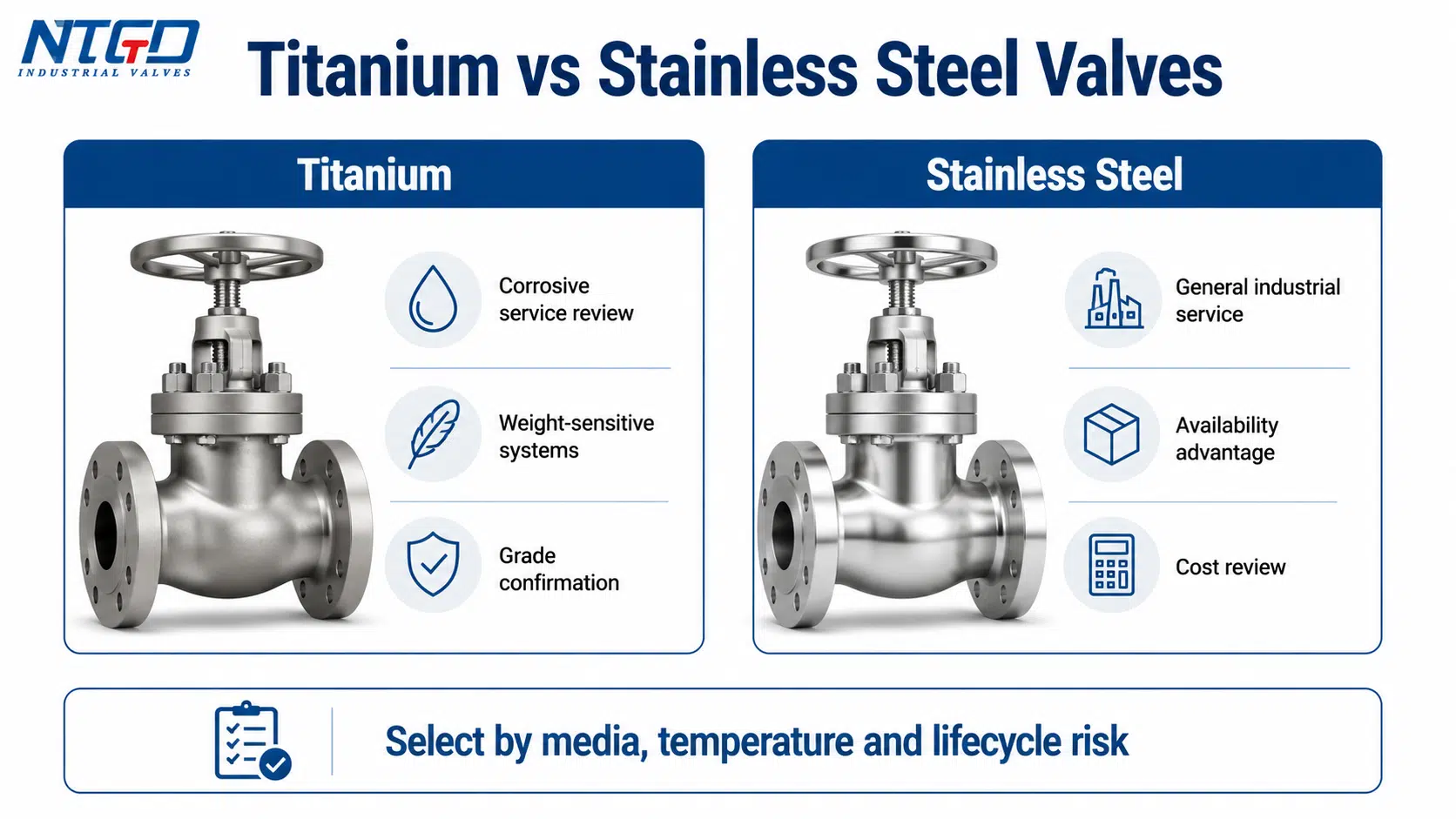
Are titanium valves better than stainless steel valves?
Titanium valves are not automatically better than stainless steel valves. Titanium may be preferred in selected corrosive services, especially where stainless steel is not suitable. Stainless steel may still be more practical, available, and cost-effective in many general industrial applications. The comparison should be based on media, temperature, chloride level, corrosion risk, and required service life.
Can titanium gate valves be used for throttling?
Titanium gate valves are generally not selected for throttling. Operating a gate valve partially open can damage the gate and seat area, increase vibration, and reduce shutoff performance. If throttling is required, a globe valve or control valve should usually be reviewed instead.
Conclusion: Selecting Titanium Valves for Corrosive Service
Titanium valves are valuable when an industrial piping system requires corrosion-resistant wetted parts for demanding service. However, the material alone does not define the valve’s function or guarantee suitability.
A reliable titanium valve selection should connect five decisions: the service media, the titanium grade, the valve type, the seat / seal / trim materials, and the required RFQ documentation.
For a general titanium valve overview page, the most important point is to keep the material and valve design decisions together. A titanium ball valve, titanium check valve, titanium gate valve, titanium globe valve, and titanium butterfly valve may all use titanium, but they solve different process problems.
When these differences are clarified before RFQ, the specification review becomes more direct and the risk of wrong material or wrong valve type selection is reduced.
Need help reviewing an industrial titanium valve configuration?
To avoid common selection mistakes such as wrong grade, wrong valve type, or incompatible seat / seal materials, share the media, pressure, temperature, valve type, titanium grade requirement, end connection, and documentation needs before final selection. NTGD Valve can help review the corrosive-service valve configuration and prepare a specification-based response for industrial titanium valve projects.
