
Author Name: Bruce Zheng
Author Role: Co-Founder and Valve Engineer at NTGD Valve
Author Bio: Bruce Zheng is Co-Founder and Valve Engineer at NTGD Valve, focusing on industrial valve selection, application, and technical content for global B2B buyers.
Last Updated: May 25, 2026
A V-port ball valve is a ball valve with a V-shaped or characterized opening in the ball, seat, or flow passage. Instead of opening with a round bore like a standard ball valve, the V-shaped opening exposes the flow area gradually as the valve rotates. This makes the valve more suitable for throttling or modulating service where the flow rate needs to be adjusted rather than simply turned on or off.
In simple terms, a V port ball valve combines compact quarter-turn operation with more predictable flow control behavior. It is often reviewed when a system needs better throttling than a standard ball valve can normally provide, but does not necessarily require the very fine control of a dedicated globe or needle valve. It can support both shutoff and control in many industrial services, but it is not automatically the best choice for every control application.
A useful quick selection frame is:
- A standard ball valve is mainly for on/off isolation.
- A V-port ball valve is designed for more controlled throttling.
- A globe or needle valve may still be preferred for very fine or severe control service.
- A V-port control ball valve should be reviewed as a complete package, including valve, actuator, positioner, control data, and project datasheet requirements.
The final selection still depends on media, pressure drop, temperature, required Cv, shutoff class, V-port angle, seat design, flow characteristic, and whether the valve will be operated manually or with an actuator and positioner.
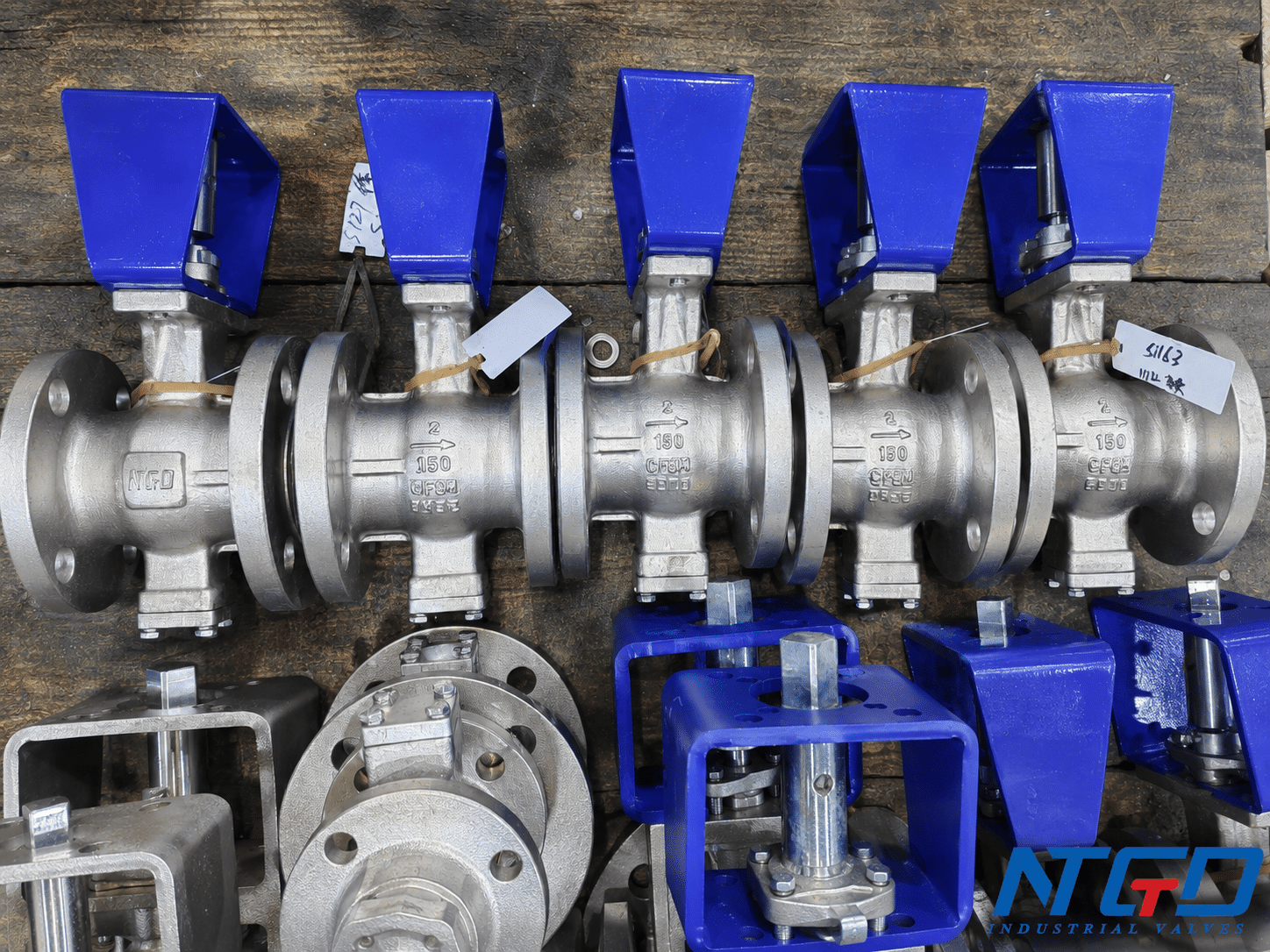
What Is a V-Port Ball Valve?
Basic Definition
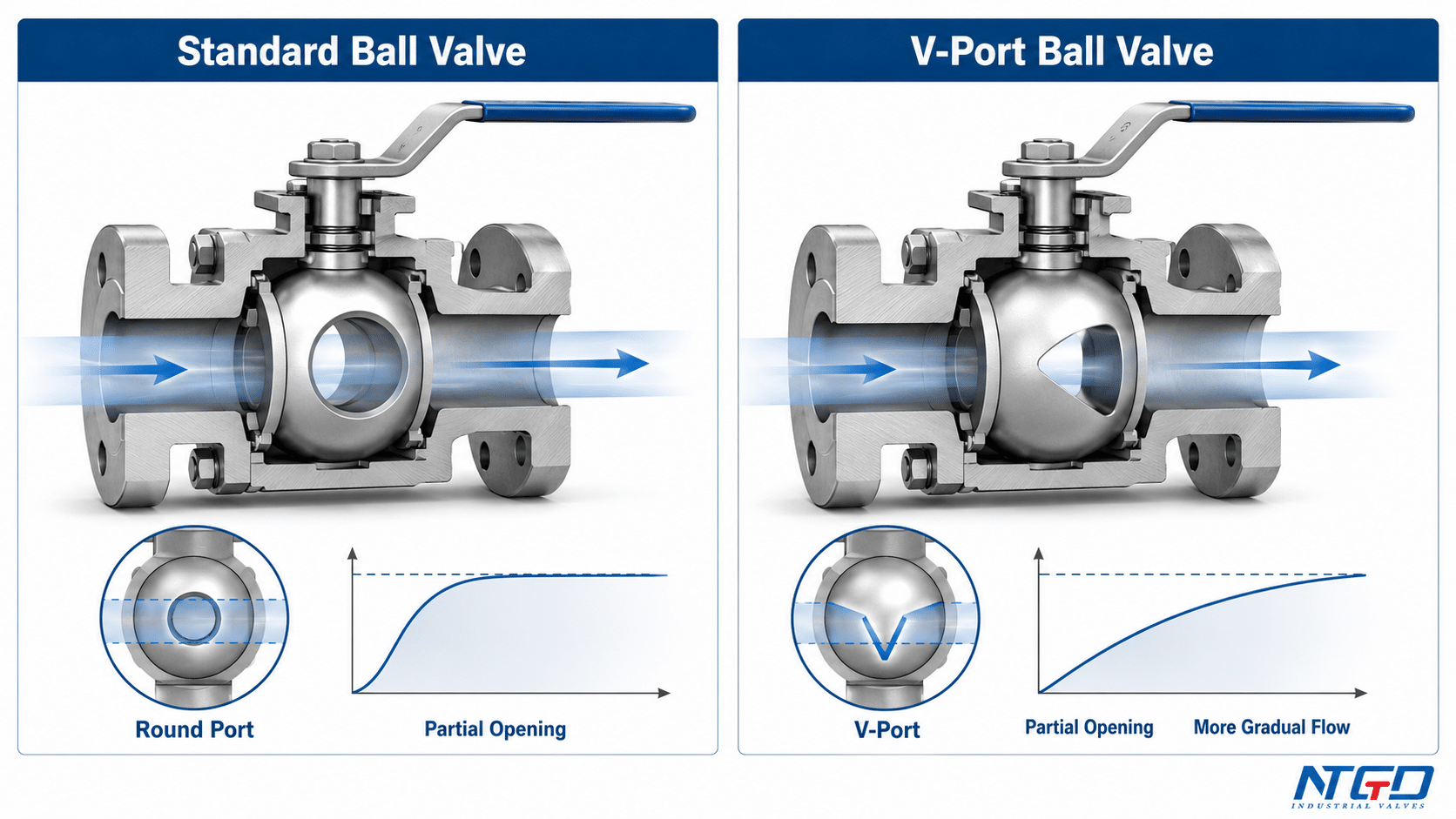
A V-port ball valve is a quarter-turn valve that uses a V-shaped opening to regulate flow more gradually than a standard round-port ball valve. When the valve begins to open, only the narrow end of the V is exposed to the flow path. As the ball continues to rotate, the opening area increases in a controlled way.
This design helps the valve handle applications where the operator needs more than simple open / close operation. In many systems, the V-shaped opening makes flow adjustment more predictable across partial opening positions.
The exact design can vary. Some valves use a V-shaped cut in the ball. Others may use a characterized ball, seat, or segment-style trim. For this reason, the drawing, datasheet, and manufacturer’s technical documentation should always be checked before assuming how a specific valve will behave.
How It Differs from a Standard Round-Port Ball Valve
A standard ball valve normally uses a circular bore through the ball. This design is efficient for isolation because it can provide a direct flow path when fully open. However, at partial opening positions, a standard round port may not provide stable or predictable throttling. A small change in handle or actuator position can expose a large flow area and cause a sharp change in flow.
A V-port ball valve changes that behavior. The V-shaped opening creates a smaller initial flow path and then increases the opening area more progressively. This allows the valve to provide better flow modulation than a standard ball valve in many services.
| Feature | Standard Ball Valve | V-Port Ball Valve |
|---|---|---|
| Main function | On/off isolation | Throttling plus shutoff support |
| Port shape | Round bore | V-shaped or characterized opening |
| Partial opening behavior | Less predictable for control | More gradual opening profile |
| Typical control use | Limited, simple adjustment only | Better fit for modulating service |
| Selection focus | Size, pressure class, material, end connection | All standard factors plus V-port angle, Cv, flow characteristic, actuator, and shutoff requirement |
This additional selection focus means that specifying a V-port ball valve usually requires more than matching size, pressure class, and material.
V-Port, V-Ball, V-Notch, and Segmented Ball Valve Terminology
Buyers and engineers may use several related terms when discussing this valve type. They do not always mean exactly the same thing, so the wording should be treated carefully during specification review.
| Term | How to Use It in This Article | Boundary |
|---|---|---|
| V-port ball valve | The main term for this article | The primary valve type discussed here |
| V-port valve | A shortened term that often refers to the same concept | Should still be confirmed as a ball valve, not another valve type |
| V-ball valve | Common wording in some product and control valve contexts | Often related to V-port ball valve behavior, but the exact trim design should be checked |
| V-notch ball valve | Usually emphasizes the V-shaped notch or characterized opening | Useful for mechanism explanation, but not the main topic of this article |
| V-shaped ball valve / V type ball valve | Describes the shape concept | Should be tied back to actual valve construction |
| Segmented ball valve | A related rotary control valve concept | Adjacent topic; not always identical to a full V-port ball valve |
| Vport ball valve | Search or shorthand spelling used by some buyers | Treat as a spelling variant, not a separate technical category |
In actual selection work, these terms should not replace the valve drawing. A buyer may ask for a “V-ball valve,” “V-notch ball valve,” or “vport ball valve,” but the final review should be based on the actual ball geometry, trim design, seat design, Cv data, shutoff requirement, and service condition. A segment ball valve may appear in similar rotary control valve discussions, but it should not be assumed to be the same as the V-port ball valve discussed in this article.
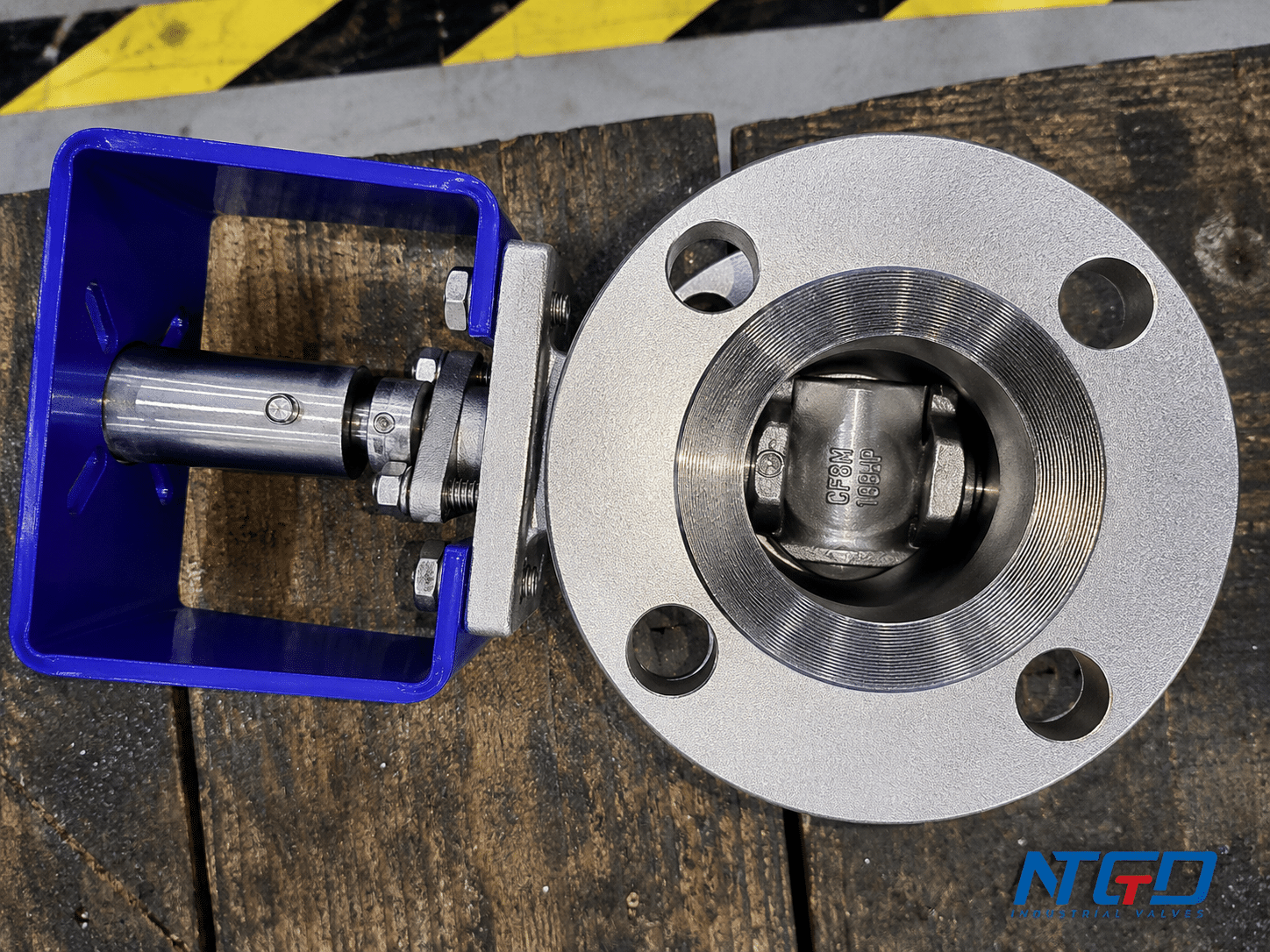
How a V-Shaped Port Controls Flow
Small Opening First: Why the V Shape Matters
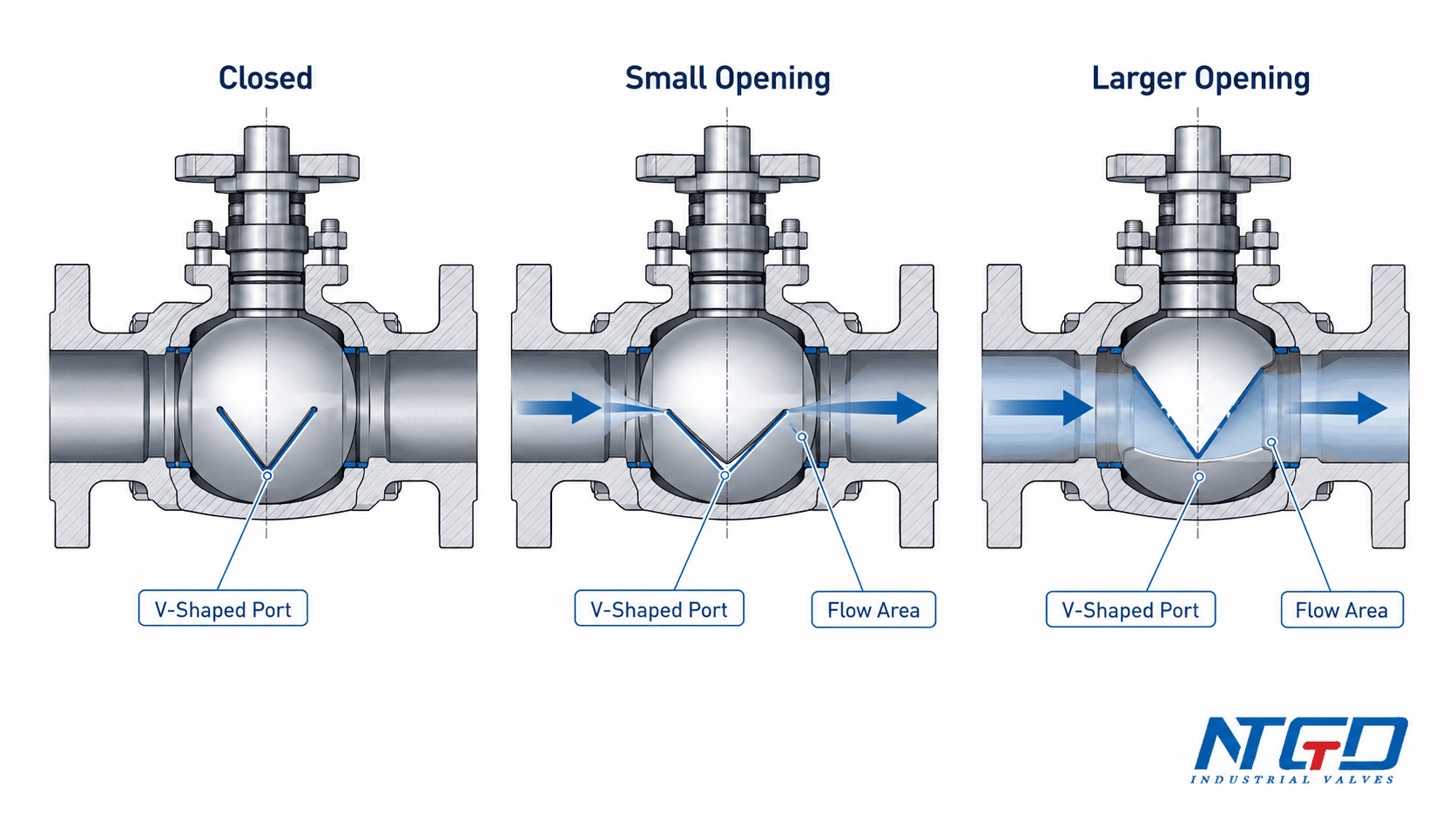
The core function of a V-port ball valve comes from the shape of the opening. When the ball starts to rotate from the closed position, the narrow point of the V opens first. This creates a smaller initial flow area than a standard round-port ball valve would normally expose.
By contrast, a standard round port can expose a relatively large flow area even at small opening angles. This can make fine adjustment difficult and less repeatable, especially when the system is sensitive to sudden flow changes.
As the valve continues opening, more of the V-shaped area becomes available. The flow area increases progressively instead of suddenly. In many applications, this progressive exposure can help reduce sudden flow change, overshoot, or unstable adjustment that may occur with a round port at low opening percentages.
This does not mean every V-port design has the same control behavior. The port angle, seat design, ball geometry, pressure drop, media condition, and actuator control method all affect actual performance.
Quarter-Turn Movement and Opening Area
Like other ball valves, a V-port ball valve operates by rotating the ball 90 degrees. In a standard full-port design, the valve is mainly expected to be either fully open or fully closed. In a V-port design, the intermediate positions become more useful because the opening shape is designed to control flow area.
At lower opening positions, the V-shaped cut restricts the flow path. At larger opening positions, the flow area increases and allows more capacity. This creates a stronger connection between valve travel and flow response than a standard round-port ball valve.
In practice, this matters for systems where flow needs to be adjusted repeatedly, such as water treatment, chemical dosing, process cooling, viscous liquid handling, or other services where stable flow adjustment is needed.
Manual Operation vs Actuated Control
A manually operated V-port ball valve may be used for simple adjustment where frequent or precise modulation is not required. However, when the valve must respond to a control signal, maintain a process variable, or repeat positions accurately, the valve is normally reviewed as part of an actuated package.
That package may include:
- actuator type;
- positioner requirement;
- control signal;
- valve torque;
- shutoff requirement;
- required flow characteristic;
- Cv and rangeability review;
- fail-safe position;
- media and temperature compatibility.
This is where the phrase V-port control ball valve often appears. The term usually refers not only to the valve body, but to a valve assembly used in a modulating control service. The valve itself still needs to be checked against the full service condition.
V-Port Angle and Flow Characteristics
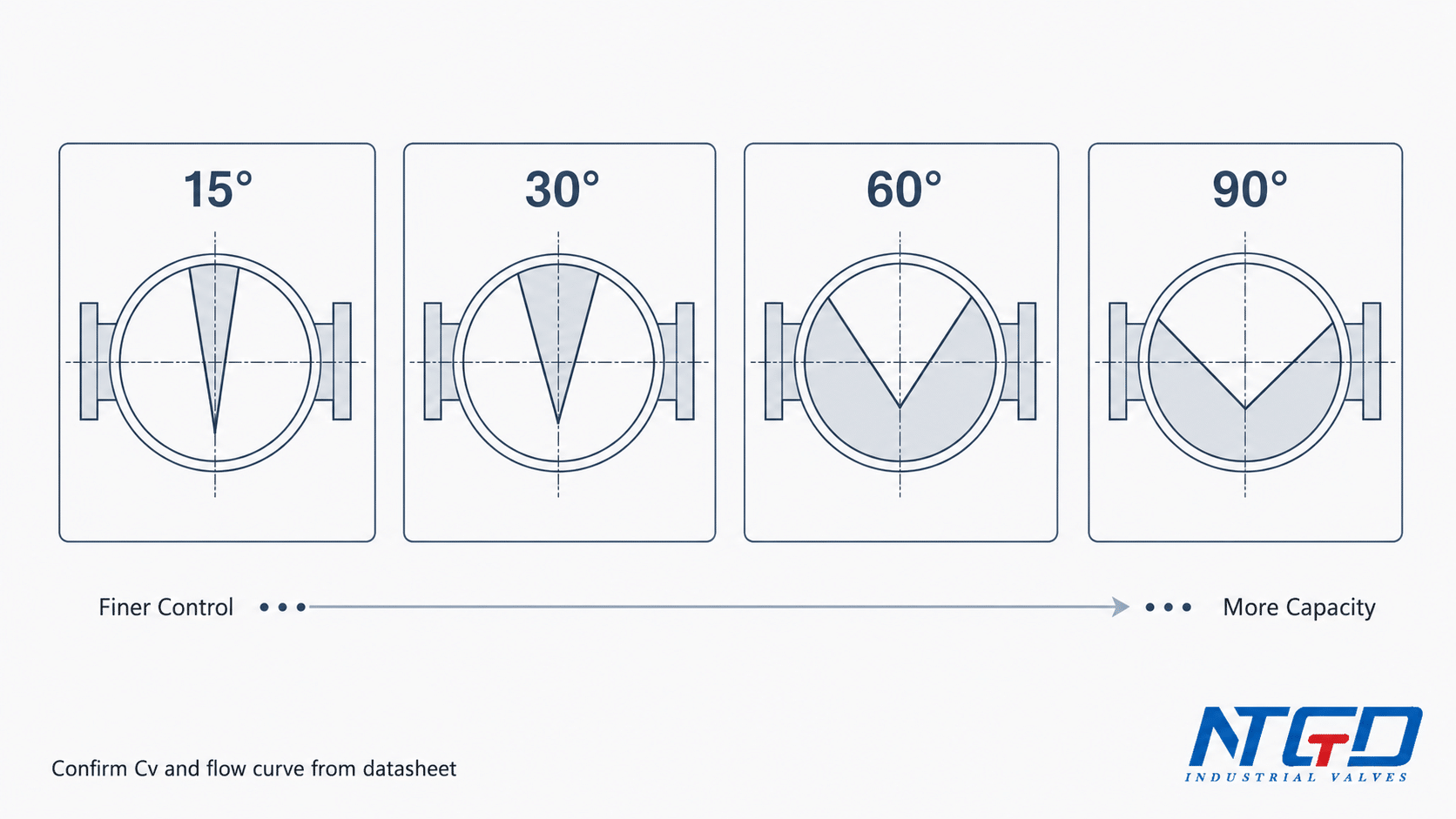
Common V-Port Angles: 15°, 30°, 60°, and 90°
V-port ball valves may be designed with different V-port angles. Common examples include 15°, 30°, 60°, and 90° ports. These angle references are useful, but they should not be treated as universal performance rules. Different manufacturers may design the port geometry differently, and the final flow curve must be confirmed against the valve datasheet.
In general, a smaller V angle is often reviewed when the service requires finer control at lower openings. A larger V angle is often reviewed when the service needs more flow capacity while still maintaining better throttling behavior than a standard round-port ball valve.
| V-Port Angle | Typical Control Logic | Common Review Point |
|---|---|---|
| 15° | Finer low-opening control | Confirm minimum controllable flow, Cv data, and low-end controllability |
| 30° | Controlled throttling with moderate capacity | Confirm flow curve and expected operating range |
| 60° | Larger opening capacity | Confirm pressure drop, control stability, and actuator response |
| 90° | High capacity with control support | Confirm whether the control precision is sufficient for the required service |
The angle alone should not decide the valve. It must be reviewed together with line size, pressure drop, actuator control, media, viscosity, solids content, temperature, and required shutoff performance.
Linear, Equal Percentage, and Modified Equal Percentage Flow
In control valve discussions, flow characteristic describes how flow changes as the valve opens. For V-port ball valves, common descriptions include linear, equal percentage, or modified equal percentage behavior. These terms should be used carefully.
A linear characteristic generally means the flow changes more proportionally with valve travel. An equal percentage characteristic means each equal movement of the valve produces a percentage change in flow, which can be useful in systems with changing pressure conditions. Modified equal percentage is often used when the actual valve design creates a curve between simple linear and equal percentage behavior.
V-port angle influences the opening profile, but the final curve should come from the datasheet, not from the angle number alone. Smaller angles are often reviewed for finer low-opening control, while larger angles are often reviewed for higher flow capacity. The actual relationship between angle, Cv, and flow characteristic must be checked for the specific valve size and design.
The important point is not the label alone. The buyer should confirm the expected flow curve and Cv data for the selected valve size and port design.
Cv, Rangeability, and Pressure Drop: What Must Be Confirmed
A V-port ball valve may offer high flow capacity compared with some other control valve styles, but pressure drop and Cv should not be assumed.
Before selecting a V-port ball valve, confirm:
- required minimum, normal, and maximum flow;
- pressure drop across the valve;
- required Cv at the expected operating range;
- whether the valve will normally operate near low opening, mid-opening, or high opening;
- whether the actuator can control the required position range;
- whether cavitation, flashing, noise, erosion, or vibration must be considered.
A V-port ball valve can improve flow control compared with a standard ball valve, but it is still not a substitute for proper ball valve sizing and service review.
V-Port Ball Valve vs Standard Ball Valve, Globe Valve, Needle Valve, and Butterfly Valve
V-Port vs Standard Ball Valve
The most important comparison is between a V-port ball valve and a standard round-port ball valve. Both are quarter-turn valves, but their behavior at partial opening is different.
A standard ball valve is excellent for isolation. It is compact, quick to operate, and has a direct flow path when fully open. But it is usually not the best choice for throttling service because the round opening can expose flow area too quickly.
A V-port ball valve is designed to make partial opening more useful. The V-shaped opening gives the valve a more controlled flow path, especially during the early and middle stages of opening.
V-Port vs Globe or Needle Valve
A V-port ball valve is often compared with globe valves and needle valves because all of them may be used in flow regulation. The correct choice depends on the required control accuracy, pressure drop, flow rate, media, installation space, and shutoff requirement.
Globe valves are commonly reviewed for precise control and severe throttling service.
Needle valves are often used for fine low-flow adjustment. A V-port ball valve may be preferred when the project needs a compact quarter-turn valve with good throttling behavior and shutoff support.
The key is not to say one valve is always better. Each design solves a different problem.
V-Port vs Butterfly Valve
Butterfly valves are often selected for larger pipelines, compact installation, and certain low-pressure or moderate control services. Their control behavior depends heavily on disc design, seat design, and opening position.
A V-port ball valve is usually reviewed when the buyer wants a characterized ball opening and more predictable flow control than a standard ball valve. A butterfly valve may still be suitable in many large-size services, but it should not be treated as the same control mechanism.
| Valve Type | Best Used For | Flow Control Behavior | Main Boundary |
|---|---|---|---|
| Standard ball valve | On/off isolation | Less predictable at partial opening | Not ideal for precise throttling |
| V-port ball valve | Throttling plus shutoff support | More predictable opening profile | Incorrect port angle or sizing can lead to poor control quality |
| Globe valve | Precise control | Strong throttling capability | May have higher pressure drop or larger body design |
| Needle valve | Fine low-flow adjustment | Very precise small-flow control | Not suitable for large flow capacity |
| Butterfly valve | Large pipeline modulation or isolation | Depends on disc and seat design | Not the same sealing or control logic as a V-port ball valve |
Choose a V-port ball valve when quarter-turn operation, shutoff support, compact design, and improved throttling are all important. Review globe or needle valves when very high precision, severe pressure drop control, or extremely fine low-flow adjustment is the main requirement. A V-port ball valve should be treated as a strong option in the correct service, not as a universal replacement for every control valve.
Advantages and Limitations of V-Port Ball Valves
Advantages in Flow Control
The main advantage of a V-port ball valve is more predictable flow adjustment than a standard ball valve. The V-shaped port allows the opening area to change gradually, which helps the valve handle throttling or modulating service more effectively.
Common advantages include:
| Advantage | Why It Matters |
|---|---|
| More predictable throttling | The V-shaped opening helps control flow area at partial openings |
| Quarter-turn operation | Compact operation and easier automation compared with multi-turn valves |
| Shutoff plus control support | Can support both isolation and flow adjustment when properly selected |
| High flow capacity potential | May allow good flow capacity compared with some control valve designs |
| Actuator compatibility | Can be used in automated systems when torque and control requirements are checked |
| Compact body style | Useful where installation space is limited |
These advantages are strongest when the valve is selected with the correct V-port angle, seat material, actuator, flow data, and service conditions. They should not be treated as automatic results of the valve name alone.
Where V-Port Ball Valves Have Limits
A V-port ball valve should not be treated as a universal control valve. It may not be the best choice for very fine low-flow control, severe pressure drop, cavitating service, flashing service, high noise risk, or services where trim erosion is expected.
It also requires careful review in abrasive, dirty, fibrous, or solids-containing media. Some V-port designs may help manage certain difficult flow conditions, but clogging, seat wear, torque increase, erosion, and leakage risk must be checked.
| Limitation | Why It Requires Review |
|---|---|
| Very fine control | The V-shaped opening is more controllable than a round port, but may not provide the fine adjustment resolution of globe or needle valve designs |
| Severe pressure drop | High ΔP applications may require special trim or another valve style to review cavitation, flashing, noise, or erosion risk |
| Abrasive or solids-containing media | Seat, ball, and trim surfaces may wear faster if not properly selected |
| Dirty or fibrous service | Clogging and torque increase must be reviewed |
| High temperature | Seat and seal material must be compatible |
| Tight shutoff requirement | Leakage class depends on valve design, seat, media, and service condition |
When Another Control Valve May Need Review
Another valve type should be reviewed when the process requires very high control accuracy, stable low-flow regulation, severe service protection, or detailed control valve sizing. In those cases, a globe control valve, segmented control valve, needle valve, or another dedicated control valve design may be more appropriate.
A V-port ball valve is often a strong candidate when the application needs a compact rotary valve that can combine shutoff with better flow modulation than a standard ball valve. It becomes less suitable when the control problem is too severe for the selected ball valve design.
Where V-Port Ball Valves Are Commonly Reviewed
Good-Fit Conditions
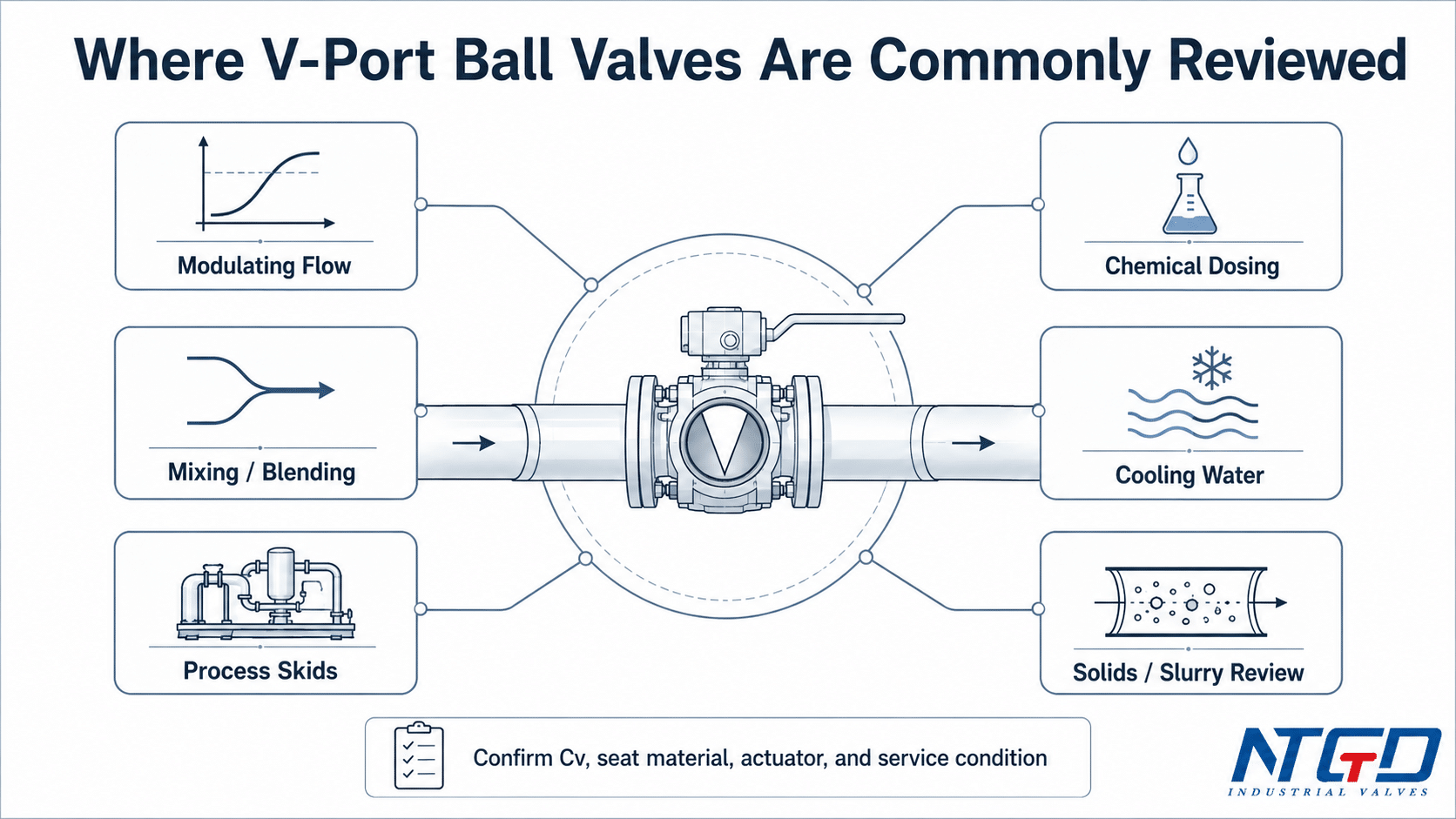
V-port ball valves are commonly reviewed for industrial services where flow needs to be adjusted, but the system still benefits from compact quarter-turn operation. Typical review areas include clean liquid flow control, process water, chemical service, cooling lines, and selected viscous media.
In these cases, the V-port design can help create more stable control than a standard ball valve, especially when paired with the correct actuator and port angle.
Review-Carefully Conditions
Some services may be possible but require careful engineering review. These include dirty media, fibrous media, suspended solids, viscous fluids, high temperature, high pressure, and corrosive chemicals.
The valve may need special body material, seat material, coating, actuator sizing, or trim review. The buyer should not select a V-port ball valve based only on the valve name.
Applications That Should Not Be Assumed Automatically
Certain applications should not be assumed without specification review. Food and beverage service, sanitary service, slurry service, severe throttling, steam control, and high-pressure drop control all require additional confirmation.
| Service Condition | V-Port Ball Valve Fit | Review Point |
|---|---|---|
| Clean liquid flow control | Good candidate | The V-shaped opening can support stable adjustment; confirm Cv and V-port angle |
| Water treatment | Common review area | Useful where flow adjustment is needed; confirm material, seat, and corrosion compatibility |
| Chemical process | Possible | Confirm chemical compatibility, temperature, pressure, and sealing material |
| Viscous media | Possible | Confirm torque, actuator sizing, flow curve, and seat design |
| Dirty / fibrous / suspended solids | Review carefully | Confirm trim, seat, clogging risk, erosion risk, and cleaning access |
| High pressure / high temperature | Do not assume | Confirm pressure class, temperature rating, body material, seat material, and test requirement |
| Gas service | Possible in selected applications | Confirm leakage requirement, high-velocity trim erosion risk, noise, vibration, and bubble-tight shutoff if required |
| Food / beverage | Cautious | Confirm sanitary, cleaning, and material requirements |
| HVAC / building automation | Secondary light context only | The main focus of this article is industrial process service, not building automation selection |
A good application fit is not defined only by industry. It is defined by media, pressure, temperature, required control range, valve size, material compatibility, shutoff expectation, and whether the valve can operate in the expected control range without instability.
What to Confirm Before Selecting or Requesting a V-Port Ball Valve
Before selecting or requesting a V-port ball valve, first confirm the service condition and control requirement as part of broader industrial valve selection.
Then review the valve geometry, material, actuator package, and shutoff expectation. This sequence helps avoid choosing a valve based only on size and pressure class while missing the control behavior that makes V-port selection different.
Process and Media Data
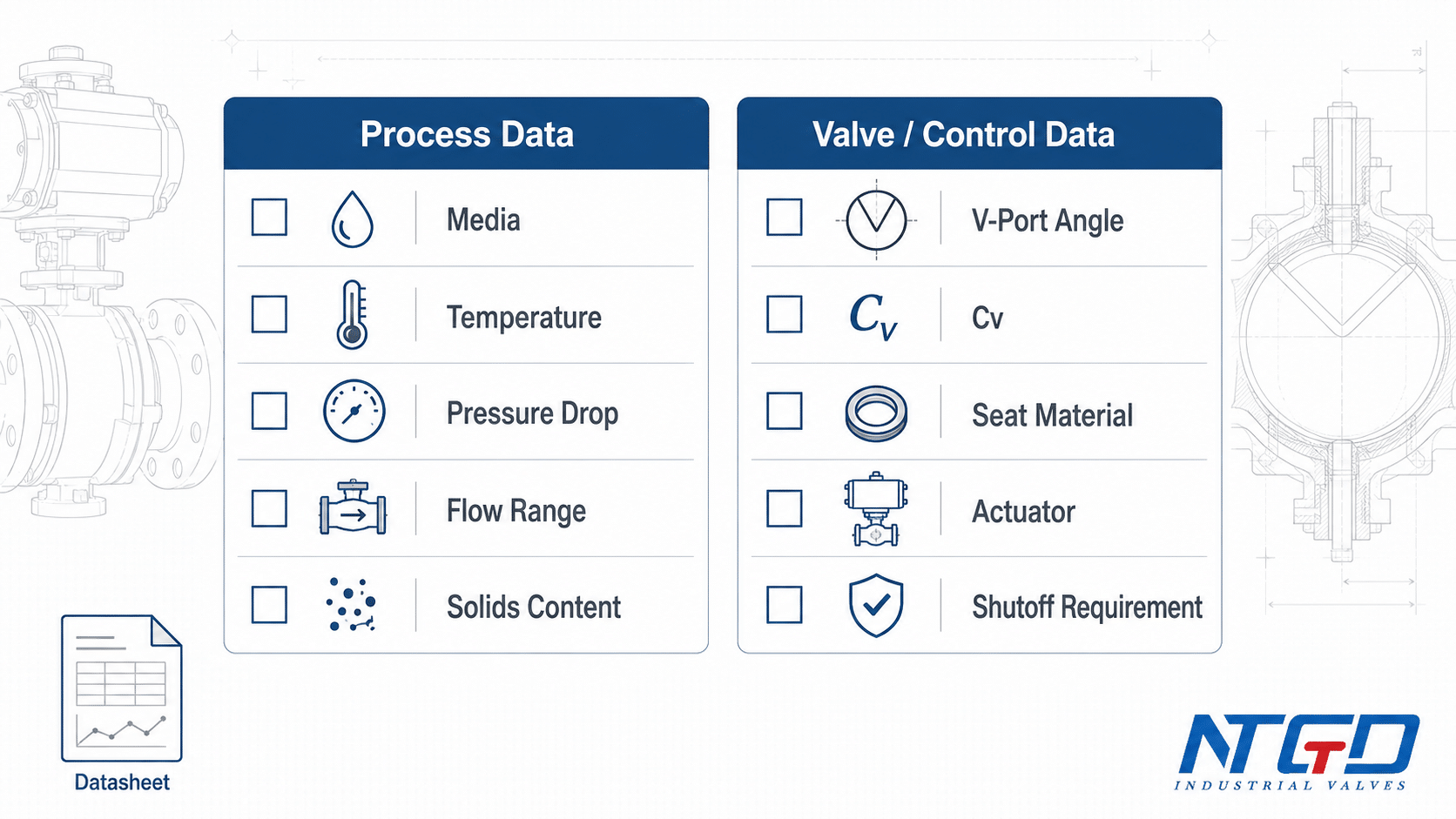
Before requesting or selecting a V-port ball valve, the process data should be clear. The most important information includes the media, temperature, pressure, flow range, pressure drop, solids content, viscosity, and whether the valve will operate mainly at low, middle, or high opening positions.
Without this information, the V-port angle, Cv, and expected flow characteristic cannot be reviewed properly.
Valve Design and Materials
The valve body, ball, seat, stem, seals, and end connection should match the service. Stainless steel, carbon steel, alloy materials, soft seats, metal seats, and special sealing materials may all be possible depending on the application, but the final choice must be checked against the project specification.
Do not assume that one V-port ball valve design fits all services. Material compatibility, pressure class, temperature, corrosion risk, erosion risk, and shutoff requirement must be confirmed.
Actuation, Control, and Shutoff Requirements
If the valve is used for continuous control, manual operation may not be enough. The actuator, positioner, control signal, valve torque, fail position, and shutoff requirement should be reviewed together.
A V-port control ball valve is best evaluated as a complete control assembly rather than only as a valve body.
| Category | Information to Confirm | Why It Matters |
|---|---|---|
| Process data | Media and solids content | Affects material, seat selection, clogging risk, and wear |
| Process data | Temperature | Affects seat, seal, and body material selection |
| Process data | Pressure drop | Affects control stability, noise, cavitation, flashing, and erosion risk |
| Process data | Required minimum, normal, and maximum flow | Needed to review Cv and control range |
| Valve design | Valve size and pressure class | Affects body design, rating, and installation |
| Valve design | End connection | Affects installation and piping compatibility |
| Valve design | V-port angle | Affects opening profile, flow capacity, and low-end controllability |
| Valve design | Desired flow characteristic | Helps determine whether linear, equal percentage, or modified behavior is required |
| Valve design | Shutoff requirement | Affects seat design and leakage class review |
| Control package | Actuator / positioner requirement | Needed for repeatable modulating control |
| Control package | Flow direction / installation condition | Must be confirmed with drawing or datasheet because not all designs should be judged from appearance alone |
| Control package | Applicable standard or test requirement | Affects procurement, inspection, and acceptance criteria |
The final selection should be verified against the datasheet, project specification, and service conditions before purchase or installation.
For buyers reviewing V-port ball valve specifications, factory testing and inspection are also part of the selection process. The following NTGD video shows a ball valve pressure test procedure, which can be used as a practical reference for understanding valve verification before shipment.
FAQ About V-Port Ball Valves
What is a V-port ball valve?
A V-port ball valve is a ball valve with a V-shaped or characterized opening designed to provide more controlled flow adjustment than a standard round-port ball valve. It is often used where throttling or modulating service is required.
What is the purpose of a V-port ball valve?
The purpose of a V-port ball valve is to combine ball valve shutoff capability with better flow control behavior. The V-shaped opening allows flow area to increase more gradually as the valve opens.
How does a V-port ball valve work?
A V-port ball valve works by rotating a ball with a V-shaped opening. When the valve starts to open, the narrow end of the V exposes a small flow area first. As the ball rotates further, the opening area increases and allows more flow.
What is the difference between a V-port ball valve and a standard ball valve?
A standard ball valve usually has a round bore and is mainly used for on/off service. A V-port ball valve has a V-shaped opening that makes partial opening more useful for throttling and flow modulation.
Is a V-ball valve the same as a V-port ball valve?
In many discussions, V-ball valve and V-port ball valve are used to describe similar rotary control concepts. However, the exact design can vary, so the valve drawing and datasheet should be checked before treating the terms as identical.
What is a V-notch ball valve?
A V-notch ball valve usually refers to a ball valve design with a V-shaped notch or characterized opening. It is closely related to V-port ball valve terminology, but the exact construction should be confirmed.
Can a ball valve be used for flow control?
A standard ball valve can sometimes be used for simple flow adjustment, but it is usually not ideal for precise or continuous throttling. A V-port ball valve is a more suitable flow control ball valve design when a quarter-turn valve needs better modulation.
Is a V-port ball valve better than a globe valve?
Not always. As a simplified starting point, consider a V-port ball valve when compact quarter-turn operation, shutoff support, and improved throttling are all important. Consider a globe valve when the highest control precision, severe pressure drop handling, or stable fine throttling is the primary concern. The best choice depends on required precision, pressure drop, space constraints, media condition, and total cost of ownership.
What V-port angle should be selected?
There is no single correct answer from the angle number alone. The V-port angle should be selected based on required flow range, Cv, pressure drop, control precision, and operating position. The final angle should be verified against the manufacturer’s flow curve, including Cv versus opening percentage, for the specific valve size and operating conditions.
Can a V-port ball valve be used for both shutoff and control, and when does it need an actuator?
Yes, many V-port ball valves are selected for both shutoff and control support. However, shutoff performance depends on seat design, leakage requirement, media, temperature, pressure, and valve condition. If the valve must respond to a control signal, hold repeatable intermediate positions, or modulate continuously, an actuator and positioner should be reviewed as part of the valve package.
Conclusion
A V-port ball valve is not simply a standard ball valve with a different opening shape. Its V-shaped port changes how flow area develops as the valve opens, making it more suitable for predictable throttling and modulating service than a standard round-port ball valve. The strongest applications are those where the system needs compact quarter-turn operation, shutoff support, and controlled flow adjustment.
The most important selection factors are V-port angle, flow characteristic, Cv, pressure drop, media condition, seat material, actuator package, flow direction, and shutoff requirement. A V-port ball valve can be an effective solution, but it should be selected through service review rather than assumed from the valve name alone.
After completing the selection checklist above, the next step is to share the confirmed service data for a detailed valve review. For a V-port ball valve selection review, prepare the media, pressure, temperature, flow range, pressure drop, desired flow characteristic, shutoff requirement, flow direction, and actuation needs. NTGD can help review these conditions and match the valve design to the project specification before RFQ confirmation.
