
Author Name: Bruce Zheng
Author Role: Co-Founder and Valve Engineer at NTGD Valve
Author Bio: Bruce Zheng is Co-Founder and Valve Engineer at NTGD Valve, focusing on industrial valve selection, application, and technical content for global B2B buyers.
Last Updated: May 25, 2026
Quick Answer: What Are the Main Types of Gate Valves?
The main gate valve types are usually classified by gate or disc design, stem movement, seat design, and application service. The most common design families include wedge gate valves, parallel slide gate valves, slab or through conduit gate valves, knife gate valves, and several special service designs such as pressure seal or bellow sealed gate valves.
There is no single fixed number of gate valve types because different industries classify them in different ways. A buyer may classify a gate valve by closure design, stem type, seat material, pressure service, or pipeline application. For industrial selection, the most useful starting point is to understand how each design affects sealing, operating torque, flow path, solids handling, and service suitability.
Gate valves are mainly selected for on/off isolation, not precise throttling. The sections below first explain the classification logic, then compare the main gate valve designs, map them to typical applications, and finish with an RFQ checklist for narrowing the starting selection.
Why Gate Valve Type Matters in Industrial Pipelines
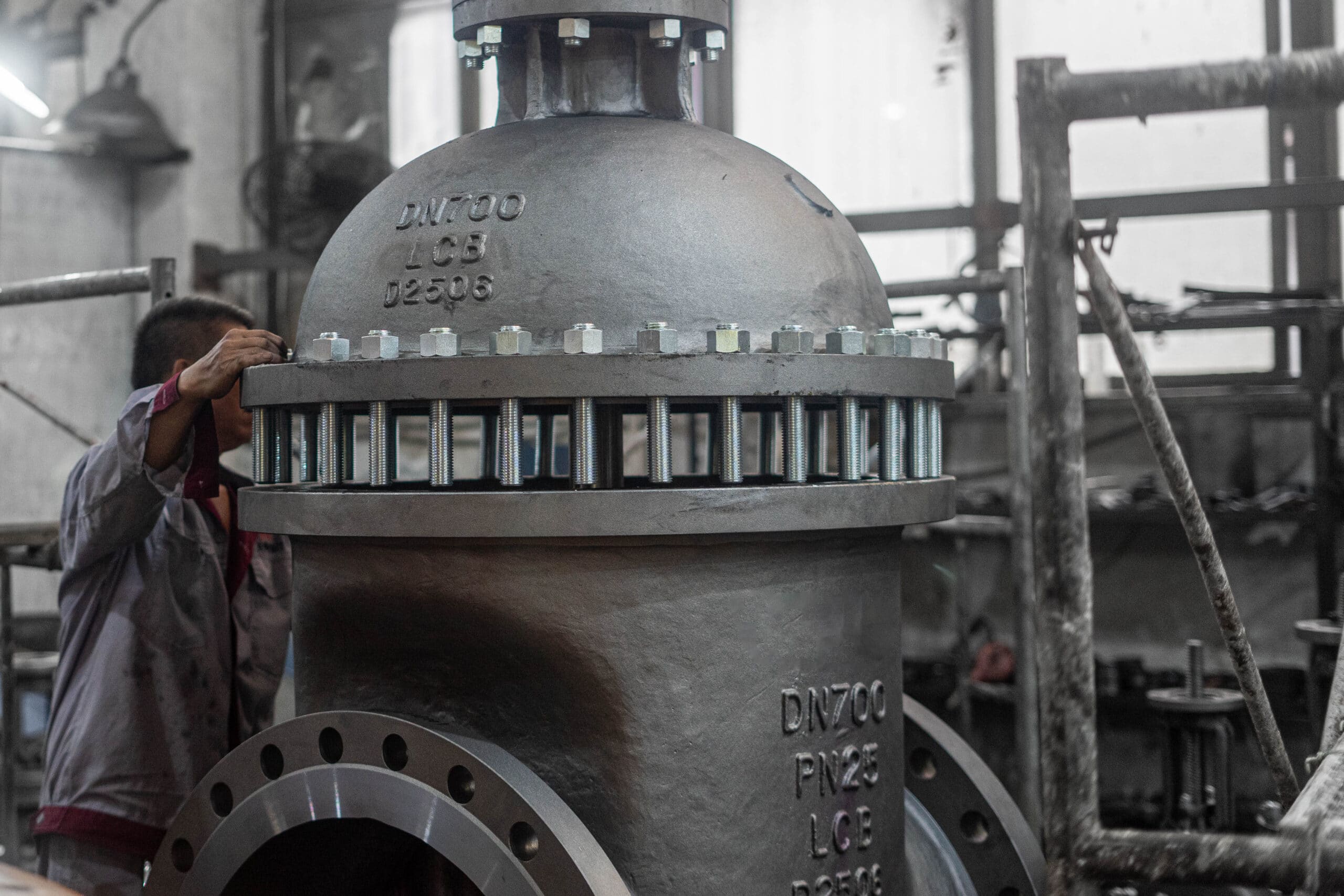
A gate valve is a linear-motion valve used to start or stop flow in a pipeline. When the valve is fully open, the gate is lifted out of the flow path. When the valve is closed, the gate moves down to block the flow. This makes gate valves useful for isolation service where the valve is normally either fully open or fully closed.
For an external engineering reference, this engineering overview of gate valve isolation service explains why gate valves are generally used fully open or fully closed rather than as throttling valves.
However, not all gate valves behave the same way in service. The internal design affects how the valve seals, how much torque is required to operate it, how it handles temperature change, and whether it is suitable for clean fluid, steam, slurry, pipeline pigging, or solids-containing media.
For example, a standard wedge gate valve may be suitable for many general isolation services, but a slurry line may need a knife gate valve. A high-temperature steam line may require closer attention to wedge binding or parallel slide design. A pipeline that requires pigging access may point toward a full-bore slab or through conduit gate valve.
Correctly understanding the valve type early can reduce RFQ back-and-forth, prevent the wrong starting design from entering the specification, and help the buyer move from a general valve request to a more accurate application review.
How Gate Valves Are Classified
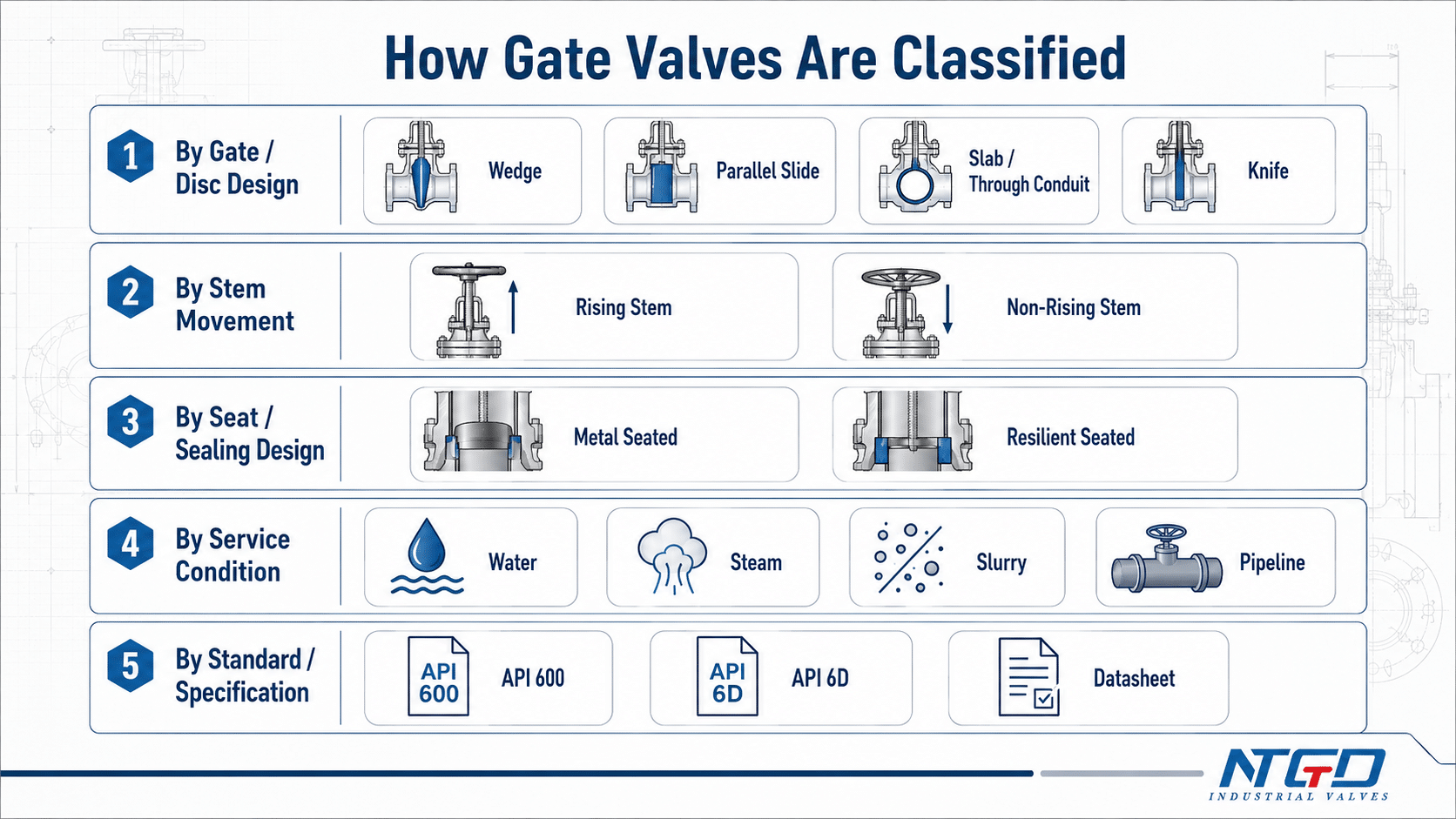
Gate valves are often classified in several overlapping ways. This is why one source may say there are two common types, while another lists six or more. The difference usually comes from the classification method.
| Classification Layer | Common Examples | Why It Matters | Depth in This Article |
|---|---|---|---|
| By gate or disc design | Wedge, parallel slide, slab, knife | Affects sealing logic, flow path, torque, and service fit | Core |
| By stem movement | Rising stem, non-rising stem | Affects space, position indication, and installation layout | Supporting |
| By seat or sealing design | Metal seated, resilient seated | Affects shutoff expectation, media compatibility, and temperature limits | Supporting |
| By service condition | Steam, slurry, water, oil and gas pipeline, chemical process | Helps narrow the starting valve type | Core mapping |
| By standard or specification | API 600, API 6D, project datasheet | Important for procurement and compliance, but not the main type category | Checklist only |
By gate or disc design
This is the most useful classification layer for a gate valve types article. It explains the actual closure geometry inside the valve. Wedge gate valves, parallel slide gate valves, slab or through conduit gate valves, and knife gate valves are different because the gate shape, sealing surface, and flow path behave differently. This classification directly affects sealing logic, pressure loss, operating torque, solids handling, and service suitability.
By stem movement
A gate valve can also be classified as a rising stem or non-rising stem design. This does not define the gate shape itself, but it affects installation space, visibility of valve position, and maintenance access. Stem selection becomes especially important when the valve is installed underground, inside a confined space, or in a location where operators need clear visual position indication.
By seat and sealing design
Metal seated and resilient seated gate valves are also common classifications. Seat design affects sealing expectation, temperature limits, media compatibility, and how the valve behaves in clean water, wastewater, steam, or industrial process lines. A seat material that works in one service may be unsuitable in another if the temperature, solids content, or leakage expectation changes.
By service condition or application
In real projects, application often drives the final decision. A water distribution line, steam service, slurry pipeline, oil and gas transmission line, and chemical process line may all use gate valves, but the suitable design can be different. Service conditions help determine whether a standard wedge design is enough or whether a knife, parallel slide, through conduit, pressure seal, or special sealing design should be reviewed.
By standard or specification
Standards, end connections, pressure classes, materials, and actuator types are important for procurement. But they should usually be treated as specification layers, not as the primary way to explain gate valve types. They confirm whether the chosen valve design can meet the project requirements, but they do not replace the basic design selection.
Main Gate Valve Design Types

Wedge Gate Valve
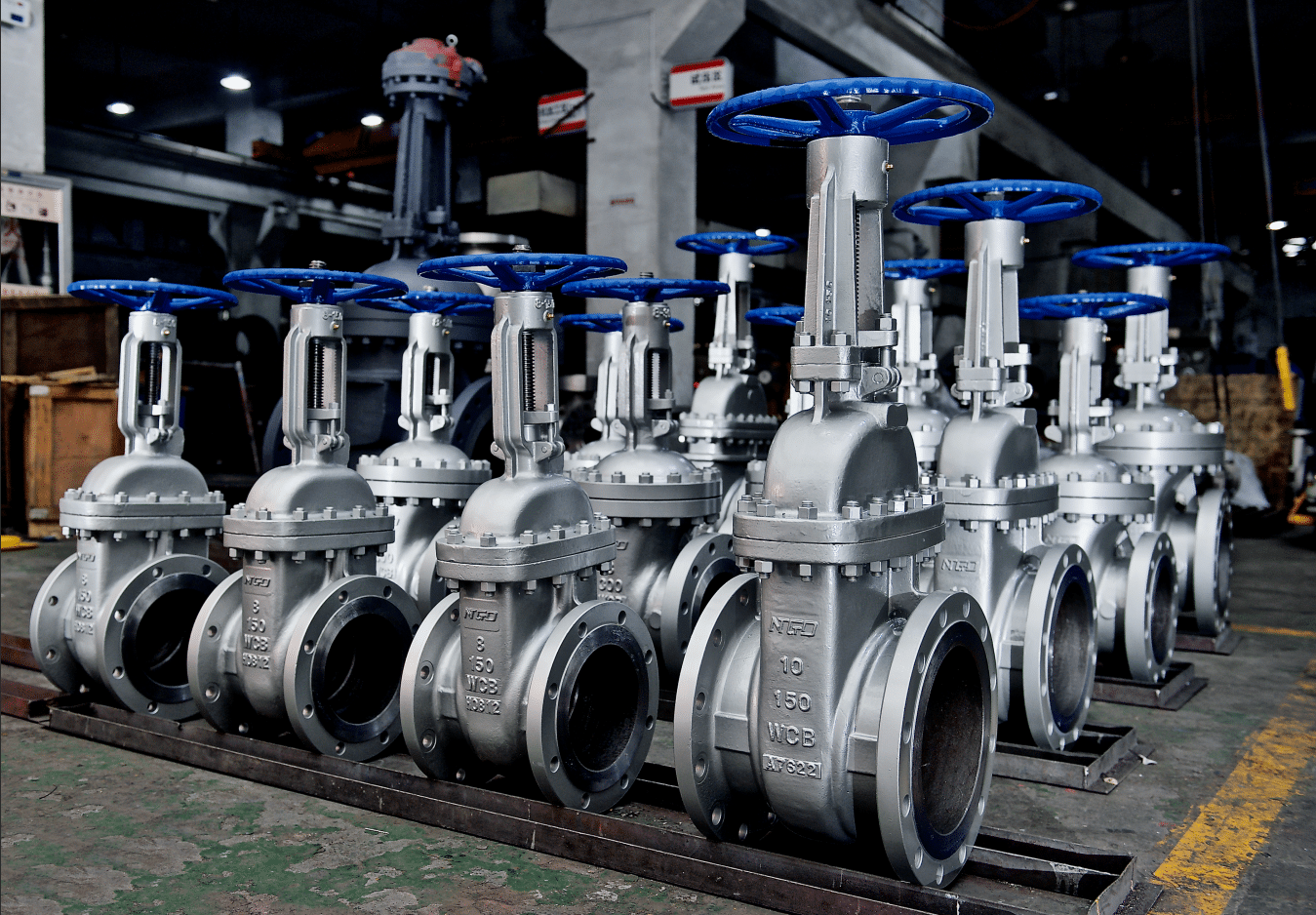
A wedge gate valve uses a wedge-shaped gate that moves between two inclined seat surfaces. This is one of the most common gate valve design families for general industrial isolation. It is widely used because the design is familiar, compact, and suitable for many clean liquid, gas, steam, water, and process services when correctly specified.
Within the wedge family, there are several subtypes, including solid wedge, flexible wedge, split wedge, and resilient wedge designs. These subtypes differ in how they handle thermal movement, seat alignment, sealing pressure, and media conditions.
For a deeper breakdown of wedge-family options, use NTGD’s types of wedge gate valves guide as the next step after this overview.
The main selection risk is assuming that all wedge designs behave the same. A solid wedge, flexible wedge, split wedge, or resilient seated wedge may respond differently to temperature change, seat alignment, solids, and leakage expectation. If the service involves high temperature, dirty media, or solids, the wedge subtype should be reviewed through a dedicated wedge gate valve technical page or product discussion instead of being decided only from this overview.
If the decision is mainly between rigid and more tolerant wedge behavior, the more specific solid vs flexible wedge gate valve selection guide is the better follow-up page.

Parallel Slide Gate Valve
A parallel slide gate valve uses parallel-faced discs instead of a wedge-shaped gate. The sealing logic is different from a wedge valve. In many designs, spring preload and line pressure help the discs seal against the seats.

This non-wedging design can be useful in high-pressure or high-temperature isolation duties, especially where thermal expansion, operating torque, or wedge binding may be a concern. Steam, feedwater, and power service are common contexts where parallel slide gate valves are considered.
The key boundary is that a parallel slide gate valve should not be treated as a short paragraph replacement for a full product review. Disc construction, pressure seal design, spring arrangement, power-service requirements, and operating conditions should be checked in a dedicated parallel slide gate valve page or datasheet before final specification.
For construction details, disc arrangement, and application notes, review NTGD’s dedicated parallel slide gate valve page instead of expanding this Hub section into a product guide.
Slab / Through Conduit Gate Valve
A slab or through conduit gate valve is a full-bore design used where straight-through flow is important. In the fully open position, the bore is aligned with the pipeline, which can help reduce pressure drop and allow pigging access in suitable pipeline systems.

Wermac’s overview of slab gate valves also identifies slab gate valves as through conduit gate valves used in gas, crude oil, and oil-product transportation pipelines.
This type is commonly associated with oil and gas pipelines, transmission lines, terminals, and other pipeline services where full-bore passage and low flow restriction are important. Slab gate and expanding gate constructions may both appear in through conduit valve discussions, but those details belong to a more specialized product or pipeline valve page.
The main selection risk is treating pigging service like a normal isolation line. If a pipeline requires full-bore passage, a standard wedge gate valve may not meet the requirement. API 6D-related details, DBB / DIB requirements, seat arrangement, and pipeline documentation should be handled in a dedicated through conduit gate valve review, not in a general gate valve types article.
For full-bore pipeline design details, continue to NTGD’s through conduit gate valve page.
Knife Gate Valve
A knife gate valve uses a thin gate or blade-like closure that is designed to cut through or move through certain solids-containing media. It is commonly considered for slurry, pulp, mining, wastewater, and other services where suspended solids or thick media may be present.
Wermac’s knife gate valve guide supports the same boundary: knife gate valves are intended for on/off isolation in high-solids services and should not be used for flow control unless specifically designed for it.
A knife gate valve should not be treated as a direct substitute for a standard wedge gate valve. Its body design, sealing method, pressure capability, and media suitability can be very different. Some knife gate valves are designed for specific slurry or solids service, while others may be lighter-duty isolation valves.
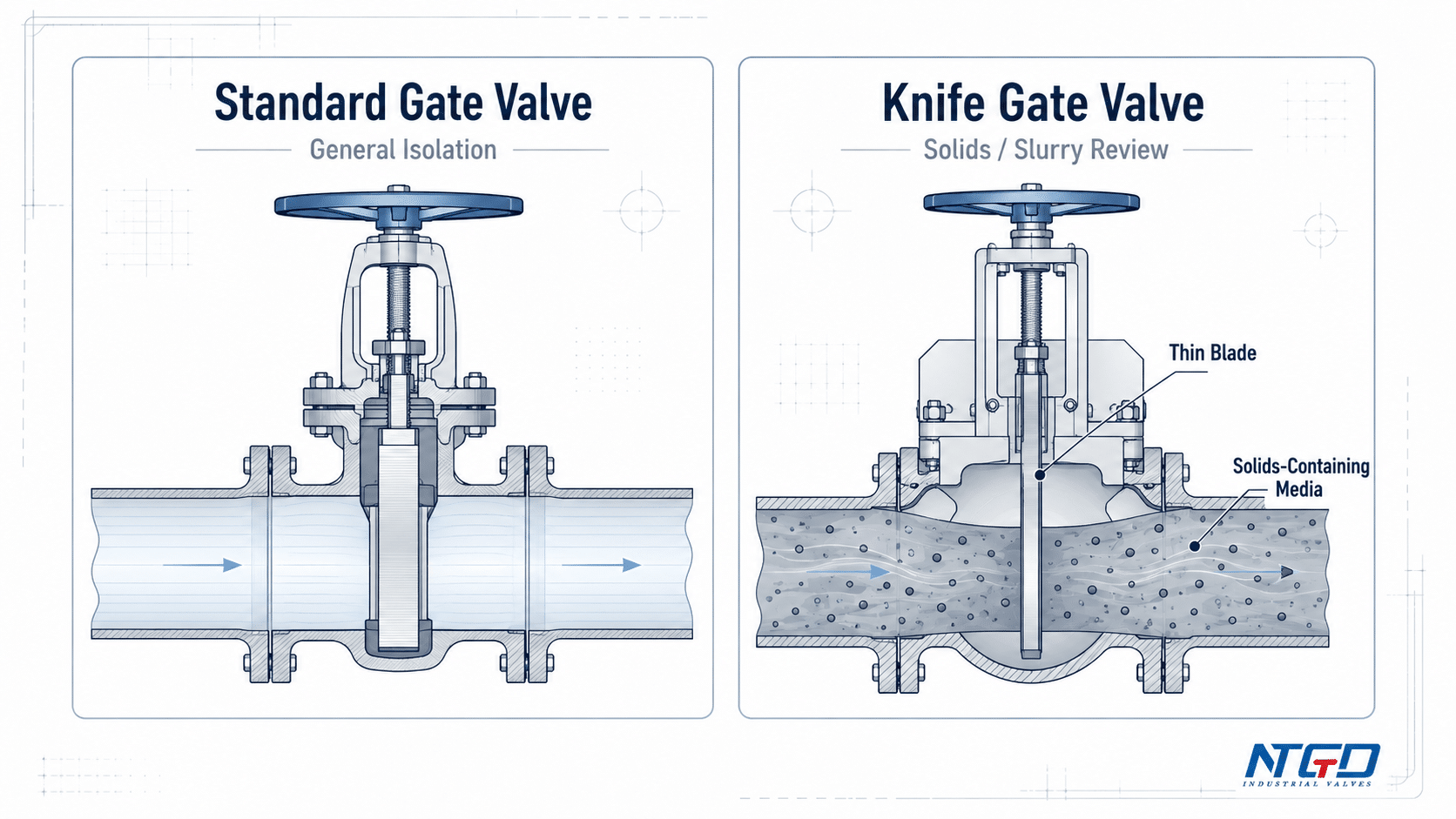
The main boundary is that “solids service” is not one single condition. Solids size, abrasiveness, pressure, temperature, seat design, and body style must still be checked. Detailed knife gate valve types, slurry service limits, and seat options should be reviewed in a dedicated knife gate valve page.
For detailed construction, classification, and solids-service notes, use NTGD’s knife valve page as the next technical reference.
Special Gate Valve Designs
Some gate valves are classified by special service features rather than by the basic gate shape. Examples include pressure seal gate valves, bellow sealed gate valves, bypass gate valves, cryogenic gate valves, and high-temperature or high-pressure service designs.
These are important in procurement, but they should not be mixed with the main gate design families without explanation. For example, a pressure seal bonnet describes a pressure-containing construction feature. A bellow sealed design addresses leakage control around the stem area. These features can be combined with other gate valve design types depending on the project requirement.
Special designs usually require application-specific review. They should be considered after the media, pressure, temperature, leakage requirement, operation method, and project standard are known.

Gate Valve Type Comparison Table
| Gate Valve Type | Design Logic | Typical Service | Selection Cue | Scope Warning | Product / Internal Bridge Direction |
|---|---|---|---|---|---|
| Wedge gate valve | Wedge-shaped gate seats between inclined seats | General isolation, water, steam, industrial process lines | Common starting point for many clean or moderate services | Do not assume all wedge subtypes behave the same under heat, solids, or seat alignment issues | Wedge gate valve article; wedge subtype product or technical pages |
| Parallel slide gate valve | Parallel-faced discs seal with spring preload and line pressure | Steam, feedwater, high-pressure / high-temperature isolation | Consider when non-wedging behavior and thermal movement matter | Do not turn this overview into a parallel slide product or power-plant service guide | Parallel slide product / technical page; power-service article if available |
| Slab / through conduit gate valve | Full-bore, straight-through pipeline design | Oil and gas pipelines, terminals, pigging service | Consider when full-bore passage and low restriction are important | Do not expand into API 6D, DBB, DIB, or pipeline catalog details here | Through conduit / slab gate valve product page |
| Knife gate valve | Thin blade-like gate for solids-containing media | Slurry, pulp, mining, wastewater, solids service | Consider when the media contains solids or thick slurry | Do not treat all slurry services as identical; pressure and seat design still matter | Knife gate valve product or slurry-service application page |
| Pressure seal / special service gate valve | Construction feature for demanding pressure, temperature, or leakage requirements | Power, high-pressure, emission-sensitive, or special process service | Consider after confirming pressure, temperature, leakage, and standard requirements | Do not make special service features the main type structure | Special service product page; standard or specification support page |
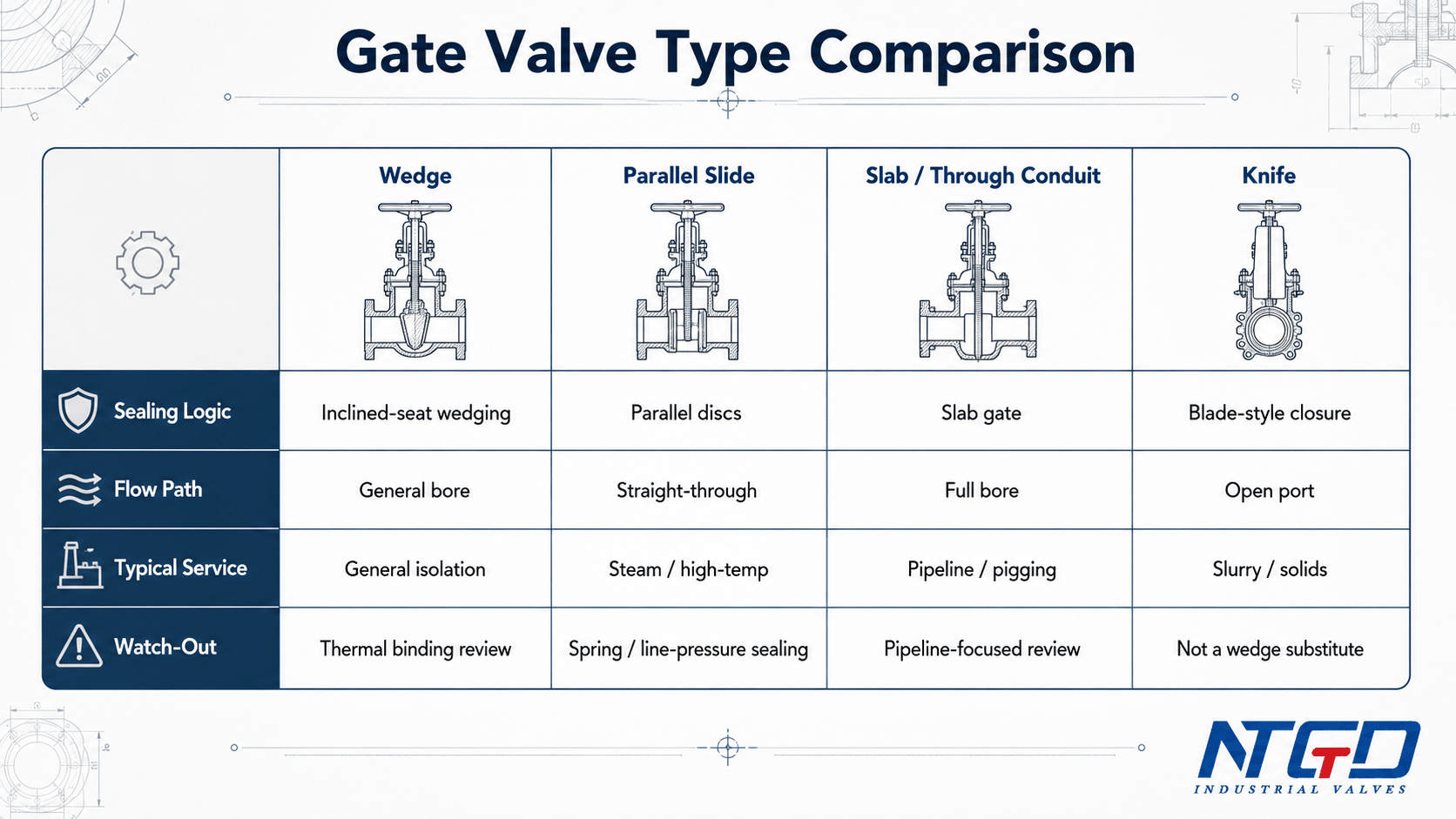
This table should be used as a starting point, not as the final specification. The application mapping below helps narrow the likely direction, while the RFQ checklist confirms the details needed before quotation.
Secondary Classifications: Stem, Seat and Operation
Rising Stem vs Non-Rising Stem Gate Valves
A rising stem gate valve has a stem that moves upward as the valve opens. This gives a clear visual indication of valve position, which can be useful in many industrial installations. However, it requires enough vertical space above the valve.
A non-rising stem gate valve keeps the stem height more compact during operation. This can be useful where vertical clearance is limited, such as underground lines or confined spaces. The trade-off is that valve position may not be as visually obvious without other indicators.
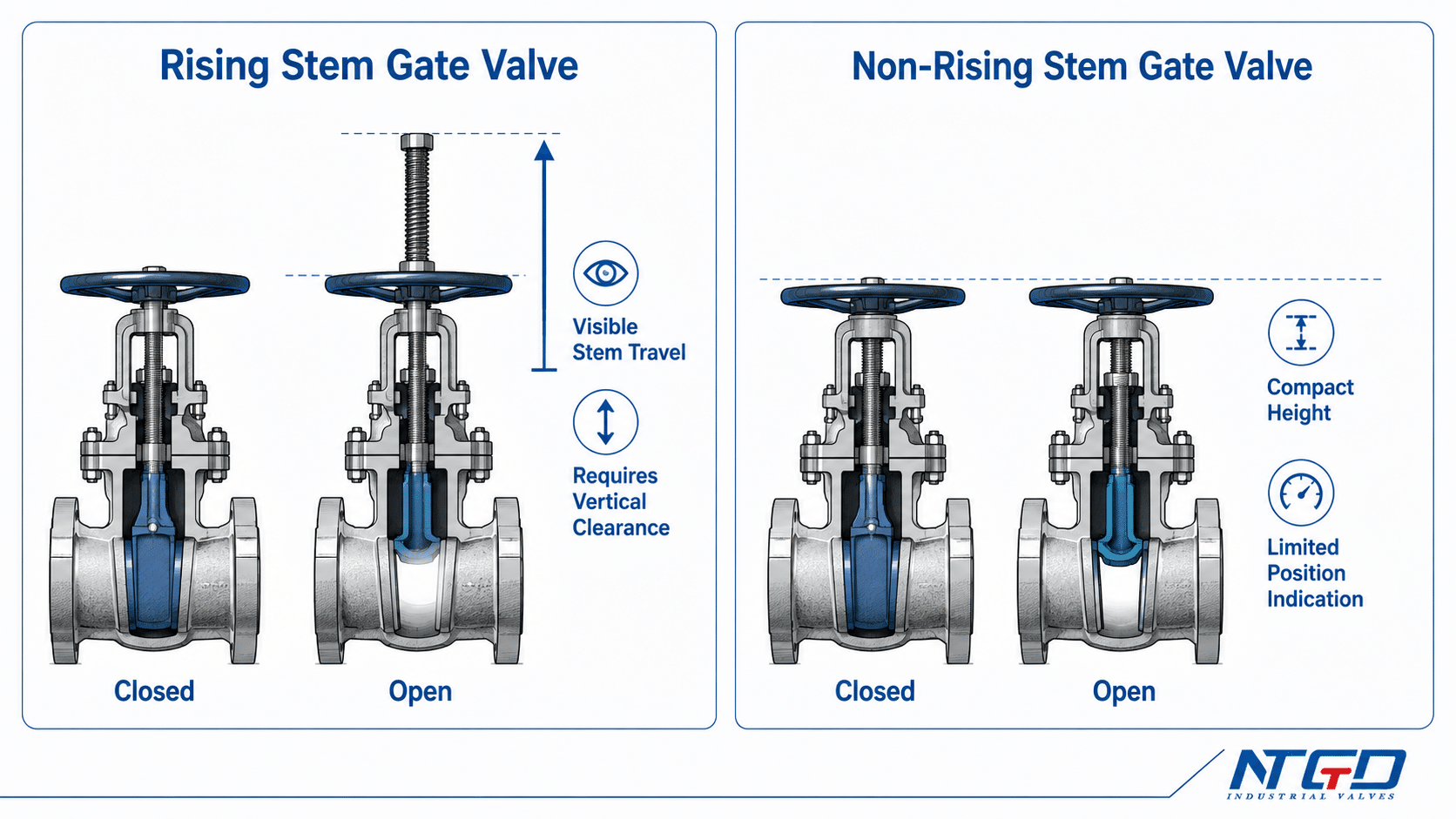
Stem movement is important, but it is a supporting classification. Using a rising stem design where vertical clearance is limited may create installation or operation problems. Using a non-rising stem design in a location where operators need obvious position indication may increase the risk of misreading valve status.
For a deeper fit-check on clearance, position indication, and maintenance access, see NTGD’s rising stem vs non-rising stem gate valves comparison.
Metal Seated vs Resilient Seated Gate Valves
Seat design also affects gate valve selection. Metal seated gate valves are often considered where temperature, pressure, or media conditions require metallic sealing surfaces. Resilient seated gate valves use an elastomer or softer sealing element and are common in many water and wastewater applications.
The correct choice depends on media cleanliness, temperature, leakage expectation, pressure, corrosion risk, and applicable standards. A resilient seated gate valve may not be suitable for high-temperature service. A metal seated gate valve may require different leakage expectations and operating conditions.
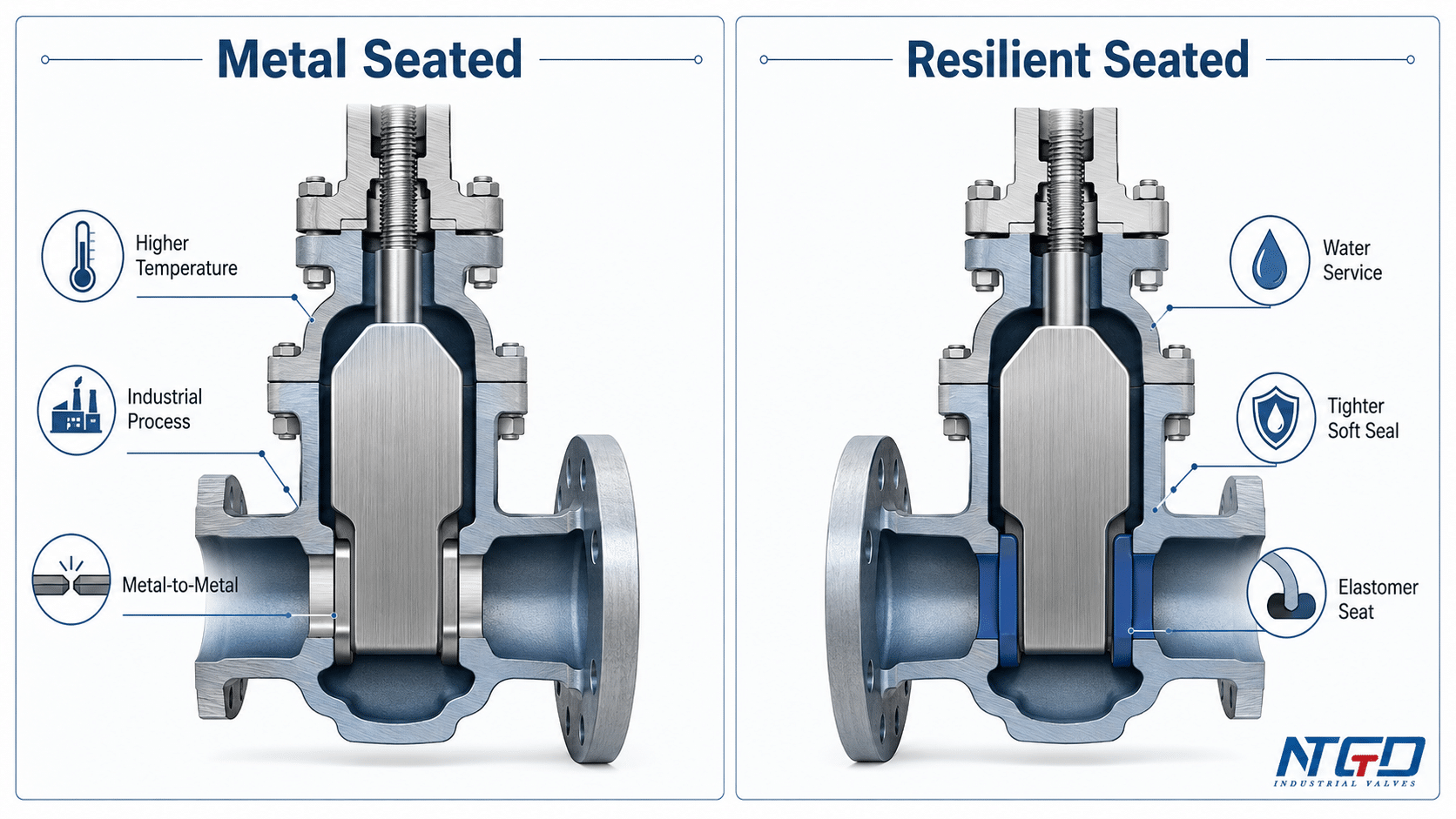
Seat type should be discussed as a selection layer, not as the only way to define gate valve types. Choosing the wrong seat design may lead to premature seat wear, leakage that does not meet the project expectation, or material incompatibility with the service medium.
For seat-route selection, NTGD’s resilient seated vs metal seated gate valves guide gives a more focused comparison.
Manual, Gear, Electric and Pneumatic Operation
Operation method is another specification layer. Gate valves may be operated by handwheel, gearbox, electric actuator, pneumatic actuator, or hydraulic actuator depending on valve size, torque, automation requirement, and plant control philosophy.
However, actuation does not usually define the basic gate valve type. An electric gate valve can still be a wedge gate valve, parallel slide gate valve, or another design. For RFQ preparation, operation method should be confirmed after the basic valve type and service conditions are clear.
If the operation method is selected too early, the project may underestimate torque, automation requirements, space limitations, or control-system integration. This is why valve type, service conditions, and operating method should be reviewed together.
Gate Valve Types and Applications
The best gate valve type depends on the application. A good application mapping does not simply list industries. It connects the service condition to the valve design logic.
| Application / Service | Starting Gate Valve Type to Consider | Why It May Fit | Key Verification Point | Wrong-Choice Risk |
|---|---|---|---|---|
| Water / wastewater | Wedge or resilient seated gate valve; knife gate for solids | Common isolation service; resilient seats may suit clean water; knife design may suit solids | Media cleanliness, solids content, seat material, buried or above-ground installation | Poor seat fit or solids accumulation may reduce shutoff reliability |
| Steam / power | Parallel slide, pressure seal, suitable wedge design | High temperature and thermal movement can affect sealing and operating torque | Temperature, pressure class, bonnet design, thermal binding risk | Wrong design may increase torque or binding risk under thermal cycling |
| Oil and gas pipeline | Slab / through conduit gate valve | Full-bore flow and pigging access may be required | API / project standard, pigging requirement, pressure class, seat arrangement | Non-full-bore design may interfere with pigging or pipeline flow requirements |
| Slurry / mining / pulp | Knife gate valve or other solids-service design | Thin gate design may handle suspended solids better than standard wedge designs | Solids size, abrasiveness, pressure, seat and body design | Standard seats may wear, clog, or fail to close completely |
| Chemical / industrial process | Wedge, metal seated, bellow sealed or special design | Depends on corrosion, leakage, temperature, and isolation requirement | Material compatibility, leakage class, packing / stem sealing, standard | Wrong material or sealing design may create leakage or compatibility problems |
| Space-limited installation | Non-rising stem gate valve as a stem option | Compact vertical movement can help in limited spaces | Position indication, maintenance access, buried service requirement | Wrong stem design may cause clearance or operation problems |
| High-pressure / high-temperature service | Parallel slide, pressure seal, suitable metal seated design | Service may require special sealing and bonnet construction | Pressure-temperature rating, material, standard, operation torque | Incorrect construction may affect shutoff stability and maintainability |
| Solids or abrasive media | Knife gate or special solids-service design | Standard gate valves may suffer from seat damage or incomplete closure | Abrasion, particle size, shutoff expectation, maintenance access | Seat damage and incomplete closure may occur if solids are ignored |

Water and Wastewater Systems
Water and wastewater systems often use gate valves for isolation, section shutdown, maintenance, and line control. In clean water service, wedge or resilient seated gate valves are common starting points. In wastewater or solids-containing service, a knife gate valve or another solids-service design may be more appropriate.
Selection should not be based only on the word “water.” The media condition matters. Clean water, raw water, wastewater, sludge, and slurry can require different seat materials, body designs, and maintenance expectations. Before selection, confirm whether the service is clean, contains suspended solids, is buried, or requires a specific leakage expectation.
Steam and Power Service
Steam and power service can create temperature-related challenges. High temperature and thermal cycling may affect wedge seating, operating torque, and sealing stability. In these duties, parallel slide gate valves, pressure seal gate valves, or carefully selected wedge designs may be considered.
The final choice depends on temperature, pressure, cycling frequency, shutoff expectation, and plant standard. If thermal movement is ignored, the selected valve may become harder to operate or may not maintain the intended shutoff performance over repeated cycles.
Oil and Gas Pipeline Service
Oil and gas transmission lines often require low restriction, full-bore flow, and pigging access. In these cases, slab or through conduit gate valves are commonly considered. Their design is different from a standard wedge gate valve because the pipeline flow path and open-bore condition are central to the application.
For these services, the buyer should verify project standards, pressure class, end connection, seat arrangement, fire-safe requirements, and whether pigging is required. A valve that works for ordinary isolation may not meet the flow-path or pigging requirements of a pipeline system.
Slurry, Mining, Pulp and Solids-Containing Media
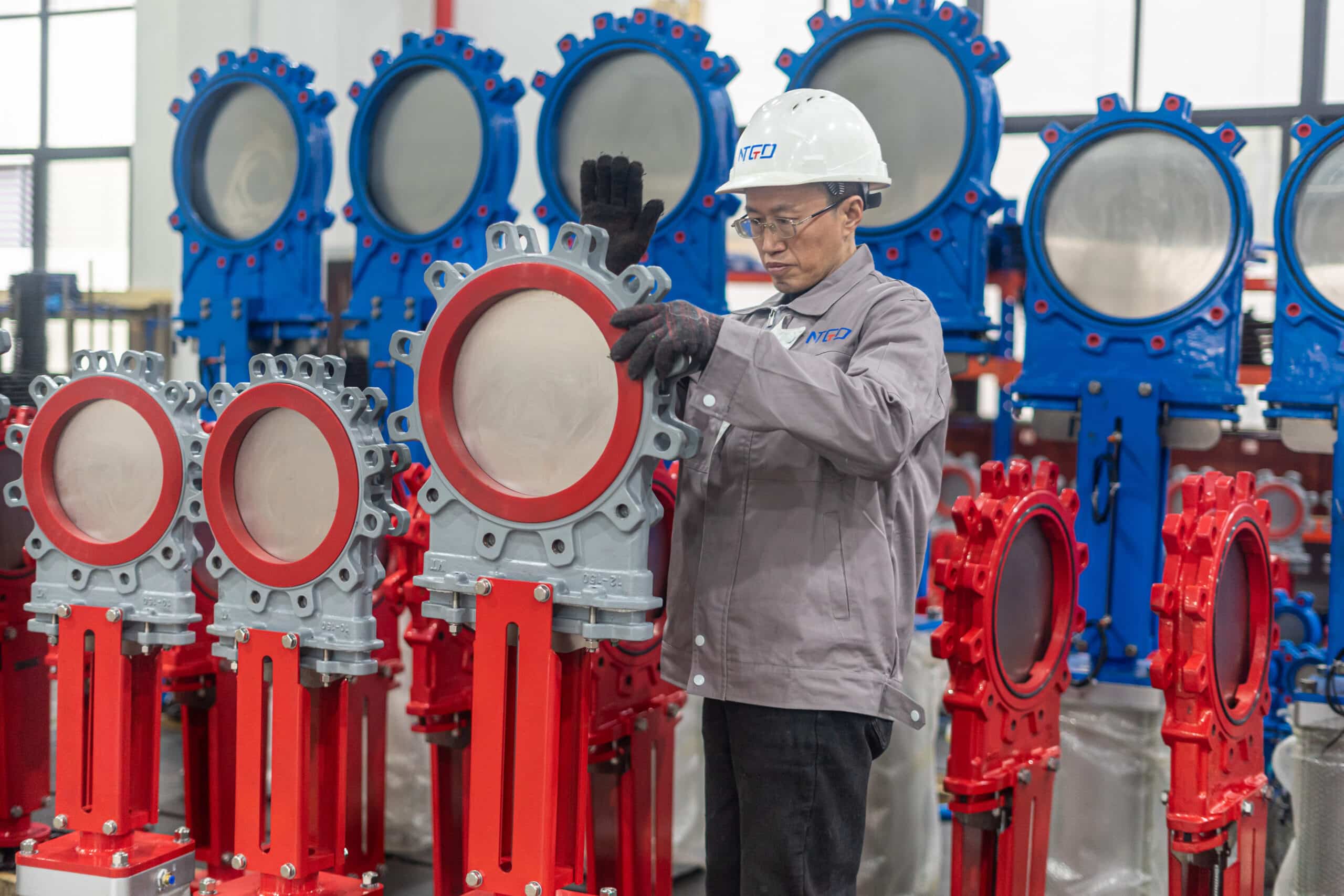
Slurry and solids-containing media can create problems for ordinary gate valves. Solids may collect near the seat area, damage sealing surfaces, or prevent complete closure. Knife gate valves are often considered for pulp, mining, wastewater, and slurry applications because the gate design is better suited to some solids-containing services.
However, not every knife gate valve is suitable for every slurry. The buyer must verify pressure, temperature, solids size, abrasiveness, seat design, body style, and maintenance access. If these details are not checked, the valve may close poorly, leak, or require maintenance sooner than expected.
For slurry and pulp-specific service logic, review NTGD’s guide to knife gate valves for slurry and pulp applications.
Chemical and General Industrial Process Lines
Chemical and general process lines can use several gate valve types depending on the media. A wedge gate valve may be suitable for general isolation. A metal seated design may be required for high temperature or more demanding service. A bellow sealed gate valve may be considered where stem leakage control is important.
The key is to match the valve design to the fluid, temperature, corrosion risk, leakage expectation, and operating frequency, rather than selecting only by valve name. Material compatibility and sealing method should be verified before the valve type is finalized.
Common Selection Mistakes When Choosing Gate Valve Types
Using a gate valve for throttling
Gate valves are normally selected for on/off isolation. They are not usually recommended for continuous throttling or precise flow control. When a gate valve is partially open, high-velocity flow may concentrate near the gate and seat area. This can increase erosion, vibration, noise, and unstable shutoff behavior.
The practical result is not only poor control. Over time, seat and gate wear may reduce shutoff reliability, increase leakage risk, and make future operation less predictable. If throttling is required, another valve type should be reviewed instead of assuming that a gate valve can perform as a control valve.
Selecting wedge design without checking thermal binding risk
Wedge gate valves are common and reliable in many services, but high temperature and thermal cycling can create additional design concerns. In some applications, thermal movement may increase operating torque or create binding risk. This is one reason flexible wedge, split wedge, or parallel slide designs may be considered in certain services.
The lesson is not that wedge gate valves are unsuitable. The lesson is that wedge subtype, temperature, pressure, and operating conditions must be reviewed together. If the service involves repeated thermal cycling, the buyer should confirm whether a standard wedge design is enough or whether a different design should be considered.
Using standard gate valves in slurry or solids service
A standard wedge gate valve may not be the best starting point for slurry or solids-containing media. Solids can settle, collect, or damage sealing surfaces. Incomplete closure and seat wear may become serious issues if the valve is not designed for the media.
For pulp, mining, wastewater, or slurry service, knife gate valves or other solids-service designs should be reviewed instead of assuming a general gate valve will perform correctly. The selection should consider particle size, abrasion, pressure, seat style, body design, and maintenance access.
Treating pigging service like a normal isolation line
Pipeline pigging service requires attention to the internal bore and flow path. A standard gate valve may not provide the full-bore passage needed for pigging. Through conduit or slab gate valves are often considered when straight-through passage and pigging access are part of the pipeline requirement.
This is a product-specific decision. It should be confirmed with project standards, drawings, and datasheets before final selection. If the pigging requirement is missed during RFQ, the selected valve may meet general shutoff needs but fail the pipeline flow-path requirement.
Final Gate Valve Type Selection Checklist Before RFQ
Before sending an RFQ, confirm the service data as completely as possible. Clear information helps avoid wrong valve type selection, unclear quotation, repeated technical clarification, and specification revisions after the project has already moved forward.
For a broader project-level selection process, use NTGD’s guide on how to choose the right gate valve for your industrial application.
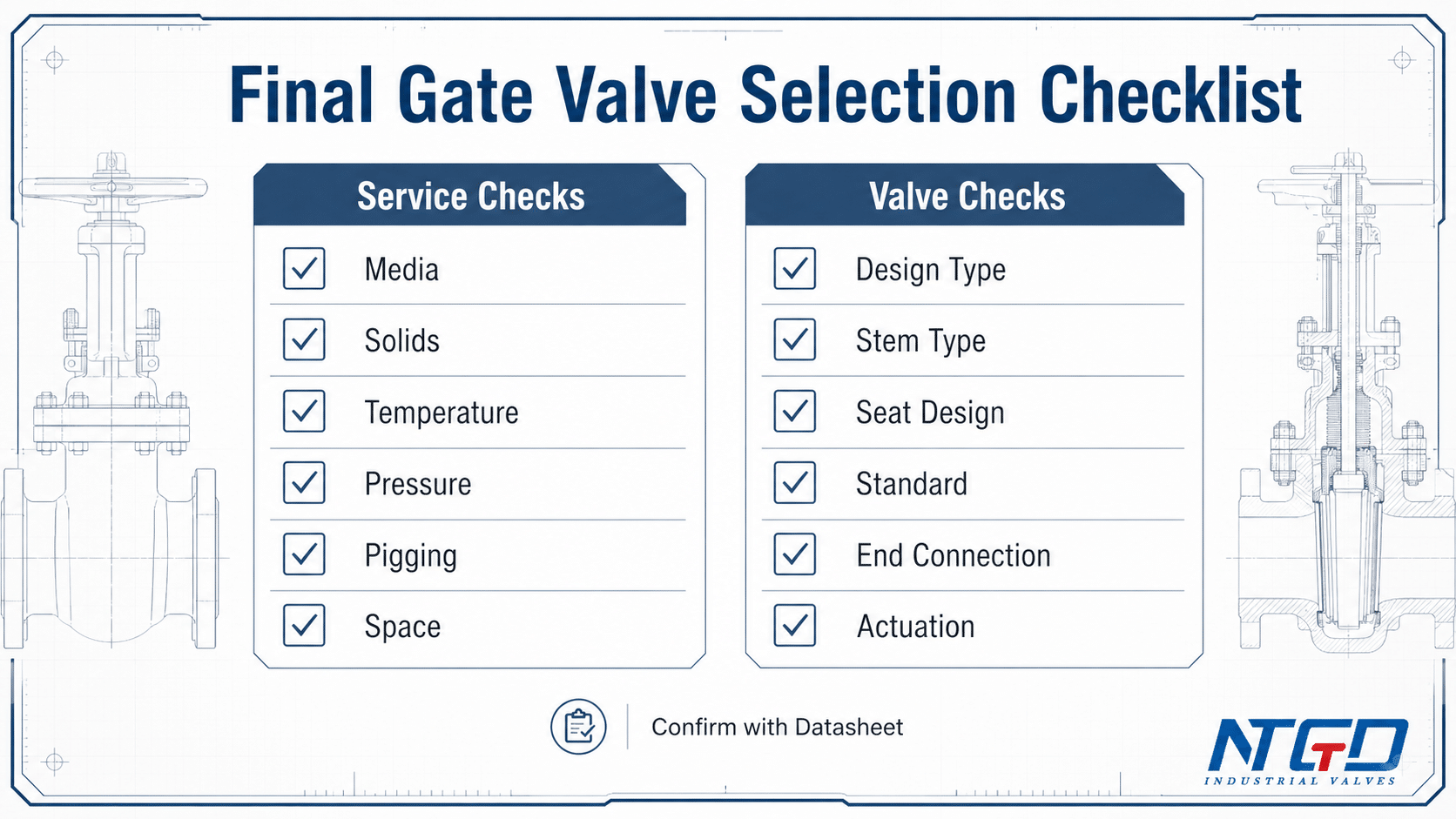
| Checklist Item | What to Confirm | Why It Matters |
|---|---|---|
| Valve type | Wedge, parallel slide, through conduit, knife, special design | Defines the starting design family and avoids mixing product intents |
| Media | Water, steam, oil, gas, slurry, chemical, wastewater | Controls seat, material, sealing method, and service suitability |
| Solids content | Clean, suspended solids, abrasive particles, pulp, sludge | Helps identify whether knife or other solids-service designs should be reviewed |
| Pressure class | Required pressure rating or project class | Controls body, bonnet, seat design, and documentation expectations |
| Temperature | Normal and maximum operating temperature | Affects seat material, thermal binding risk, bonnet design, and construction review |
| Pipeline size | Nominal size and flow condition | Affects torque, operation method, weight, and installation planning |
| End connection | Flanged, butt-weld, threaded, wafer or other | Must match pipeline specification and installation practice |
| Seat type | Metal seated, resilient seated, special sealing | Controls shutoff expectation, temperature range, and media compatibility |
| Stem design | Rising stem or non-rising stem | Affects space, position indication, buried service, and maintenance access |
| Operation | Manual, gear, electric, pneumatic, hydraulic | Must match torque, automation requirement, and control philosophy |
| Applicable standard | API, ASME, EN, project specification, or customer standard | Affects inspection, documentation, project approval, and acceptance criteria |
| Required documents | Drawing, datasheet, material certificate, test report, inspection plan | Reduces RFQ ambiguity and supports technical approval |
If the RFQ must reference API requirements, NTGD’s API standards for gate valves guide can help separate API 600, API 6D, and API 598 discussion before final documentation review.
For an official standard reference, the API Standard 600 preview shows that API 600 covers heavy-duty bolted-bonnet steel gate valves with features such as outside screw and yoke, rising stems, wedge or parallel seating, metallic seating surfaces, and flanged or butt-welding ends.
A clear RFQ should not only say “gate valve.” It should describe the intended service, operating conditions, and required design features.
FAQ About Gate Valve Types
What are the different types of gate valves?
The main design-based types include wedge gate valves, parallel slide gate valves, slab or through conduit gate valves, knife gate valves, and special service gate valves. Gate valves can also be classified by stem movement, seat design, service condition, and project standard.
What are the two common types of gate valves?
The two broad design families often discussed are wedge gate valves and parallel gate valves. However, this is only one classification method. Gate valves can also be classified by stem movement, seat design, service condition, and specification requirements.
How many types of gate valves are there?
There is no single universal number. For initial industrial selection, buyers usually start with four main design families: wedge, parallel slide, slab or through conduit, and knife gate valves. After that, stem type, seat design, pressure service, material, actuator, and standard requirements narrow the final choice.
Is a knife gate valve a type of gate valve?
Yes. A knife gate valve is a special gate valve type designed for certain solids-containing or slurry services. It uses a thin gate or blade-like closure. However, it should not be treated as interchangeable with a standard wedge gate valve.
What is the difference between wedge and parallel gate valves?
A wedge gate valve uses a wedge-shaped gate that seats between inclined surfaces. A parallel slide gate valve uses parallel-faced discs and does not rely mainly on wedge action. This difference affects sealing logic, operating torque, and suitability for some high-temperature or high-pressure services.
Which gate valve type is used for slurry?
Slurry service often points toward a knife gate valve or another solids-service design. The final selection depends on solids size, abrasiveness, pressure, temperature, seat design, and shutoff expectation. A standard wedge gate valve should not be selected for slurry service without review.
Which gate valve type is used for pipeline pigging?
Pipeline pigging service often requires a full-bore valve design. Slab or through conduit gate valves are commonly considered because they can provide a straight-through flow path when fully open. The final selection must be confirmed with the pipeline standard, pigging requirement, and valve datasheet.
Are gate valves suitable for throttling?
Gate valves are generally not recommended for continuous throttling or precise flow regulation. They are mainly used for fully open or fully closed isolation. Partial opening may expose the gate and seat to high-velocity flow, which can cause seat wear, vibration, leakage risk, and unstable shutoff.
Conclusion
Understanding gate valve types is not only about memorizing names. It is about knowing which classification layer matters for the service: gate design, stem movement, seat type, application, or project specification.
For most industrial buyers, the practical path is:
- identify the main service condition;
- choose the starting gate valve design family;
- compare sealing logic and flow-path requirements;
- verify pressure, temperature, media, seat, stem, operation and standard;
- confirm the final selection with drawings and datasheets.
A wedge gate valve may be a common starting point for general isolation. A parallel slide gate valve may be considered for high-temperature or high-pressure isolation. A through conduit gate valve may be required for full-bore pipeline service. A knife gate valve may be more suitable for slurry or solids-containing media.
The comparison table and RFQ checklist above can help narrow the starting choice. Final selection should still be checked against real service data, project standards, drawings, and datasheets.
Need Help Matching a Gate Valve Type to Your Service?
If you are not sure which gate valve type fits your pipeline, NTGD can review the service conditions and help narrow the starting valve type before quotation. Useful information includes media, pressure, temperature, pipeline size, solids content, required standard, seat type, stem design, operation method, and any drawing or datasheet requirement. This helps reduce specification ambiguity before detailed RFQ review.
