
Nome do autor: Bruce Zheng
Função do autor: Cofundador e engenheiro de válvulas da NTGD Valve
Biografia do autor: Bruce Zheng é cofundador e engenheiro de válvulas da NTGD Valve, com foco na seleção de válvulas industriais, aplicação e conteúdo técnico para compradores B2B globais.
Última atualização: 25 de junho de 2026
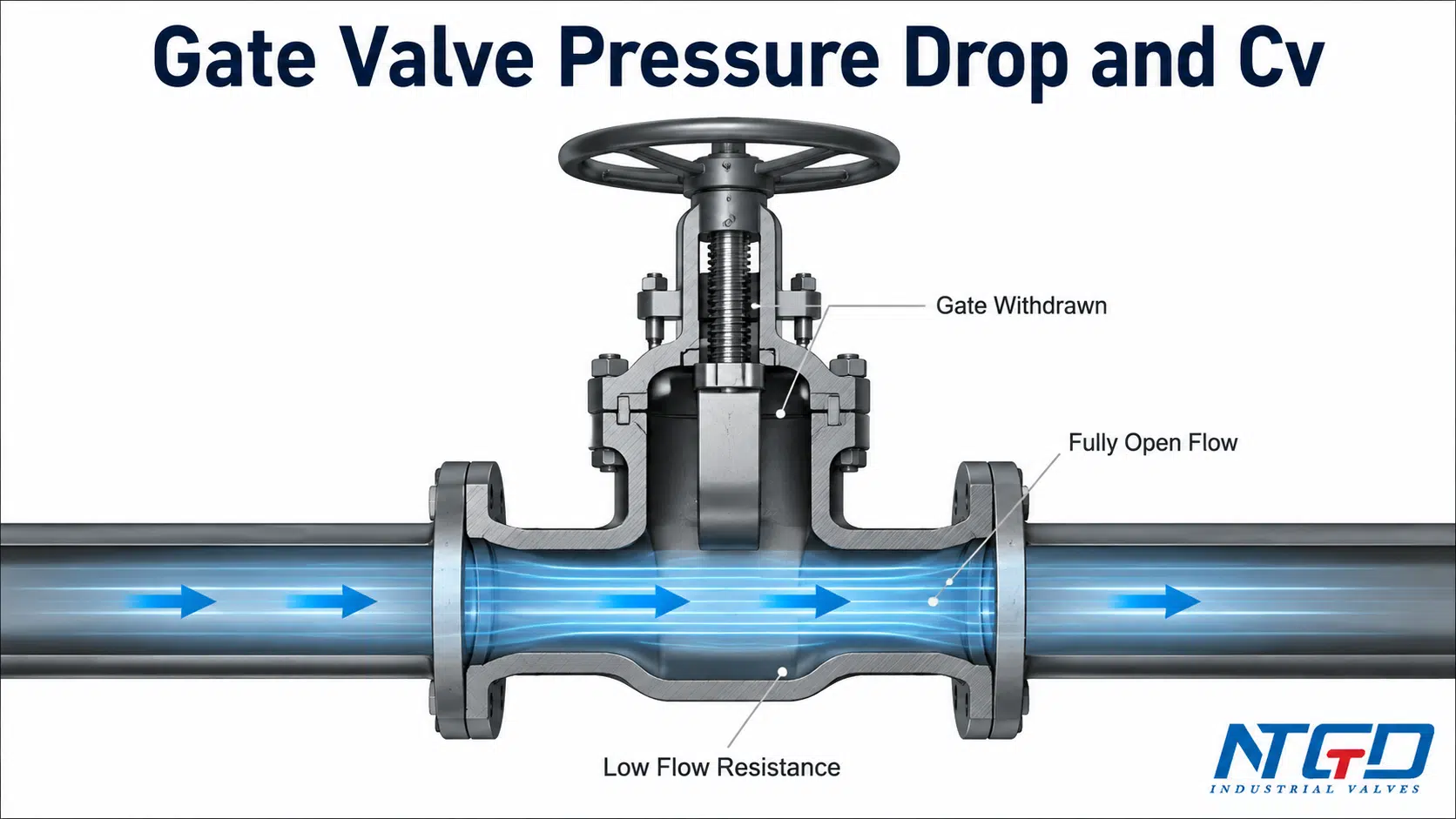
A gate valve usually has low pressure drop when it is fully open, correctly sized and used for isolation service. In a fully open gate valve, the gate or wedge is lifted out of the main flow path, so the fluid can pass through a relatively straight bore with limited obstruction.
That does not mean the pressure drop is always zero. Actual gate valve pressure drop depends on flow rate, bore design, fluid properties, valve size, pressure class, body geometry, installation conditions and the manufacturer’s Cv or Kv data. The low-pressure-drop advantage is most valuable in fully open isolation service; using a partially open gate valve to reduce pressure can create turbulence, seat erosion, vibration and unstable pressure loss instead of reliable control.
For industrial pipeline selection, the key point is simple: a gate valve is normally selected for open / close isolation where low flow resistance is required. It should not be selected as a stable throttling valve or pressure regulator. If a project requires controlled pressure reduction, flow regulation or accurate throttling, the valve type and sizing method must be reviewed separately.
This guide explains how gate valve pressure drop, gate valve Cv, pressure loss and flow resistance work together in industrial pipeline service.
What Is Gate Valve Pressure Drop?
Gate valve pressure drop is the pressure difference between the upstream side and downstream side of the valve while fluid is flowing through it. In simple terms:
Pressure drop = inlet pressure – outlet pressure
In engineering discussions, several related terms may appear together: pressure drop, pressure loss and flow resistance. They are connected, but they describe the problem from slightly different angles.
| Prazo | Significado | How It Applies to Gate Valves |
|---|---|---|
| Queda de pressão | The pressure difference between P1 and P2 across the valve | Used to evaluate how much pressure is lost through the valve |
| Perda de pressão | The energy loss caused by flow through the valve and system | Usually low for a fully open, full-bore gate valve |
| Resistência ao fluxo | The restriction or obstruction that causes pressure loss | Depends on bore size, valve opening, flow rate, fluid properties and valve design |
For a gate valve, the most important condition is the valve position. A fully open gate valve can offer a low-resistance path. A partially open gate valve can create a much higher and less stable pressure drop because the gate remains in the flow path.
Why Fully Open Gate Valves Usually Have Low Pressure Drop
A gate valve creates low pressure drop in fully open service primarily because its internal closure element is withdrawn from the flow path. In a wedge gate valve, for example, the wedge moves upward when the valve opens. When the valve is fully open, the main bore is much less obstructed than it would be in a throttling valve.
For a deeper explanation of how the closing element moves and opens the flow path, see NTGD’s gate valve working principle guide.
Full-Bore Flow Path and Gate Withdrawn from the Flow
A full-bore or near full-bore gate valve allows the fluid to pass through a relatively straight passage. The media does not need to make a sharp turn through a seat and disc arrangement as it would in many globe valve designs.
This is why gate valves are commonly used in pipelines where the main duty is:
- full open flow;
- full close isolation;
- low pressure loss in normal operation;
- bidirectional or near bidirectional service, depending on valve design and specification;
- large-diameter pipeline isolation.
The low-resistance advantage becomes more important in large-flow pipelines, long pipe runs and pump-energy-sensitive systems, where unnecessary pressure loss can affect system efficiency. If the project has a strict allowable pressure drop or critical operating condition, the actual bore geometry, seat and wedge area, body design and manufacturer Cv/Kv data should be confirmed before final selection.
For wedge-specific details, the wedge gate valve structure guide explains how the wedge, seats, stem and body work together in isolation service.
The pressure drop is still affected by the actual valve design. A cast steel gate valve, forged gate valve, pressure seal gate valve or special service design may have different internal geometry. The actual Cv/Kv should therefore be confirmed from the manufacturer’s data when pressure loss is important.
Why “Fully Open” Matters
A frase totalmente aberto is not a small detail. It defines the service condition under which gate valves normally provide low flow resistance.
When a gate valve is only partly open, the gate or wedge remains in the fluid path. The available flow area is reduced, velocity can increase through the restricted opening and turbulence can develop around the wedge and seat area. That can increase pressure drop and may also create vibration, noise or sealing surface wear.
For this reason, gate valve pressure drop should normally be evaluated for fully open isolation service, not for long-term throttling.
Pressure Drop Across a Gate Valve: P1, P2 and ΔP
Pressure drop across a gate valve is usually expressed as the difference between upstream pressure and downstream pressure.
- P1 = inlet pressure before the valve.
- P2 = outlet pressure after the valve.
- ΔP = P1 – P2.
If P1 is higher than P2 while the fluid is flowing, the difference is the pressure drop across the valve.
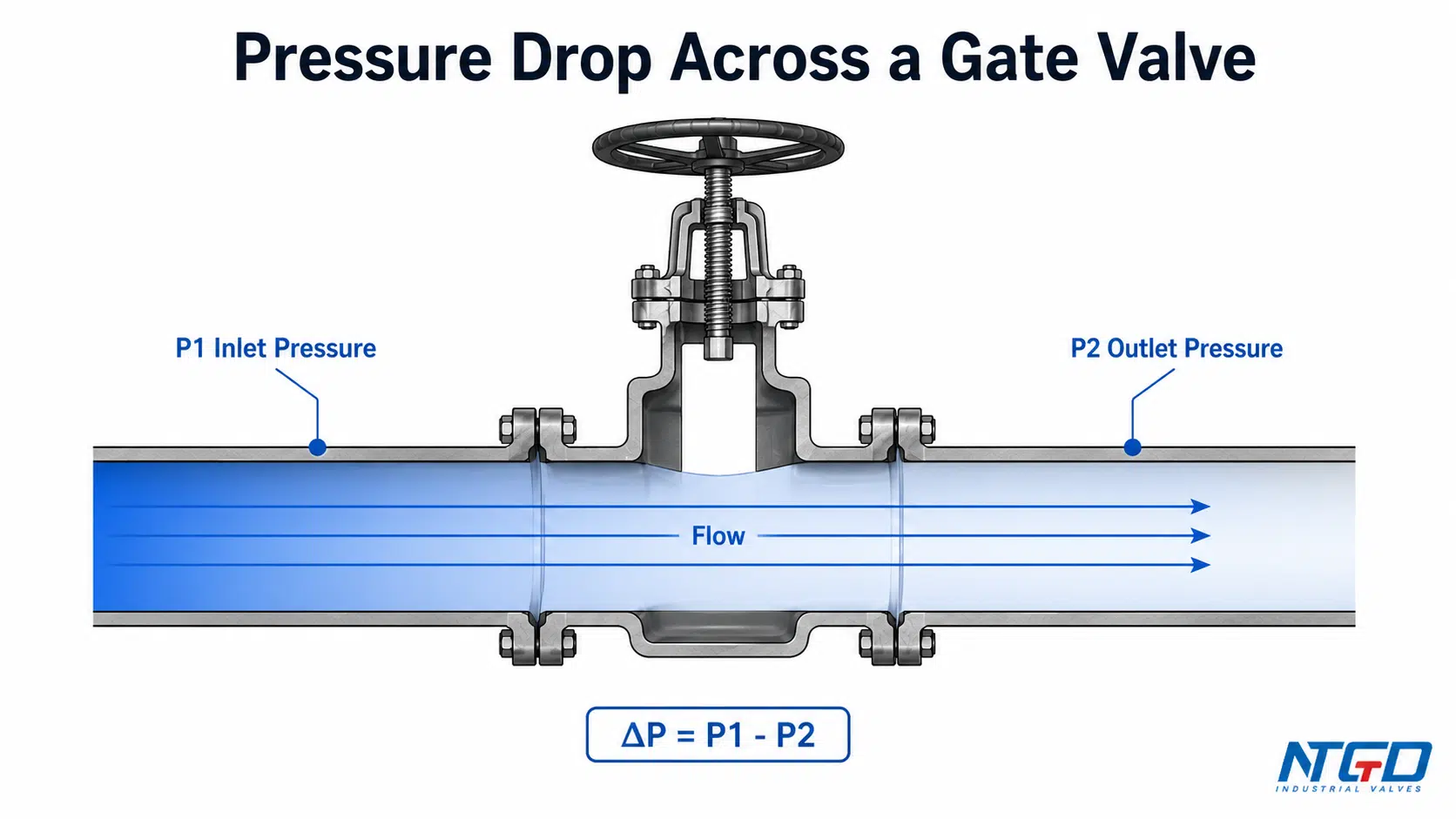
How to Read Inlet Pressure, Outlet Pressure and ΔP
A gate valve does not “consume” pressure by itself in a static system. Pressure drop is meaningful when there is flow. In a flowing pipeline, fluid loses energy as it passes through pipes, valves, elbows, reducers, strainers and other restrictions. The valve is one part of the total system loss.
A simplified reading is:
| Measurement Point | Significado | Por que é importante |
|---|---|---|
| P1 | Pressure upstream of the gate valve | Shows available pressure before the valve |
| P2 | Pressure downstream of the gate valve | Shows remaining pressure after the valve |
| ΔP | P1 – P2 | Shows the pressure loss across the valve |
If there is no flow, the pressure difference across a fully open gate valve may not represent operating pressure loss. This is why a gate valve should not be misunderstood as a pressure regulator. It can create pressure drop when flow passes through resistance, but it does not provide stable pressure control.
What Data Is Needed Before Estimating ΔP?
Before estimating pressure drop across a gate valve, the project should confirm the operating data. At minimum, the review normally needs:
- taxa de fluxo;
- médio;
- density or specific gravity;
- temperatura;
- tamanho da válvula;
- Tipo de furo;
- classe de pressão;
- manufacturer Cv/Kv or resistance coefficient;
- inlet pressure and outlet pressure requirement;
- queda de pressão permitida;
- installation condition and nearby fittings.
Without this data, any pressure drop value is only a rough estimate.
Gate Valve Cv and Pressure Drop Relationship
Gate valve Cv is a key value for estimating how much flow a valve can pass under a defined pressure drop. In valve selection, Cv connects flow rate, pressure drop and fluid properties.
What Is Cv in a Gate Valve?
Cv is the valve flow coefficient. For liquid service, it represents the valve’s flow capacity under a specified pressure drop condition. A higher Cv generally means the valve can pass more flow with less pressure drop under comparable conditions.
For a gate valve, Cv is usually most meaningful in the fully open position. That is because gate valves are normally selected for isolation service, not for modulating control across many opening positions.
However, gate valve Cv is not a universal number. It depends on:
- tamanho da válvula;
- bore design;
- classe de pressão;
- padrão corporal;
- wedge and seat geometry;
- conexão final;
- projeto do fabricante;
- actual tested or published flow data.
A generic Cv chart may help during early estimation, but final selection should use manufacturer Cv/Kv data for the actual valve design.
Light Formula: Cv, Flow Rate, Specific Gravity and ΔP
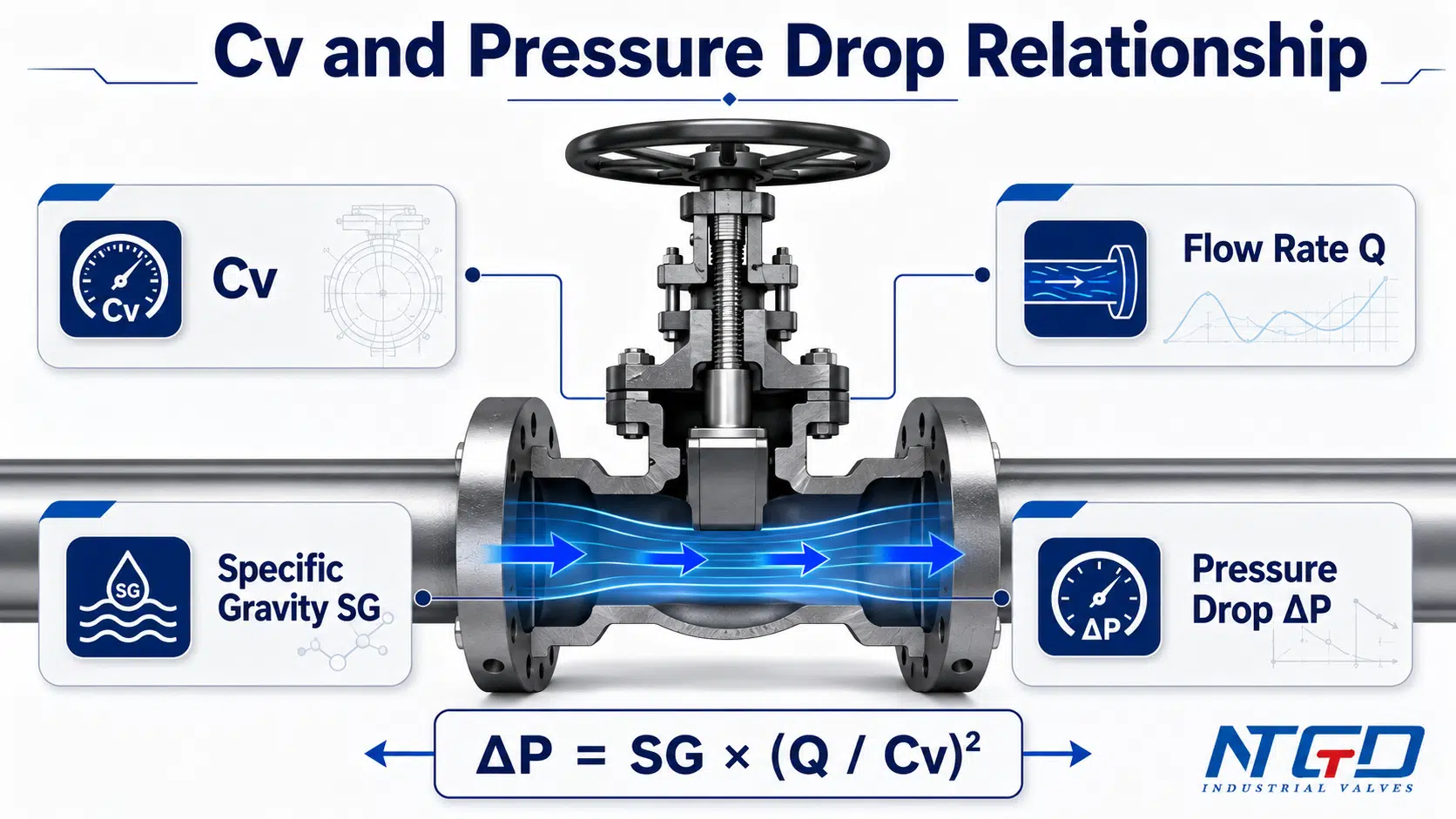
For liquid service, the Cv relationship is often expressed as:
Q = Cv × √(ΔP / SG)
The same relationship can be rearranged as:
ΔP = SG × (Q / Cv)²
Onde:
| Símbolo | Significado |
|---|---|
| Q | Taxa de fluxo |
| Cv | Coeficiente de fluxo da válvula |
| ΔP | Pressure drop across the valve |
| SG | Specific gravity of the liquid |
For formula support, Engineering ToolBox defines Cv for liquids using water flow at 60°F with a 1 psi pressure drop and expresses the relationship between flow, specific gravity and pressure drop in its flow coefficient Cv reference.
This relationship is useful for understanding the logic in liquid or incompressible service:
- higher flow rate increases pressure drop;
- higher specific gravity increases pressure drop;
- higher Cv reduces pressure drop under comparable liquid service;
- wrong Cv input leads to wrong pressure drop estimates.
This formula should not be treated as a complete sizing method for every fluid. Gas and steam are compressible, and services involving flashing, cavitation, choked flow, high viscosity fluids or critical operating conditions require more detailed calculation methods and project-specific review. Using the wrong Cv input can affect pump selection, energy review, allowable pressure drop checks and overall system performance.
Why Manufacturer Cv/Kv Data Matters
Gate valve Cv values vary by design. Even two valves with the same nominal size and pressure class may not have exactly the same flow coefficient. Internal bore, wedge design, seat arrangement and body geometry can change the actual flow capacity.
| Cv Data Source | Caso de uso | Limite |
|---|---|---|
| Manufacturer Cv/Kv | RFQ review, sizing confirmation, project documentation | Preferred source for final selection |
| Generic Cv chart | Early comparison or preliminary estimate | Not final design data |
| Calculator input | Quick engineering check | Only as accurate as the Cv value entered |
| Field measurement | Existing installation review | Useful for actual installed performance |
For RFQ and specification work, the safest approach is to ask for the Cv/Kv value that matches the actual valve size, class, bore and design being offered.
Full Bore vs Standard or Reduced Bore Gate Valve Pressure Drop
Bore design directly affects gate valve pressure drop. A larger and more open flow path usually produces lower resistance, while a smaller or restricted bore can increase velocity and pressure loss.
How Bore Design Affects Cv and Flow Resistance
A full-bore gate valve gives the fluid a more open internal path. This usually supports a higher Cv and lower pressure drop compared with a restricted bore under similar operating conditions.
A standard or reduced bore design can still be acceptable in many services, but it should be reviewed when the project has a strict allowable pressure drop, high flow rate or pump energy concern.
| Tipo de furo | Caminho do fluxo | Cv / Flow Capacity | Tendência de queda de pressão | Nota de seleção |
|---|---|---|---|---|
| Furo completo | More open internal passage | Mais alto | Inferior | Preferred when low resistance is important |
| Standard bore | Slightly restricted path | Médio | Médio | Confirm actual manufacturer data |
| Furo reduzido | More restricted flow area | Inferior | Mais alto | Review allowable ΔP before selection |
The terms full bore, standard bore and reduced bore should be confirmed in the datasheet. Nominal pipe size alone does not guarantee the internal flow area or the actual Cv.
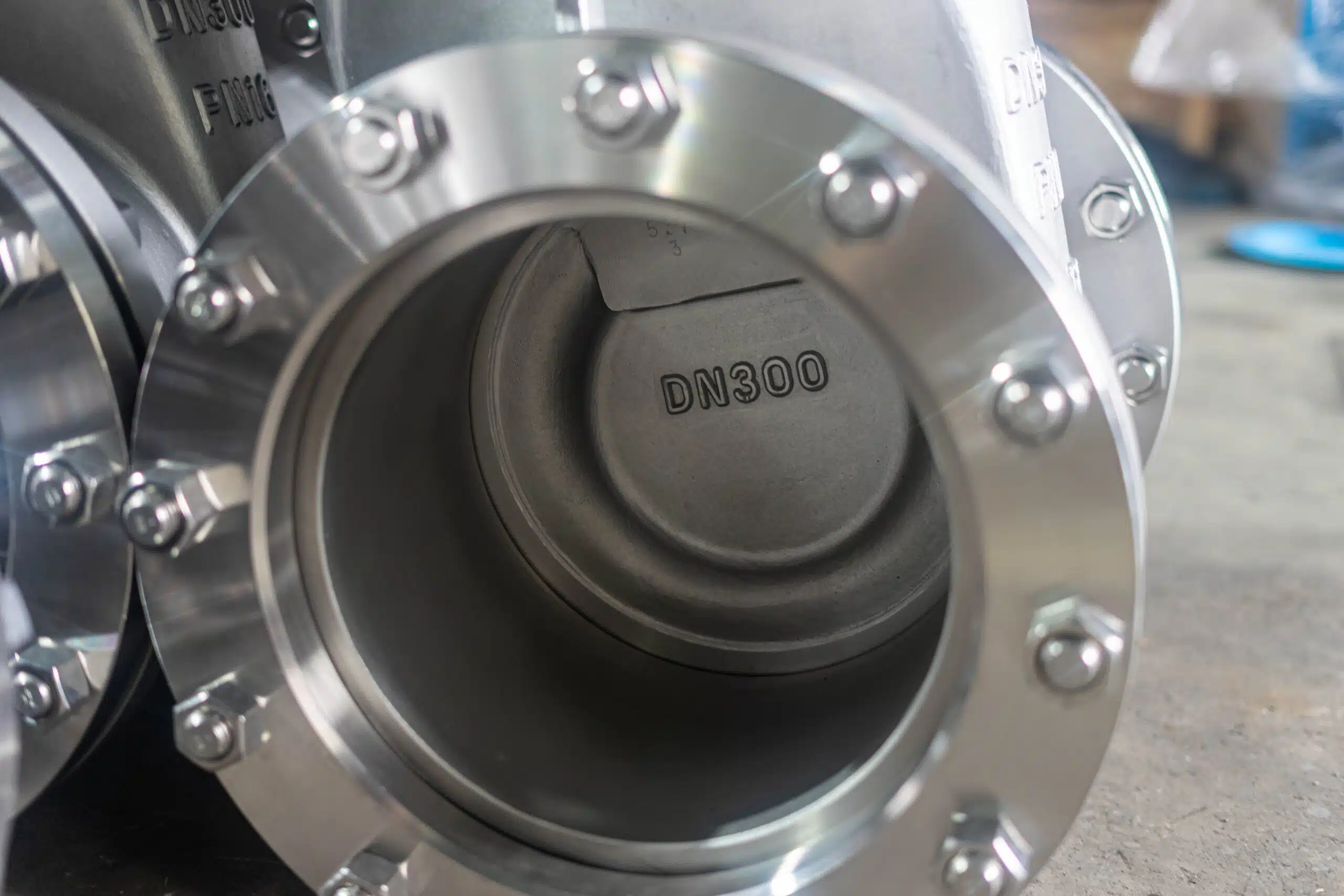
When the allowable ΔP is strict, the flow rate is high or pump energy is a concern, the bore type and manufacturer Cv/Kv should be checked before approval. A smaller flow area may increase velocity, pressure drop, erosion risk or vibration risk under demanding service conditions.
Fully Open vs Partially Open Gate Valve
A gate valve should normally operate either fully open or fully closed. Using a gate valve in a partially open position may increase pressure drop, but that does not make it a good throttling valve.
Why Partially Open Gate Valves Increase Flow Resistance
When the gate is partially open, the flow area is reduced. Fluid accelerates through the smaller opening, and turbulence can form around the wedge, guides and seat area. The result may be higher pressure drop, unstable flow and mechanical stress on sealing surfaces.
A gate or wedge is designed to move out of the flow path in the fully open position and seal against the seat in the fully closed position. It is not designed like control valve trim, which is intended to hold a controlled position under continuous flow force and pressure differential.
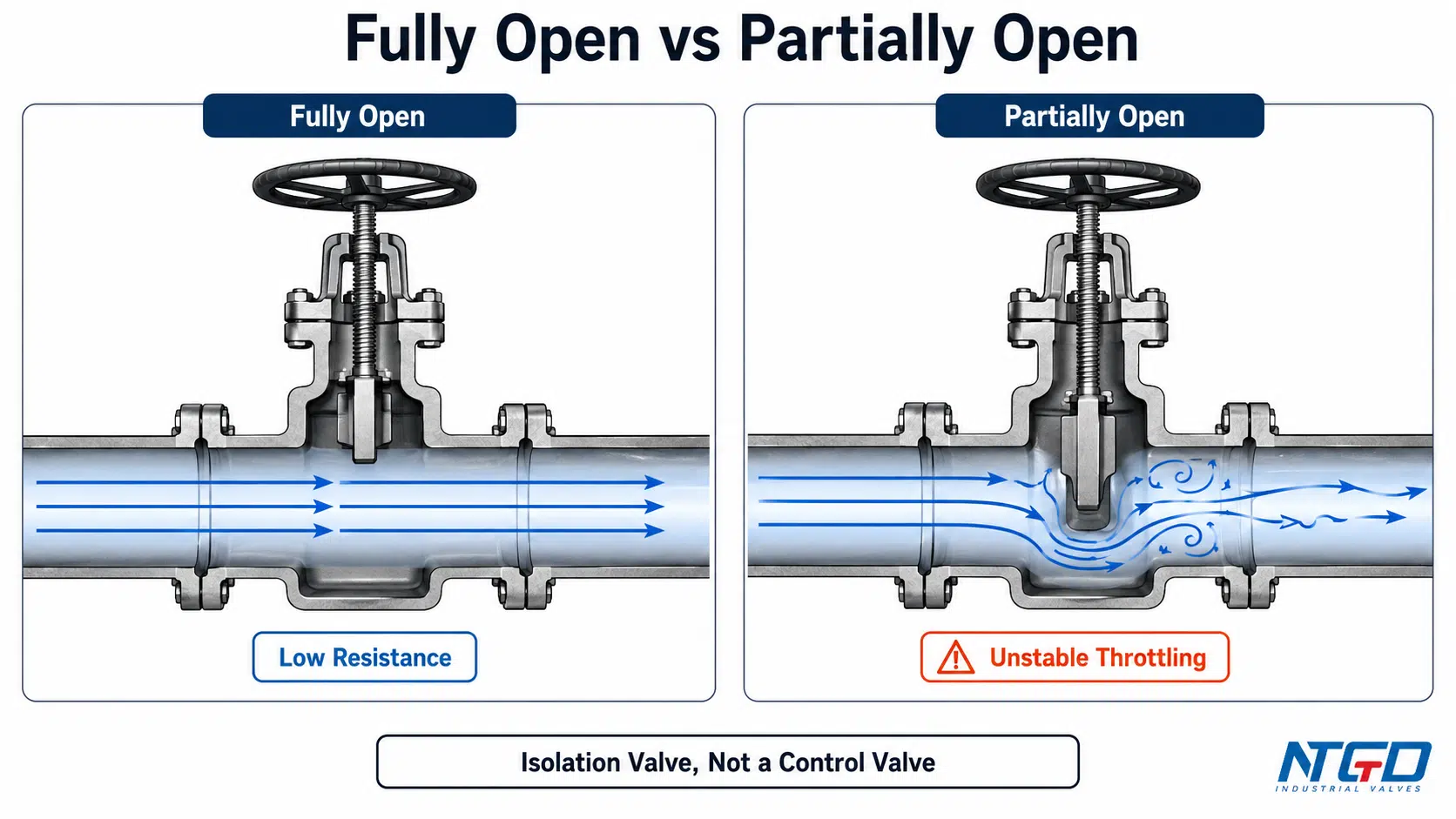
Valve Magazine also cautions that gate valves are generally poor choices for regulating flow outside fully open or fully closed positions, as partial opening can damage disc or seat-ring surfaces; use its gate valve fundamentals overview as supporting evidence for the throttling boundary.
This can lead to:
- vibration;
- noise;
- seat wear;
- erosion in severe service;
- poor flow control;
- unreliable shutoff after long throttling use.
| Posição da válvula | Queda de pressão | Flow Stability | Uso recomendado | Risco |
|---|---|---|---|---|
| Totalmente aberto | Usually low | Stable | Normal isolation service | Correct operating condition |
| Parcialmente aberto | Higher and less predictable | Less stable | Temporary or commissioning condition only | Turbulence, wear, vibration |
| Nearly closed | Very high and unstable | Ruim | Não recomendado para estrangulamento | Noise, damage, poor control |
Gate Valve Pressure Drop Is Not Pressure Control
A gate valve can create pressure drop when there is flow. But it should not be selected as a reliable pressure control device.
Long-term partial opening increases the risk of vibration-induced maintenance, seat damage, poor shutoff and unplanned downtime. If the project requires stable throttling, accurate flow regulation or controlled downstream pressure, the valve type should be reviewed. A globe valve, control valve or pressure regulating device may be more suitable depending on the service.
That decision should be handled in the project’s control and sizing review, not by forcing a gate valve to work in a partially open position.
Cv Method vs K Coefficient Method
Gate valve pressure drop can be estimated using different methods. Two common approaches are the Cv/Kv method and the K coefficient method.
When to Use Cv / Kv
Cv and Kv are commonly used in valve selection because they connect flow capacity with pressure drop. They are practical when the valve manufacturer provides a flow coefficient for the exact valve.
Cv/Kv is useful for:
- preliminary gate valve pressure drop review;
- comparing full bore and reduced bore options;
- checking whether a selected valve meets allowable ΔP;
- supporting RFQ discussion with the manufacturer.
The limitation is clear: if the Cv/Kv value is generic or incorrect, the pressure drop result will also be unreliable.
When to Use K Coefficient / Resistance Coefficient
The K coefficient, also called a resistance coefficient or loss coefficient, is often used in piping system loss calculations. Instead of focusing on valve flow capacity, it relates the pressure loss to flow velocity and fluid density.
| Método | Main Input | Melhor uso | Limite |
|---|---|---|---|
| Cv / Kv method | Flow rate, specific gravity, Cv/Kv | Valve selection and RFQ review | Needs actual valve data |
| K coefficient method | Velocity, density, resistance coefficient | Piping system loss calculation | K varies by design and data source |
| Field measurement | Actual P1 and P2 | Existing installed system | Requires operating measurement |
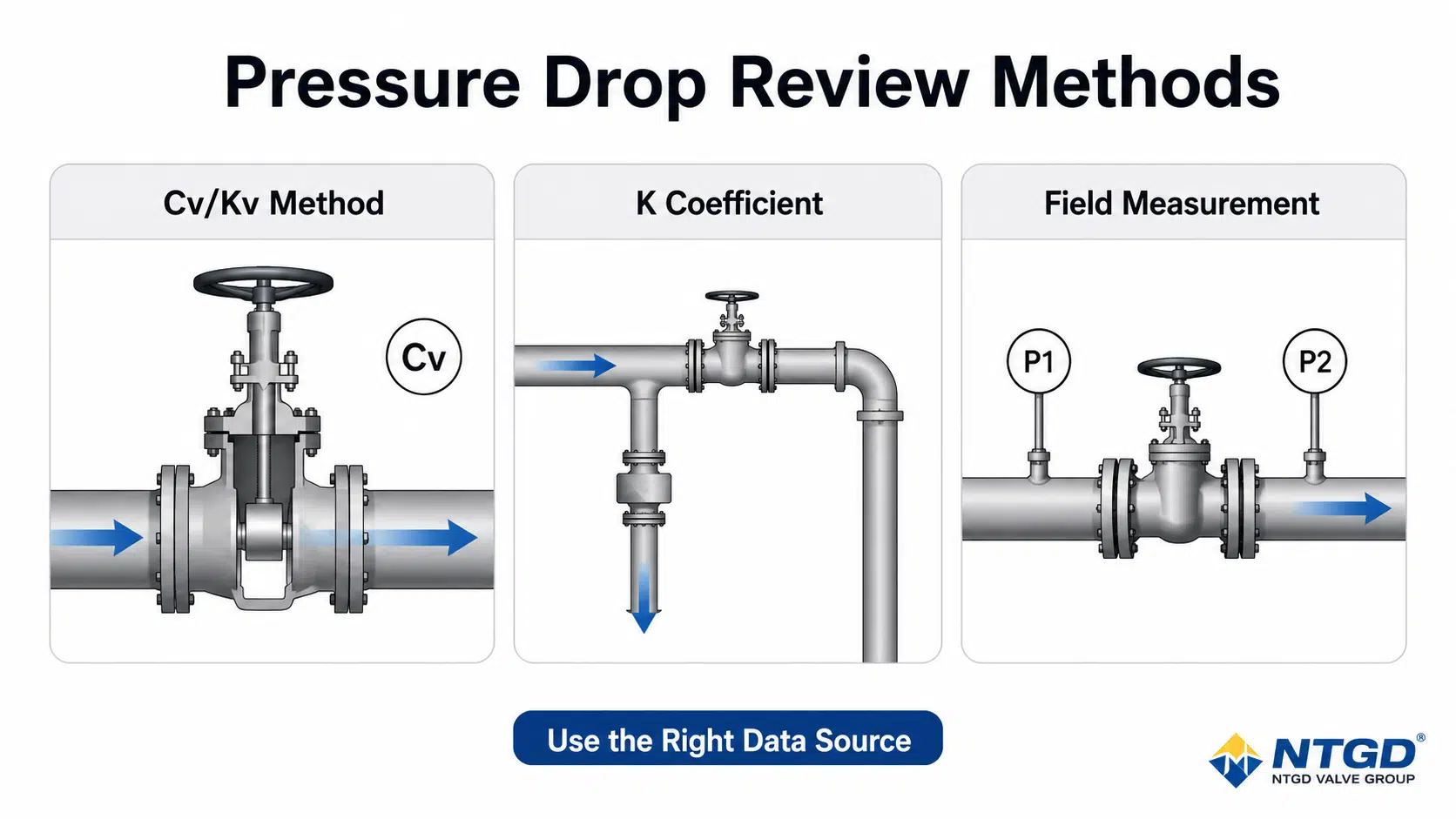
For the K-coefficient method, the Hydraulic Institute data tool explains that valve and fitting minor losses can be calculated from velocity head and resistance coefficient K in a valves and fittings frictional loss reference.
For a single gate valve RFQ or sizing confirmation, manufacturer Cv/Kv is usually the first data to request. For complete piping system loss modeling, the K coefficient method can help calculate the combined resistance of valves, pipe runs and fittings. Field measurement is useful when an existing installation needs actual pressure drop verification rather than only theoretical estimation.
A full K coefficient database or calculator should be handled separately.
Factors Affecting Gate Valve Pressure Drop
A gate valve may be a low pressure drop valve in fully open service, but the actual pressure loss still depends on several design and operating factors.
Flow Rate and Velocity
Flow rate directly affects the pressure drop level across a gate valve. As flow rate increases, velocity through the valve and surrounding pipework can increase. Higher velocity generally increases energy loss.
Even a low-resistance valve can become part of a higher system pressure drop if the pipeline velocity is too high or if the valve is installed near reducers, elbows or other turbulence sources. If flow rate varies widely or the allowable ΔP is tight, the project should review full-bore design, line size, velocity and manufacturer Cv/Kv instead of relying on nominal valve size alone.
Propriedades do fluido
Specific gravity, density and viscosity influence pressure drop. The simplified Cv relationship uses specific gravity for liquid flow, but real service may require a more detailed review when the medium is viscous, hot, dirty, erosive or multiphase.
Temperature can also affect fluid properties and material selection. For high-temperature, cryogenic, corrosive or severe service conditions, pressure drop should be reviewed together with material, sealing and operating requirements.
Valve Size, Class and Body Design
Valve size affects flow area. Pressure class and body design can affect the internal geometry and available Cv/Kv data. A Class 150 gate valve and a high-pressure forged or pressure seal gate valve may not have identical internal flow characteristics even if the nominal size appears similar.
Do not assume that all gate valves of the same nominal size have the same Cv.
Installation and Pipeline Conditions
Actual pressure drop is not only created by the valve. The complete pipeline matters.
Nearby items such as elbows, reducers, strainers, check valves, expansion joints and branch connections can change the flow condition before and after the gate valve. If a project has a strict allowable pressure drop, the gate valve should be reviewed as part of the whole piping system, not as an isolated component.
In practice, pressure drop evaluation should consider the complete piping system, including upstream and downstream fittings, pipe velocity, connected equipment and allowable system loss.
Gate Valve vs Globe, Ball and Butterfly Valve Pressure Drop
A short comparison helps clarify why gate valves are often selected for low resistance isolation service. This section is only a pressure drop comparison, not a full valve selection comparison.
Gate Valve vs Globe Valve Pressure Drop
A fully open gate valve usually has lower pressure drop than a globe valve of comparable size and service condition. The reason is the flow path. A gate valve provides a more direct path when fully open, while a globe valve usually forces the fluid to change direction through the body and seat area.
That higher globe valve pressure drop is not automatically a disadvantage. Globe valves are often selected when throttling or flow regulation is required. In those services, pressure drop is part of the control function.
For the globe valve side of this comparison, the globe valve pressure drop and Cv guide explains why redirected flow paths and throttling duty usually create higher resistance.
| Tipo de válvula | Caminho do fluxo | Tendência de queda de pressão | Melhor ajuste | Selection Insight |
|---|---|---|---|---|
| Válvula de gaveta | Straight-through when fully open | Baixa | Isolamento | Best fit when low resistance and full open / full close service are required |
| Full-port ball valve | Straight-through bore | Baixa | Desligamento rápido | Useful for low-pressure-drop shutoff where quarter-turn operation is preferred |
| Válvula globo | Diverted flow path | Mais alto | Throttling / control | Better fit when pressure drop is acceptable and flow regulation is required |
| Válvula borboleta | Disc remains in the flow path | Dependente do projeto | Compact isolation or control | Review disc design, opening angle and allowable pressure drop |
For the ball valve side of the same pressure-drop topic, use the ball valve pressure drop and Cv guide instead of applying gate valve assumptions to ball valve port designs.
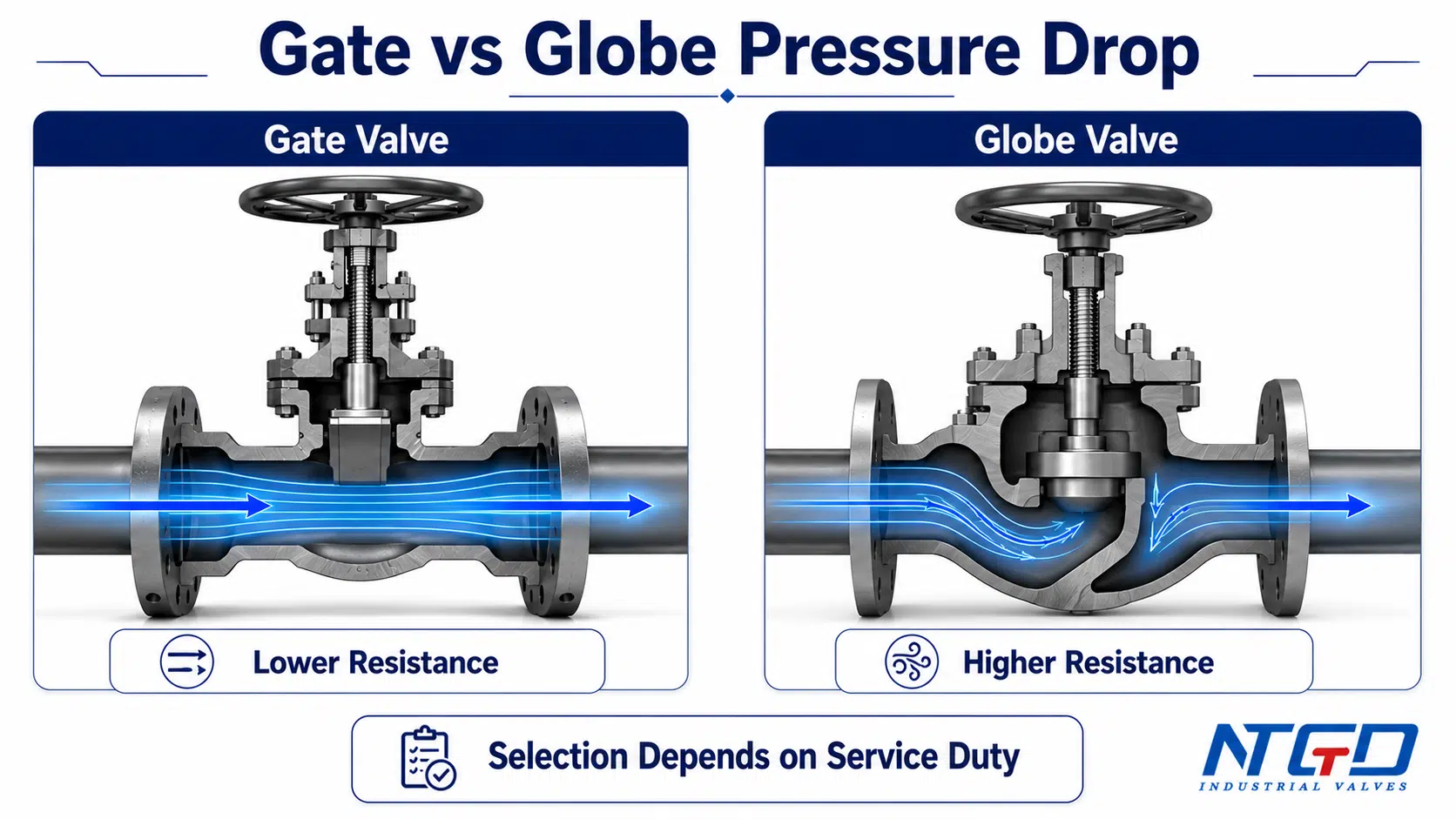
If a project needs a detailed comparison of pressure drop, Cv, throttling fit and selection limits between different valve types, that should be handled in dedicated pressure drop guides or valve comparison resources. This article keeps the comparison limited to the gate valve pressure drop context.
For a broader selection comparison beyond pressure drop, review the gate valve vs globe valve selection guide.
Gate Valve vs Ball and Butterfly Valve Pressure Drop
A full-port ball valve can also provide low pressure drop because the bore can align with the pipeline. The main difference is operation and shutoff style: a ball valve is quarter-turn, while a gate valve is usually multi-turn.
A butterfly valve may have moderate or design-dependent pressure drop because the disc remains in the flow path even when open. Actual loss depends on disc design, opening angle, seat arrangement and valve size.
For this page, the important point is that gate valve pressure drop should be evaluated within its own service role: fully open isolation in industrial pipelines.
RFQ Data Checklist for Gate Valve Pressure Drop Review
When asking a manufacturer to confirm gate valve pressure drop or Cv, provide enough service data. Without this information, the supplier can only give a broad estimate.
| Dados da solicitação de cotação | Why It Matters for Pressure Drop / Cv |
|---|---|
| Valve size / DN / NPS | Determines nominal flow area |
| Pressure class / PN / Class | Affects valve design and available data |
| Projeto do furo | Directly affects flow resistance |
| Taxa de fluxo | Core input for pressure drop estimation |
| Médio | Determines fluid behavior and material requirements |
| Gravidade específica/densidade | Needed for Cv-based liquid calculation |
| Temperatura | Afeta as propriedades do fluido e a seleção de materiais |
| Inlet pressure / outlet pressure | Defines operating condition |
| ΔP permitido | Shows the pressure drop limit |
| Manufacturer Cv/Kv | Prevents generic estimation |
| Conexão final | Affects installation and specification |
| Método de operação | Manual, gear, electric, pneumatic or hydraulic actuation |
| Service duty | Confirms isolation, throttling risk or special operating requirement |
| Project standard / datasheet | Confirms applicable requirements |
For low pressure drop selection, the RFQ should make the service condition clear: the valve is intended to operate fully open during normal flow and fully closed for isolation.
Providing these data points helps the manufacturer or engineering team confirm whether the selected gate valve bore, Cv/Kv and pressure class match the project specification. It also reduces the risk of using a generic Cv value or selecting a valve that cannot meet the allowable pressure drop in service.
Final Fit-Check Before Selecting a Gate Valve for Low Pressure Drop
Before selecting a gate valve mainly for low pressure drop, review these points:
| Pergunta sobre o Fit-Check | Por que é importante |
|---|---|
| Is the valve normally fully open during operation? | Gate valve low pressure drop depends on fully open service |
| Is the bore full, standard or reduced? | Bore design affects Cv and resistance |
| Is the flow rate confirmed? | Flow rate strongly affects ΔP |
| Are medium, SG and temperature known? | Fluid properties affect calculation |
| Is the allowable pressure drop specified? | Selection needs a target limit |
| Is manufacturer Cv/Kv available? | Prevents unreliable generic assumptions |
| Is the valve used for isolation, not throttling? | Gate valves are not stable control valves |
| Are upstream and downstream fittings reviewed? | The pipeline system affects actual loss |
| Is the final datasheet checked? | Confirms valve design, class and service compatibility |
If any key answer is “no” or “not confirmed,” the next step should be a technical review using the available service data. Continuing selection without flow rate, bore type, allowable ΔP or manufacturer Cv/Kv can lead to an inaccurate pressure drop judgment.
A gate valve can be an excellent low-resistance isolation valve, but only when the valve type, bore, operating position and service conditions match the pipeline requirement.
PERGUNTAS FREQUENTES
Qual é a queda de pressão em uma válvula de gaveta?
A queda de pressão em uma válvula de gaveta é a diferença de pressão entre a entrada e a saída enquanto o fluido flui através da válvula. O valor real depende muito do fato de a válvula estar totalmente aberta, parcialmente aberta ou de ter sido projetada corretamente.
Uma válvula de comporte totalmente aberta apresenta baixa queda de pressão?
Sim, uma válvula de guilhotina totalmente aberta geralmente apresenta baixa queda de pressão, pois a guilhotina é levantada para fora do trajeto principal do fluxo. A queda de pressão real ainda depende da vazão, do projeto do diâmetro interno, das propriedades do fluido e dos dados de Cv/Kv fornecidos pelo fabricante.
Qual é o valor de Cv de uma válvula de gaveta?
O Cv de uma válvula de gaveta é o seu coeficiente de vazão. Ele indica a capacidade de vazão da válvula sob condições definidas de queda de pressão. O valor exato do Cv depende do tamanho da válvula, do diâmetro interno, da classe de pressão e do projeto do fabricante.
Um valor mais alto de Cv significa uma queda de pressão menor?
Em condições comparáveis de serviço com fluidos, um valor de Cv mais alto geralmente significa menor queda de pressão para a mesma vazão. No entanto, o valor de Cv deve corresponder ao projeto real da válvula, e não a um valor genérico de tabela.
How do you calculate pressure drop across a gate valve?
For liquid service, a simplified Cv relationship can be used: ΔP = SG × (Q / Cv)². This is only a simplified method. Critical service, gas, steam, viscous fluid and special applications require more detailed review.
Uma válvula de gaveta pode ser usada para estrangulamento?
A gate valve is not normally recommended for throttling. Partial opening can create turbulence, vibration, seat wear and unstable control. Seat surface damage may eventually prevent tight shutoff, turning a poor throttling choice into a reliability problem for the piping system.
Do gate valves reduce pressure?
Not in the way a pressure regulator does. A gate valve can create pressure drop when fluid is flowing, especially if it is partially open or restricted, but it does not provide stable downstream pressure control. Pressure control should be handled with a suitable valve type and sizing method.
How do I get accurate Cv values for a gate valve?
Use manufacturer Cv/Kv data for the exact valve size, class, bore and design. A generic gate valve Cv chart can help with early estimation, but it should not replace the manufacturer’s data for final selection.
Is gate valve pressure drop lower than globe valve pressure drop?
A fully open gate valve usually has lower pressure drop than a globe valve under comparable conditions because the gate valve has a more direct flow path. A globe valve usually creates higher resistance, but it is better suited for throttling and control service. For full valve selection, use dedicated pressure drop guides or valve comparison resources.
Conclusão
Gate valve pressure drop is usually low when the valve is fully open, correctly sized and used for isolation service. The low resistance comes from the gate being withdrawn from the flow path and the valve providing a relatively straight bore for the fluid.
Cv helps connect gate valve flow capacity with pressure drop, but the correct Cv or Kv must come from the actual valve design. Bore type, flow rate, fluid properties, valve size, pressure class and pipeline conditions all affect the final pressure loss.
The main selection boundary is clear: use a gate valve when the service requires low-resistance open / close isolation. Do not use a gate valve as a stable throttling valve or pressure regulator. For RFQ review, prepare the listed flow rate, medium, SG, temperature, pressure class, bore type, allowable ΔP and manufacturer Cv/Kv requirements for a more precise pressure drop and Cv review.
Suporte a aplicativos/especificações
Once the RFQ data checklist is filled with the project’s preliminary data, NTGD can support application review by checking valve size, pressure class, bore type, service condition, medium, flow rate and required Cv/Kv data against the project specification.
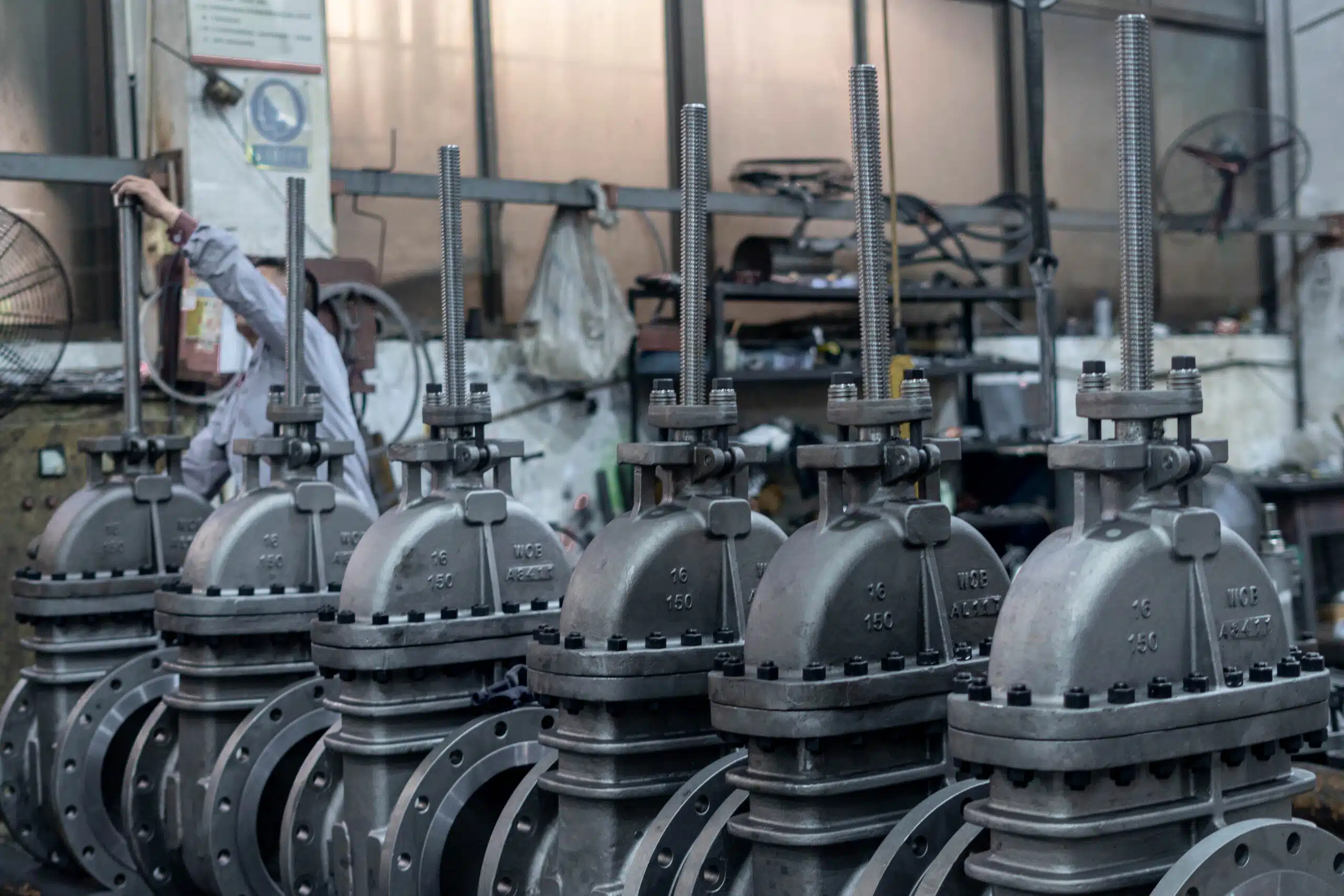
This review helps confirm whether the selected gate valve is suitable for low-pressure-drop isolation service and whether additional pressure drop, Cv or valve type review is needed before final approval.
For product-level configuration after the pressure drop review, start from the industrial gate valve product page and match the valve design to the confirmed RFQ data.
