
Author Name: Bruce Zheng
Author Role: Co-Founder and Valve Engineer at NTGD Valve
Author Bio: Bruce Zheng is Co-Founder and Valve Engineer at NTGD Valve, focusing on industrial valve selection, application, and technical content for global B2B buyers.
Last Updated: July 5, 2026
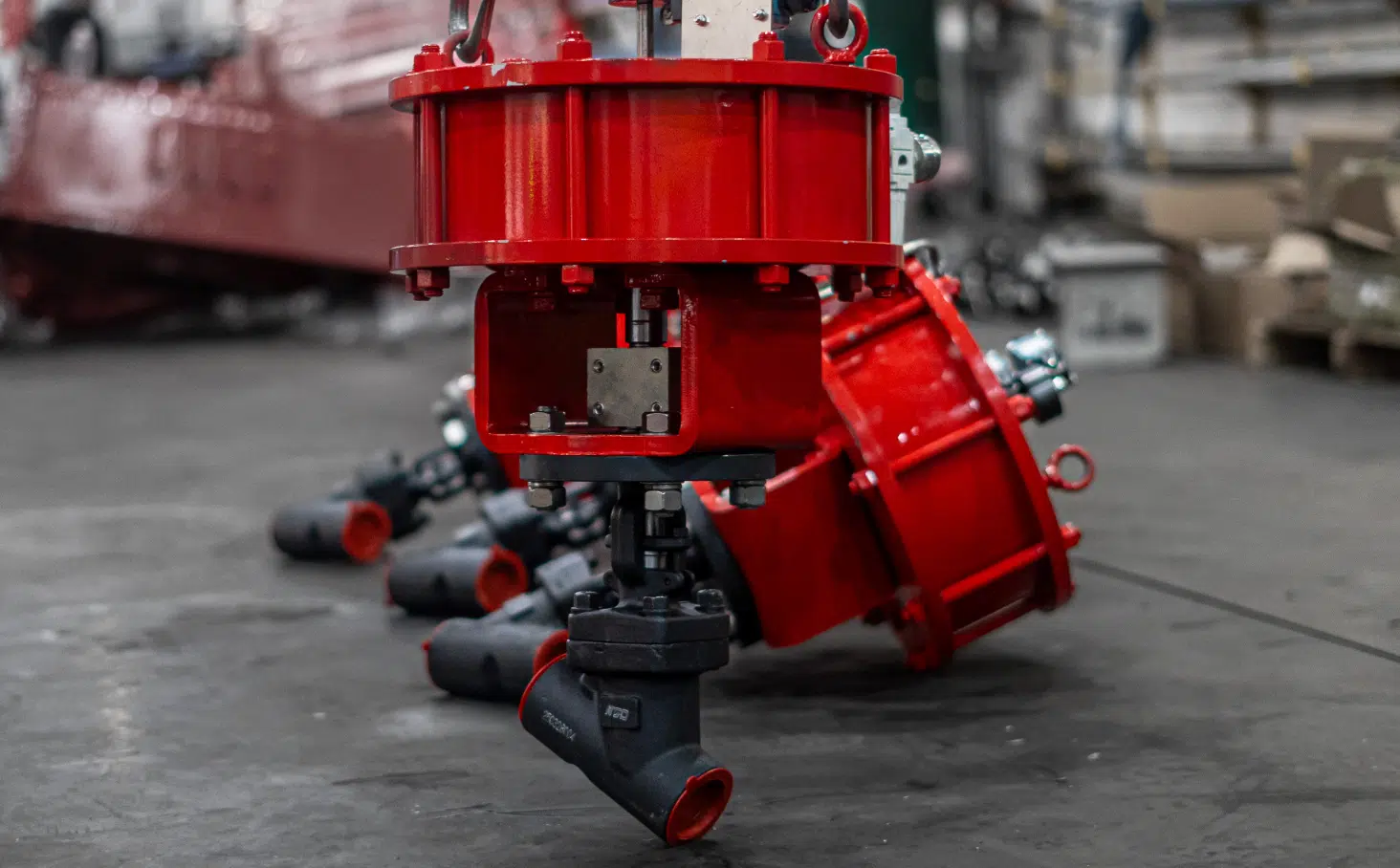
A Y pattern globe valve, also called a Y-type globe valve or oblique pattern globe valve, is a globe valve design where the seat and stem are arranged at an angle to the pipeline axis, commonly around 45 degrees. This angled internal geometry creates a straighter flow path than a conventional T-pattern globe valve, helping reduce flow resistance while still allowing shutoff and throttling control.
For industrial buyers, the main question is not only “what is a Y pattern globe valve?” but whether this body design solves a real system problem. A Y-pattern globe valve is normally evaluated when a project still needs globe-valve-style control but cannot accept the higher pressure loss associated with a standard globe valve body.
In short: a Y pattern globe valve is best treated as a lower-resistance globe valve option, not as a universal low-pressure-drop valve. It fits best when pressure loss, flow control, high-pressure service, or high-temperature service must be balanced in the same specification. Final selection should still be verified against the service data, valve drawing, datasheet, and approved project requirements.
What Is a Y Pattern Globe Valve?
A Y pattern globe valve is a linear-motion valve used to open, close, or regulate fluid flow. Like other globe valves, it uses a stem, disc, and seat to control the flow area. The difference is in the body geometry. In a Y-pattern design, the seat and stem are inclined rather than arranged perpendicular to the pipeline in the traditional T-pattern layout.
This design reduces the sharp change in flow direction inside the valve body. When the valve is open, the medium can pass through a more streamlined path. This makes the Y-pattern globe valve useful in applications where pressure loss, turbulence, erosion, or energy loss must be controlled more carefully than with a standard globe valve.
A Y pattern globe valve can be used for:
- On/off isolation where globe-valve shutoff and control are both needed, not where the only requirement is the lowest possible full-bore resistance.
- Throttling or flow regulation, provided the disc, seat, trim, actuator, and operating range are suitable for the service.
- High-pressure or high-temperature service, where the body, bonnet, trim, packing, and gasket must be reviewed together with the Y-type body geometry.
- Pressure-drop-sensitive lines, where a lower-resistance globe valve body is preferred over a traditional T-pattern globe valve.
Y Pattern, Y-Type and Oblique Pattern: Are They the Same?
In most industrial valve discussions, Y pattern globe valve, Y-type globe valve, and oblique pattern globe valve refer to the same general body concept. The wording may vary by manufacturer, market, or document style.
| Term | Meaning in Practical Selection | Notes for Buyers |
|---|---|---|
| Y pattern globe valve | Globe valve with an angled body / seat arrangement | Common technical term |
| Y-type globe valve | Same general concept as Y-pattern globe valve | Often used in product descriptions and RFQs |
| Oblique pattern globe valve | Describes the inclined or angled internal geometry | Less common but technically related |
| Y globe valve | Informal shortened wording | Use the formal name in specifications |
| Y-pattern globe valves | Plural form for multiple valves or product ranges | Natural wording in product discussions |
When preparing an RFQ, it is better to write the requirement clearly as Y pattern globe valve or Y-type globe valve and then confirm the design drawing or datasheet. Do not rely only on a shortened name such as “Y valve,” because that can be confused with Y strainers, Y-pattern check valves, or other valve types.
How the 45° Y-Type Design Reduces Flow Resistance
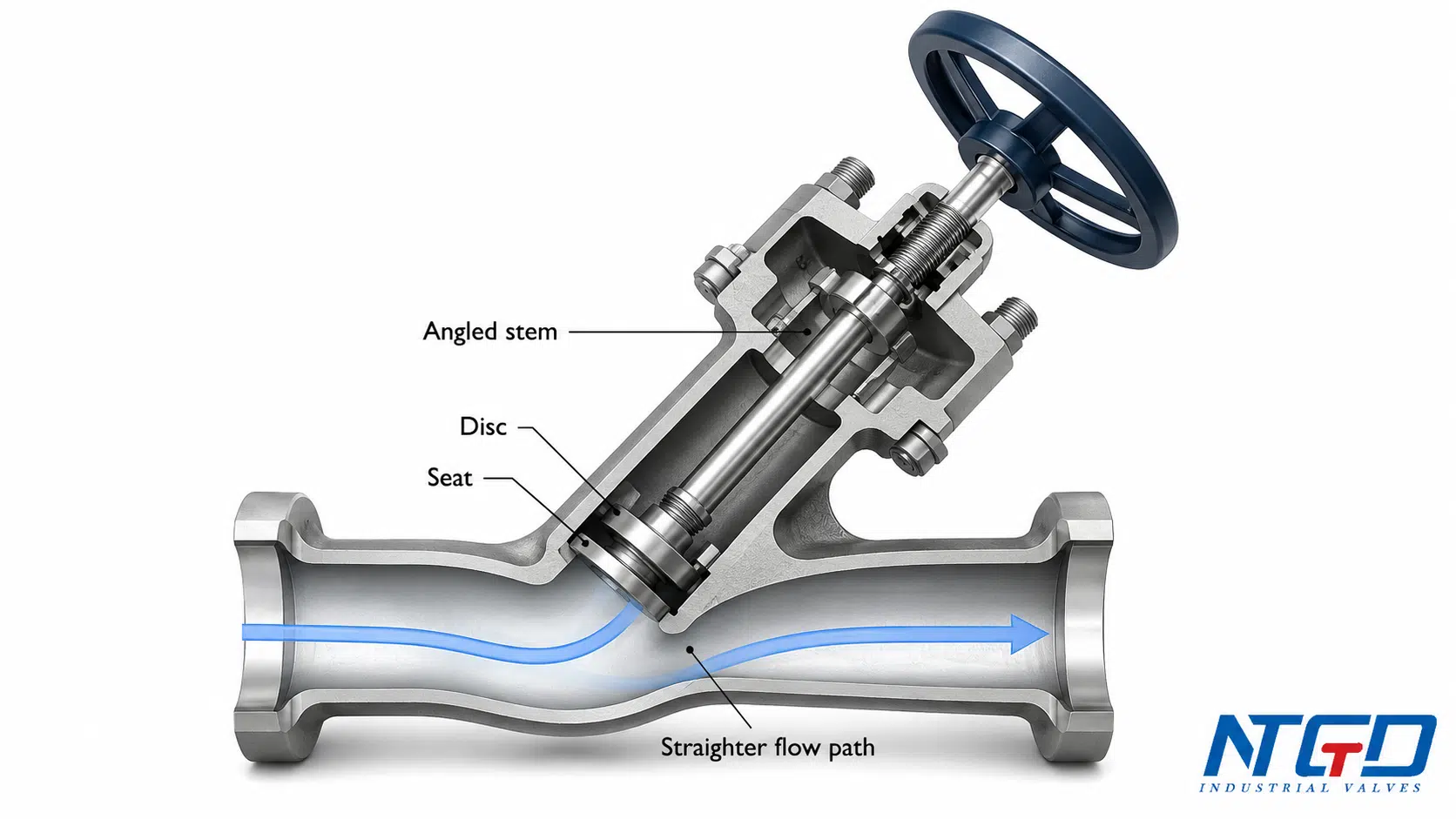
The main engineering reason to use a Y-pattern globe valve is the angled relationship between the seat, stem, and flow path. In a conventional T-pattern globe valve, the fluid usually changes direction sharply as it passes through the body. This creates higher resistance and pressure loss.
In a Y-type globe valve, the seat and stem are inclined to the pipeline. This creates a more direct path through the valve body. The flow still passes through a globe-valve-style seat and disc, but the body shape reduces the severity of the internal turn.
Seat, Stem and Flow Path Geometry
The seat and stem arrangement affects how the fluid enters, passes the disc, and exits the valve. In a Y-pattern body:
- The stem is angled relative to the pipeline.
- The seat is positioned along the inclined flow path.
- The disc moves toward or away from the seat to control flow.
- The open flow path is less tortuous than a standard T-pattern globe valve.
- The internal body shape can reduce turbulence compared with a sharper flow turn.
Because the stem and seat are inclined, the medium changes direction more gradually inside the body. This can reduce turbulence, localized energy loss, and flow resistance around the seat area. That is the main reason a Y-pattern design is often selected when a project needs globe-valve control but wants lower pressure drop than a conventional T-pattern globe valve.
This does not mean every Y-pattern globe valve has the same pressure drop. The actual pressure loss depends on valve size, pressure class, body design, disc type, seat design, opening position, flow rate, and fluid properties. The project should confirm Cv, pressure drop, and operating conditions from the valve datasheet when these values are important.
What “Lower Pressure Drop” Means in Selection
“Lower pressure drop” should be understood as a relative design advantage, not as a fixed universal value. A Y-pattern globe valve normally offers a straighter flow path than a T-pattern globe valve, but the exact pressure-loss difference must be verified for the selected valve model and service condition.
| Selection Question | Why It Matters |
|---|---|
| Is pressure loss a concern in this line? | Y-pattern designs are often considered when the system cannot accept excessive resistance. |
| Is the valve used for throttling, isolation, or both? | The disc and seat must match the intended operating mode. |
| Is the valve normally fully open or partially open? | Throttling position affects velocity, erosion risk, noise, and control behavior. |
| Is the service high pressure or high temperature? | Body, bonnet, trim, packing, and gasket design become more important. |
| Is a Cv or pressure drop calculation required? | Use valve-specific data instead of assuming a fixed pressure drop reduction. |
In high-flow, long-distance, or pump-head-sensitive systems, the relative pressure-loss advantage of a Y-pattern body may affect energy-loss assumptions or pump selection. That effect should be verified with valve-specific Cv or pressure-drop data rather than assumed from the body pattern alone.
A Y pattern globe valve is therefore best understood as a lower-resistance globe valve body option. It is still part of the globe valve family. If the main requirement is near full-bore, very low-resistance isolation with little or no throttling, a gate valve or full-port ball valve may be a more suitable valve type.
Key Components and Design Configurations of Y Pattern Globe Valves
The main components of a globe valve are similar across many designs, but in a Y pattern globe valve their arrangement and specification affect selection. Instead of viewing each part as a simple component name, buyers should check how each part influences pressure boundary, shutoff, throttling, maintenance, and service compatibility.
Component Function and Selection Impact
| Component | Main Function | Selection Impact |
|---|---|---|
| Valve body | Contains the pressure and forms the Y-shaped flow path | Confirm body material, pressure class, end connection, body pattern, and whether the angled stem / actuator envelope fits the site layout and maintenance space. |
| Bonnet | Closes the pressure boundary around the stem area | Bonnet type affects sealing reliability, maintenance access, and suitability for pressure / temperature service. |
| Stem | Transfers handwheel or actuator movement to the disc | Stem design affects operation, torque, thread exposure, and maintenance requirements. |
| Disc | Moves against or away from the seat to control flow | Disc design affects shutoff, throttling performance, wear, and service suitability. |
| Seat | Provides the sealing surface for the disc | Seat material and design affect leakage risk, erosion resistance, and temperature compatibility. |
| Gland packing | Seals around the stem to reduce external leakage | Packing material must match temperature, pressure, fluid compatibility, and maintenance expectations. |
| Cage or guiding element | Helps guide the disc and influence flow control in some designs | Important when stable throttling, controlled flow behavior, high differential pressure, or reduced vibration / wear risk must be reviewed. |
| Handwheel or actuator | Provides manual or automated operation | Choose manual, electric, pneumatic, or hydraulic operation based on torque, automation, operating frequency, and site access. |
This component view also explains why a Y-type globe valve drawing can be useful before purchase. A drawing helps confirm body geometry, flow path, end-to-end dimensions, handwheel or actuator envelope, stem angle, and maintenance space.
Bonnet, Stem and Operation Configurations
Y pattern globe valves can be configured in different ways. These configurations should not be mixed randomly in an RFQ; each one affects sealing, maintenance, cost, and service suitability.
| Configuration Area | Common Options | Practical Selection Note |
|---|---|---|
| Bonnet connection | Bolted bonnet, screwed bonnet, welded bonnet, pressure-seal bonnet in some designs | Bolted bonnet offers maintenance access; welded bonnet can improve body-bonnet sealing but limits access; pressure-seal designs are often considered in high-pressure service. |
| Stem design | Inside screw, outside screw and yoke, rising stem depending on design | An outside screw and yoke arrangement keeps threads away from the process medium and can be preferred where corrosion, temperature, or solids may affect thread life. |
| Operation method | Handwheel, gear operator, electric actuator, pneumatic actuator, hydraulic actuator | The choice depends on valve size, torque, automation need, operating frequency, and site access. |
| End connection | Flanged, butt weld, socket weld, threaded in smaller forged designs | End connection must match piping standard, pressure class, installation method, and maintenance expectations. |
| Trim / seat design | Metallic trim, hard-faced trim, soft or special seat depending on design | Confirm compatibility with temperature, pressure, erosion, corrosion, throttling duty, and shutoff requirement. |
For high-pressure or high-temperature service, the buyer should not specify only “Y pattern globe valve.” The RFQ should also define the pressure class, material, bonnet design, trim and seat design, end connection, and operation method.
How a Y Pattern Globe Valve Works and How Flow Direction Should Be Verified
A Y pattern globe valve works by moving the disc toward or away from the seat. When the handwheel or actuator moves the stem, the stem transfers motion to the disc. As the disc lifts from the seat, the flow area increases. As the disc moves toward the seat, the flow area decreases until the valve closes.
The Y-pattern body does not change how a globe valve works; it changes the internal geometry so the flow path is less abrupt than in a standard T-pattern globe valve.
Basic Working Principle
The operating sequence is usually as follows:
- The operator turns the handwheel or the actuator receives a control signal.
- The stem moves the disc upward or downward depending on the design.
- The disc changes the opening between the disc and the seat.
- The flow area increases, decreases, or closes.
- The valve performs isolation or throttling depending on the operating position.
In a Y-pattern design, this disc movement works together with the inclined seat and angled flow path. The valve still opens and closes like a globe valve, but the fluid passes through the seat and disc area with a less severe internal direction change than in a traditional T-pattern body.
This makes the Y-type globe valve suitable for services where a project needs controlled opening and closing rather than only full-bore isolation. However, if the valve will be used mainly for frequent throttling, the disc, seat, trim, actuator, and flow conditions should be reviewed carefully.
Flow Direction, Body Arrow and Drawing Check
Flow direction is critical for a Y pattern globe valve because the disc and seat are directional components. The final globe valve flow direction should be confirmed from the actual valve body arrow, approved drawing, datasheet, IOM, or manufacturer indication.
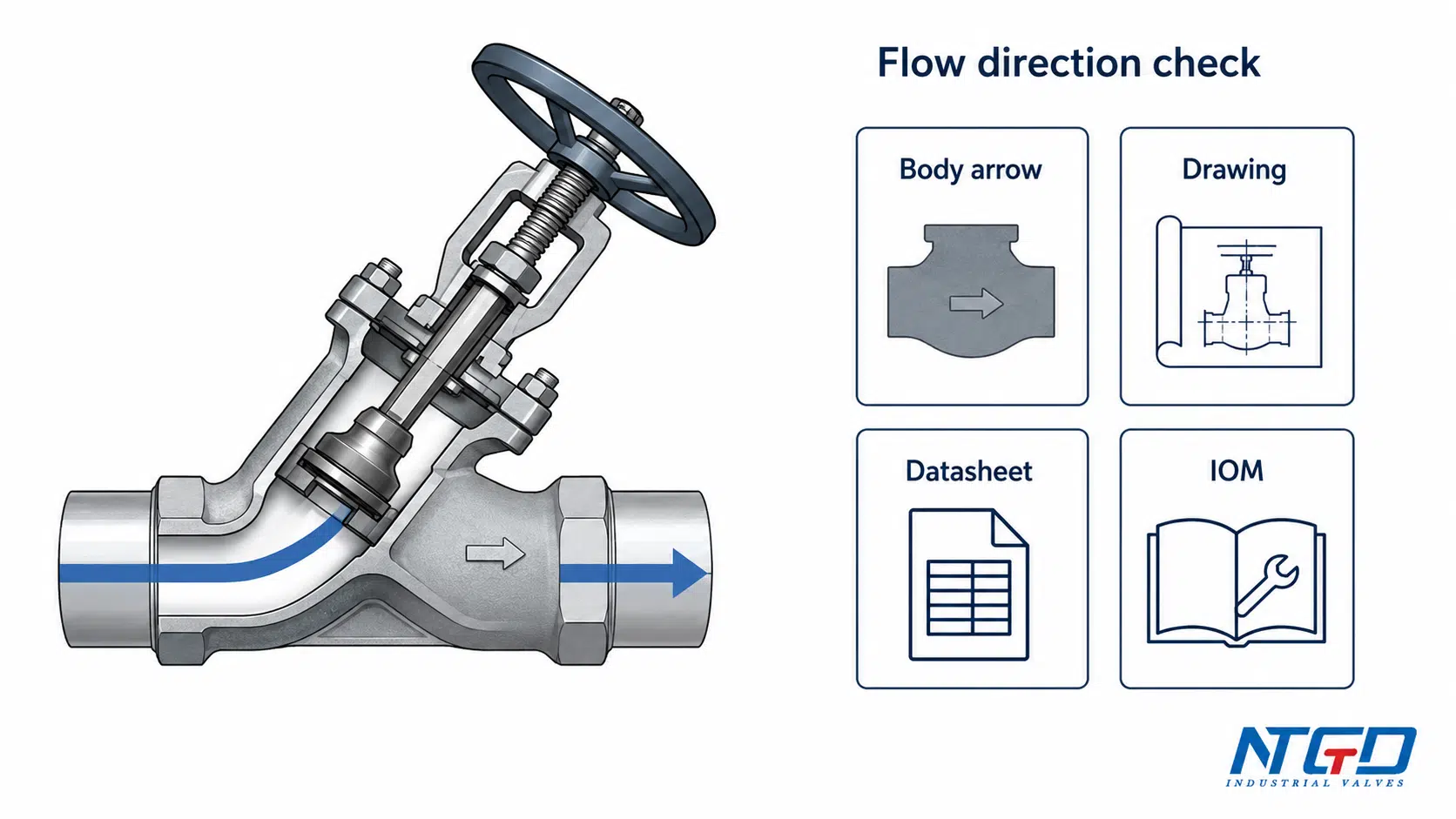
A low-in / high-out flow path is common in many globe valve arrangements, but it should not replace project-specific confirmation. In some services, differential pressure, shutoff requirement, actuator sizing, anti-slam behavior, or trim design may require a different flow-direction decision. During the RFQ stage, the buyer should provide the service condition and let the valve manufacturer confirm the appropriate disc / seat loading and flow direction.
| Flow Direction Check | What to Confirm | Why It Matters |
|---|---|---|
| Body arrow | Direction cast or marked on the valve body | This is the first field check during installation. |
| General arrangement drawing | Inlet, outlet, stem angle, seat position | Prevents installing the valve in the wrong orientation. |
| Datasheet | Flow direction note, pressure class, trim, seat design | Confirms whether the valve is intended for flow-to-open or another configuration. |
| IOM / manufacturer instruction | Installation and commissioning requirements | Helps prevent damage, vibration, leakage, or incorrect actuator sizing. |
| Project piping drawing | Line direction and valve tag position | Ensures the installed valve matches the system design. |
A Y pattern globe valve should not be installed only by visual guesswork. The Y-shaped body can make the flow path easier to understand, but the final direction must be confirmed by the marked arrow and the approved project documents.
Y Pattern vs T Pattern Globe Valve: What Actually Changes?
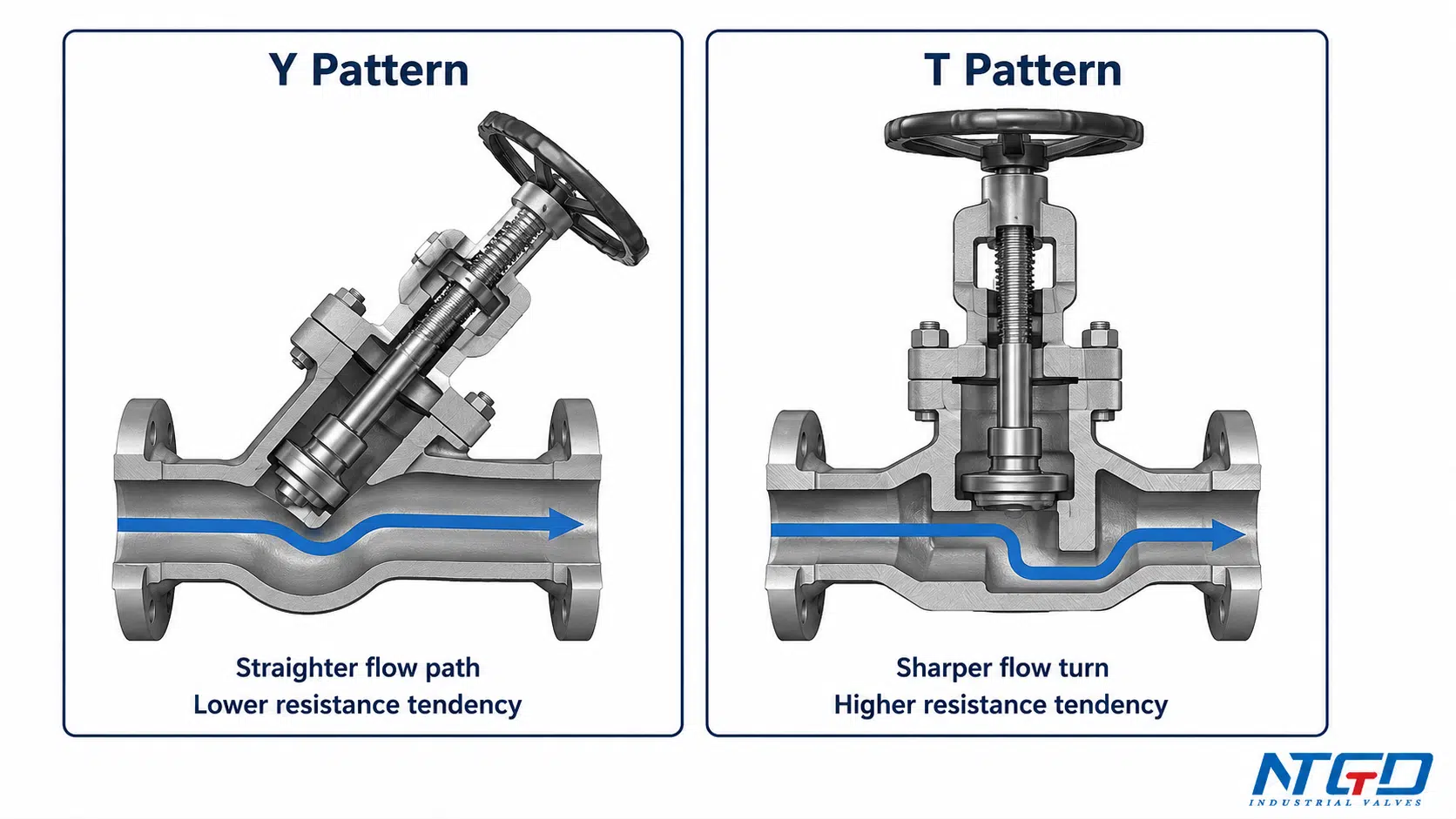
A Y pattern globe valve and a T pattern globe valve are both globe valves. Both use a disc and seat to control flow. The key difference is the internal flow path.
A T-pattern globe valve has a more tortuous path and is widely used where flow regulation and shutoff are needed and pressure drop is acceptable. A Y-pattern globe valve is selected when a more streamlined body path is preferred while still keeping globe-valve control characteristics.
Flow Path, Pressure Drop and Use-Case Differences
| Comparison Point | Y Pattern Globe Valve | T Pattern Globe Valve |
|---|---|---|
| Body geometry | Seat and stem are inclined, often around 45 degrees to the pipeline axis | Stem and disc are generally arranged more perpendicular to the flow path |
| Flow path | More direct and less tortuous | Sharper internal flow direction changes |
| Pressure drop tendency | Usually lower than a conventional T-pattern body of comparable service basis | Usually higher due to the more tortuous path |
| Control function | Suitable for shutoff and throttling when lower resistance is preferred | Suitable for common throttling and shutoff where pressure drop is acceptable |
| Typical selection reason | Used when the project needs globe-valve control but is sensitive to energy loss, pressure drop, or high-pressure / high-temperature duty | Used when the pressure drop allowance is acceptable and a standard, familiar, or easier-to-replace body layout is preferred |
| Specification focus | Confirm flow path, Cv / pressure drop data, flow direction, stem angle, actuator envelope, trim, bonnet, and pressure class | Confirm pressure-drop allowance, replacement fit, installation space, cost / availability, trim, bonnet, and pressure class |
This comparison should not be used to say that the Y-pattern design is always better. It is better for some applications because it reduces flow resistance compared with a conventional globe body, but the final selection depends on service condition, allowable pressure drop, control requirement, cost, maintainability, and availability.
When a T-Pattern Globe Valve May Still Fit Better
A T-pattern globe valve may still be appropriate when the project needs a standard globe valve body, the pressure drop is acceptable, the line layout favors a conventional design, or cost and availability are more important than pressure-loss reduction.
For low-pressure, normal-temperature, general industrial service where the pressure drop budget is sufficient, a T-pattern globe valve may be the more practical and economical choice. A Y-pattern globe valve becomes more valuable when pressure loss, flow resistance, high-pressure service, or high-temperature service creates a real engineering reason to move away from the standard body pattern.
If the project is comparing T-pattern and Y-pattern globe valves with angle-pattern globe valves, that topic should be handled as a broader globe valve type selection decision.
When to Use a Y Pattern Globe Valve
A Y pattern globe valve is most useful when the service needs globe-valve control but also benefits from a smoother flow path. Instead of selecting it only by industry name, buyers should match it to service conditions.
Suitable Service Conditions
| Service Condition | Why a Y Pattern Globe Valve May Fit | What to Confirm |
|---|---|---|
| High-pressure steam or hot fluid service | Globe-valve control is needed, and excessive pressure drop may increase energy loss or affect system performance | Pressure class, bonnet design, trim, packing, gasket, actuator, and flow direction |
| Boiler, power plant, or thermal system service | High temperature and controlled isolation may be required, and trim / packing selection can affect leakage and service life | Material, pressure-temperature rating, seat design, packing, test requirements, and maintenance access |
| Lines where pressure loss should be reduced | Y-pattern body provides a more direct flow path than a T-pattern body | Cv / pressure drop data from the valve manufacturer |
| Throttling or regulation service | Disc and seat can control flow opening, but trim stability and operating range must be reviewed | Trim, actuator, operating frequency, velocity, and erosion risk |
| Services requiring stronger body construction | Forged or pressure-rated designs may be used depending on specification | Body material, class, end connection, applicable project standards |
| Maintenance-sensitive service | Bonnet and stem configuration affect accessibility and downtime risk | Whether bolted, welded, pressure-seal, inside screw, or outside screw design is appropriate |
A Y-type globe valve is especially worth considering when the system needs both regulation and reduced resistance. However, the final selection should still be checked against the operating pressure, temperature, medium, flow rate, pressure drop, and installation conditions.
When Not to Choose It
A Y pattern globe valve is not always the best choice. It may not be suitable when:
- The system only needs full-open / full-close isolation and has no throttling requirement. In that case, a gate valve or full-port ball valve may provide a lower-resistance isolation path.
- A standard T-pattern globe valve already meets the pressure-drop allowance, control requirement, layout, and maintenance expectation. In that case, moving to a Y-pattern design may add unnecessary cost or complexity.
- The line layout does not provide enough space for the angled stem or actuator envelope. The drawing should be checked before ordering, not after installation.
- The buyer cannot confirm the required body pattern, flow direction, end-to-end dimension, and approved datasheet.
- The service includes solids, slurry, or severe erosive conditions. In those cases, the valve type, trim, seat, and flow velocity should be reviewed before assuming that a Y-pattern body solves the problem.
- The system requires a very low pressure drop but does not need globe-valve throttling. A more direct-through valve type may be a better starting point.
The safest industrial valve selection approach is to define the process duty first, then choose the valve body pattern.
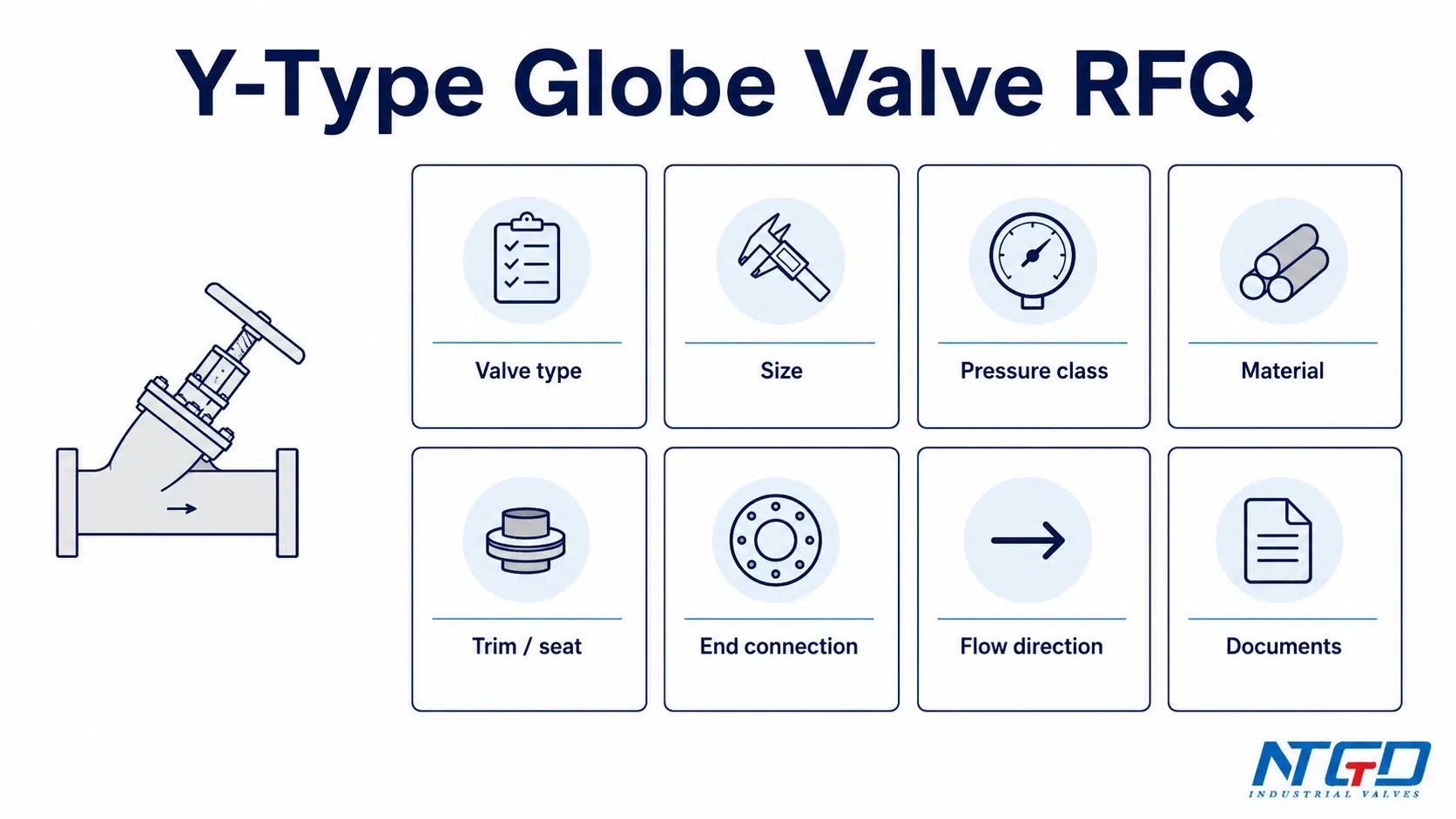
RFQ and Specification Checklist for Y-Type Globe Valves
A Y-type globe valve RFQ should give the manufacturer enough information to confirm whether the design fits the service. A vague RFQ such as “Y globe valve, please advise” can lead to the wrong body pattern, wrong pressure class, wrong end connection, wrong trim, or wrong flow direction.
Data to Confirm Before Quotation
| RFQ Item | What to Specify | Why It Matters |
|---|---|---|
| Valve type | Y pattern globe valve / Y-type globe valve | Prevents confusion with Y strainer, check valve, or other Y-shaped products. |
| Size | Nominal pipe size or DN | Affects flow capacity, pressure drop, end-to-end dimension, and actuator sizing. |
| Pressure class / rating | ASME class, PN rating, or project pressure requirement | Must match system pressure and temperature. |
| Body material | Carbon steel, stainless steel, alloy steel, or project-required material | Affects pressure boundary, corrosion resistance, and temperature suitability. |
| Trim / disc / seat | Disc type, seat material, hard-facing if required | Affects shutoff, throttling stability, erosion resistance, and service life. |
| Bonnet design | Bolted, welded, pressure-seal, or project-specified design | Affects maintenance access and pressure / temperature suitability. |
| Stem design | Inside screw, outside screw and yoke, rising stem if required | Affects thread exposure, operation, and maintenance. |
| End connection | Flanged, butt weld, socket weld, threaded | Must match piping design and installation method. |
| Operation | Handwheel, gear, electric, pneumatic, hydraulic | Affects torque, automation, and site operation. |
| Flow direction | Direction required by drawing, body arrow, or process design | Wrong direction may cause abnormal shutoff behavior, incorrect disc / seat loading, vibration under differential pressure, actuator mismatch, or unexpected Cv performance. |
| Design documents | Datasheet, drawing, IOM, test / inspection documents | Supports buyer review before purchase and installation. |
Documents to Review
Before approving a Y pattern globe valve for procurement, review the technical documents rather than relying only on the product name.
| Document | What to Check |
|---|---|
| Datasheet | Valve type, class, material, trim, seat, bonnet, operation, design conditions |
| General arrangement drawing | End-to-end dimension, stem angle, actuator envelope, flow arrow, flange / weld ends |
| Installation manual | Flow direction, installation orientation, commissioning requirements |
| Inspection / test record | Pressure test, leakage test, material traceability if required by project |
| Project specification | Applicable standards, documentation requirements, painting, tagging, and special service notes |
The RFQ should also state whether the valve is intended for isolation, throttling, startup bypass, steam service, high-temperature fluid, corrosive medium, or another specific duty. Before approval, the technical team should review the drawing, datasheet, flow arrow, actuator envelope, and inspection requirements together so the selected valve matches the actual project specification.
Limitations and Common Troubleshooting
The Y-pattern design can reduce flow resistance compared with a standard globe valve body, but it does not remove normal globe valve risks. Seat leakage, packing leakage, body-bonnet leakage, excessive torque, incorrect flow direction, and trim wear can still occur if the valve is selected or installed incorrectly.
Common Limitations
| Limitation | Practical Meaning |
|---|---|
| Not a full-bore isolation valve | If minimum pressure loss is the only goal, another valve type may fit better and may reduce unnecessary energy loss. |
| Directional installation matters | Flow direction should be checked from the body arrow, drawing, and IOM; wrong direction can affect shutoff, operation, and actuator sizing. |
| Trim selection remains critical | Disc and seat material must match temperature, pressure, erosion, corrosion, and throttling severity. |
| Maintenance access depends on bonnet design | Welded or pressure-seal designs may limit access compared with bolted bonnet designs, which can increase maintenance complexity or downtime. |
| Actuator sizing still needs review | Flow direction, differential pressure, packing friction, and disc design affect torque or thrust demand. |
| Pressure drop must be verified | The Y-pattern body can reduce resistance, but final pressure drop depends on valve data and system conditions. |
Troubleshooting Table
| Symptom | Possible Cause | Practical Check |
|---|---|---|
| Leakage at body-bonnet connection | Loose fasteners, damaged gasket, unsuitable gasket material, thermal cycling | Check bolting, gasket condition, pressure / temperature compatibility, and manufacturer instructions. |
| Seat leakage | Worn seat, damaged disc, foreign material, erosion, incorrect closure force | Inspect the seating surface, clean internal debris, verify trim compatibility, and confirm actuator / handwheel operation. |
| Leakage through stuffing box | Loose gland nuts, worn packing, improper gland follower position, stem damage | Adjust gland, inspect packing, check stem surface, and replace packing if needed. |
| Valve difficult to operate | Stem thread damage, packing too tight, actuator undersized, debris around disc / seat, pressure differential too high | Check stem condition, packing compression, actuator sizing, internal cleanliness, and operating differential pressure. |
| Poor flow control | Incorrect valve size, unsuitable trim, unstable throttling range, excessive velocity, actuator mismatch, wrong operating range | Review Cv, opening position, trim design, actuator sizing, service data, and whether the valve is being used outside its intended control range. |
Noise or vibration should not be diagnosed from the valve name alone. It may require a combined review of pressure drop, velocity, flow direction, trim design, installation condition, and the valve’s official IOM.
Globe valve maintenance and troubleshooting should always follow the manufacturer’s maintenance instructions and site safety procedure. The table above is a selection and diagnostic guide, not a substitute for the valve’s official IOM.
Final Fit-Check Before Selecting a Y Pattern Globe Valve
Before selecting a Y pattern globe valve, confirm whether the design solves the actual engineering problem. It should not be chosen only because the name appears in a catalog or because it looks more efficient than a standard globe valve.
Use this final check before RFQ or technical approval:
| Fit-Check Question | Why It Matters |
|---|---|
| Do you need globe-valve-style shutoff or throttling? | If the duty does not need globe-valve control, another valve type may fit better. |
| Is the line truly pressure-drop-sensitive? | The Y-pattern body is most useful when reduced resistance matters enough to justify this body pattern over a standard T-pattern globe valve. |
| Has the expected pressure drop been checked against system requirements? | Body pattern alone is not enough; Cv, flow rate, fluid properties, and operating position should match the pressure-drop budget. |
| Has the flow direction been confirmed by documents and markings? | Body arrow, drawing, datasheet, and IOM should not conflict before approval or installation. |
| Does the selected material and trim match the medium, temperature, pressure, and throttling severity? | Material and trim mismatch can cause leakage, erosion, corrosion, poor control, or shortened service life. |
| Is the body pattern clearly specified as Y pattern / Y-type? | Prevents confusion with T-pattern, angle pattern, check valve, or Y strainer. |
| Is the bonnet / stem design suitable for maintenance and service? | Access, thread exposure, packing, and sealing depend on configuration. |
| Are drawings and datasheets available for approval? | Dimensional, flow-direction, actuator-envelope, and document checks should be done before purchase or installation. |
A Y pattern globe valve is a strong option when a project needs globe-valve control with a more direct flow path and lower resistance than a conventional T-pattern body. The final selection should still be based on service data, manufacturer documents, and project specification.
FAQ
What is a Y-type globe valve?
A Y-type globe valve is a globe valve with the seat and stem arranged at an angle to the pipeline, commonly around 45 degrees. This angled design creates a straighter internal flow path than a conventional T-pattern globe valve and can help reduce pressure drop while keeping shutoff and throttling functions.
How do I know if a Y-type globe valve is right for a high-pressure steam line?
A Y-type globe valve may fit a high-pressure steam line when the project needs globe-valve control but also wants to reduce pressure loss compared with a standard T-pattern body. The final decision should confirm pressure class, body material, trim, bonnet design, packing, flow direction, actuator requirement, and the approved drawing.
What is the function of a Y globe valve?
The function of a Y pattern globe valve is to open, close, or regulate fluid flow. The disc moves toward or away from the seat, while the Y-shaped body provides a more direct internal flow path than a traditional T-pattern globe valve.
What is the correct Y pattern globe valve flow direction?
The correct flow direction should be confirmed from the valve body arrow, approved drawing, datasheet, and installation manual. A low-in / high-out arrangement is common in many globe valve designs, but it should not be assumed for every Y-pattern valve without manufacturer confirmation.
Can a Y pattern globe valve be installed in any direction?
No. A Y pattern globe valve should be installed according to its marked flow direction and project drawing. The angled body does not remove the need to check inlet, outlet, stem orientation, actuator space, and maintenance access.
What is the difference between a Y pattern and T pattern globe valve?
A Y pattern globe valve has an inclined seat and stem arrangement that creates a more direct flow path. A T pattern globe valve has a more tortuous internal path and usually produces higher pressure drop. T-pattern valves may still be suitable where pressure drop is acceptable and the standard body layout fits the system.
Are Y pattern globe valve dimensions standard?
Dimensions depend on size, pressure class, end connection, body design, and manufacturer. The buyer should confirm end-to-end dimension, stem angle, actuator envelope, and connection details from the general arrangement drawing before purchase or installation.
Is a Y pattern globe valve suitable for throttling?
Yes, a Y pattern globe valve can be used for throttling when the disc, seat, trim, actuator, and service conditions are suitable. For frequent or severe throttling, the project should verify trim design, velocity, pressure drop, erosion risk, and actuator sizing.
Conclusion
A Y pattern globe valve is not just a globe valve with a different body shape. Its angled seat and stem arrangement create a straighter flow path, which can reduce flow resistance compared with a conventional T-pattern globe valve while maintaining globe-valve shutoff and throttling functions. This makes it useful in services where pressure loss, high-pressure operation, high-temperature conditions, or controlled flow regulation are important.
The best selection process is to confirm the service duty first, then verify the body pattern, flow direction, pressure class, material, trim, bonnet design, end connection, operation method, and supporting documents. A Y-type globe valve can be a strong technical choice, but only when its design benefits match the actual system requirement.
Final approval should be based on project service data, the approved drawing, valve datasheet, and manufacturer performance confirmation, not only on a general comparison between Y-pattern and T-pattern body designs.
A Y-pattern globe valve configuration can perform poorly if the body angle, flow direction, trim, material, actuator, or pressure-drop assumptions do not match the service condition. That mismatch may lead to pressure-drop issues, leakage risk, difficult operation, unstable control, or shortened service life.
If you are selecting a Y pattern globe valve for steam, high-pressure fluid, thermal service, or a pressure-drop-sensitive line, prepare the service data, flow direction, pressure / temperature condition, material requirement, and drawing requirement before sending the RFQ. NTGD Valve can help review the application conditions and confirm whether a Y-type globe valve configuration fits the project specification.
