
Quick Answer: Globe Valve vs Butterfly Valve
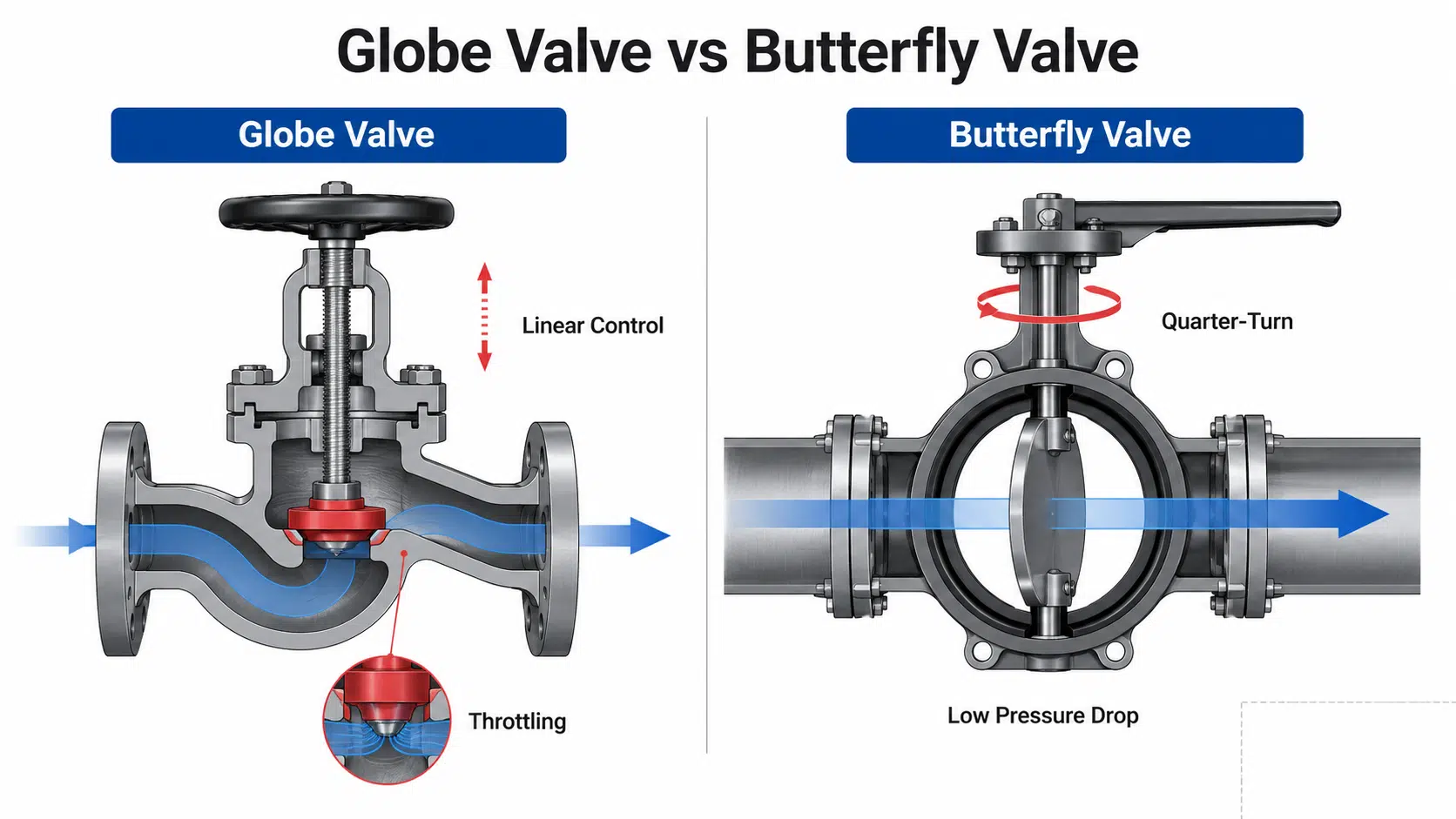
Key Difference in One Sentence
The main difference between a globe valve and a butterfly valve is how each valve controls flow. A globe valve uses linear stem movement to move a plug or disc toward the seat, making it better suited for precise throttling and flow regulation. A butterfly valve uses quarter-turn rotary motion to rotate a disc inside the pipeline, making it more compact and efficient for large-flow service, quick operation, and lower pressure drop.
In a typical industrial valve selection, a globe valve is usually preferred when the process needs accurate control, stable throttling, or pressure regulation. A butterfly valve is usually preferred when the project needs a lighter valve, shorter face-to-face length, lower flow resistance, quick shutoff, or a practical solution for larger pipe sizes.
The correct choice is not based only on the valve name. It should be checked against the medium, flow rate, pressure, temperature, required control accuracy, allowable pressure drop, leakage expectation, pipe size, seat design, actuation method, and maintenance access. A wrong selection can leave a control loop unstable, place an unnecessarily restrictive valve in a low-loss isolation line, increase pump load over time, or create maintenance problems that could have been avoided during specification.
When the Choice Usually Favors Each Valve
Escolha um válvula globo when the process needs controlled adjustment rather than simple open-close operation. This includes throttling service, pressure control, flow balancing, steam regulation, chemical dosing, bypass control, and services where the valve position may stay partially open for long periods.
Escolha um válvula borboleta when the system needs a compact valve for isolation, large-flow handling, low pressure loss, fast operation, or large-diameter piping. Butterfly valves are common in water, cooling water, HVAC, wastewater, utility lines, and many general industrial services where space, weight, and pressure drop matter.
For severe service, high differential pressure, cavitation risk, abrasive media, high temperature, or strict leakage requirements, the valve design, seat material, trim, body pattern, pressure class, and datasheet must be reviewed before final specification.
Globe Valve vs Butterfly Valve at a Glance
Key Difference Comparison Table
| Fator de seleção | Válvula globo | Válvula borboleta | What It Means for Selection |
|---|---|---|---|
| Função principal | Flow regulation, throttling, pressure control, isolation when specified | Isolation, large-flow service, quick operation, limited or special throttling depending on design | Choose globe when control accuracy is the main requirement; choose butterfly when compact, low-resistance flow service is the main requirement. |
| Motion type | Linear motion | Quarter-turn rotary motion | Globe valves adjust seat opening gradually; butterfly valves rotate a disc through the flow path. |
| Elemento de fechamento | Plug or disc moving toward / away from the seat | Disc rotating inside the valve body | The different closure movement creates different control and pressure drop behavior. |
| Caminho do fluxo | More tortuous path through the body | More direct path, with the disc remaining in the flow stream | Globe valves usually create higher pressure drop; butterfly valves usually create lower pressure drop when fully open. |
| Aceleração | Stronger for precise continuous regulation | Possible in some services, but usually less precise unless special design and actuator control are used | Use a globe valve first for fine continuous modulation. Use a butterfly valve for throttling only after checking opening-angle sensitivity, actuator control, and allowable pressure drop. |
| Control accuracy | Generally better | Generally lower for precise modulation | Butterfly valves may be suitable for coarse control or engineered control packages, but the valve, actuator, and service conditions must be reviewed together. |
| Queda de pressão | Normalmente mais alto | Usually lower in fully open large-flow service | Low pressure drop often drives butterfly valve selection for isolation or transfer service; a controlled pressure drop may be acceptable or necessary in regulation service. |
| Cv / flow capacity | Often lower for the same nominal size because of body geometry | Often higher because of a more open flow path | Cv must be checked from manufacturer data for the specific body, trim, disc, and opening condition. |
| Size and weight | Usually heavier and larger | Usually lighter and more compact | Large pipe size, limited space, lifting limits, and pipe support constraints often push the first review toward butterfly valves. |
| Operation speed | Multi-turn or actuator-controlled linear travel | Operação rápida com um quarto de volta | Butterfly valves are often easier for quick open-close operation. |
| Cost direction | Often higher in larger sizes and control-grade designs | Often lower in larger sizes, but special designs can increase cost | Compare total ownership, not only purchase cost. |
| Manutenção | More internal parts and seat / trim review may be needed | Simpler structure, but seat, disc, shaft, and seal condition still matter | Maintenance cost depends on service, material, access, operating frequency, and valve design. |
| Previsão de interrupção | Depends on disc / plug, seat, trim, and leakage requirement | Depends strongly on seat type, offset design, and sealing material | Specify the leakage expectation and seat design; do not assume shutoff performance from valve type alone. |
| Common fit | Steam control, chemical dosing, process regulation, bypass control | Cooling water, large pipelines, utility systems, isolation, low-pressure-drop service | Final selection should follow service conditions, not a generic ranking. |
What the Table Means for Industrial Valve Selection
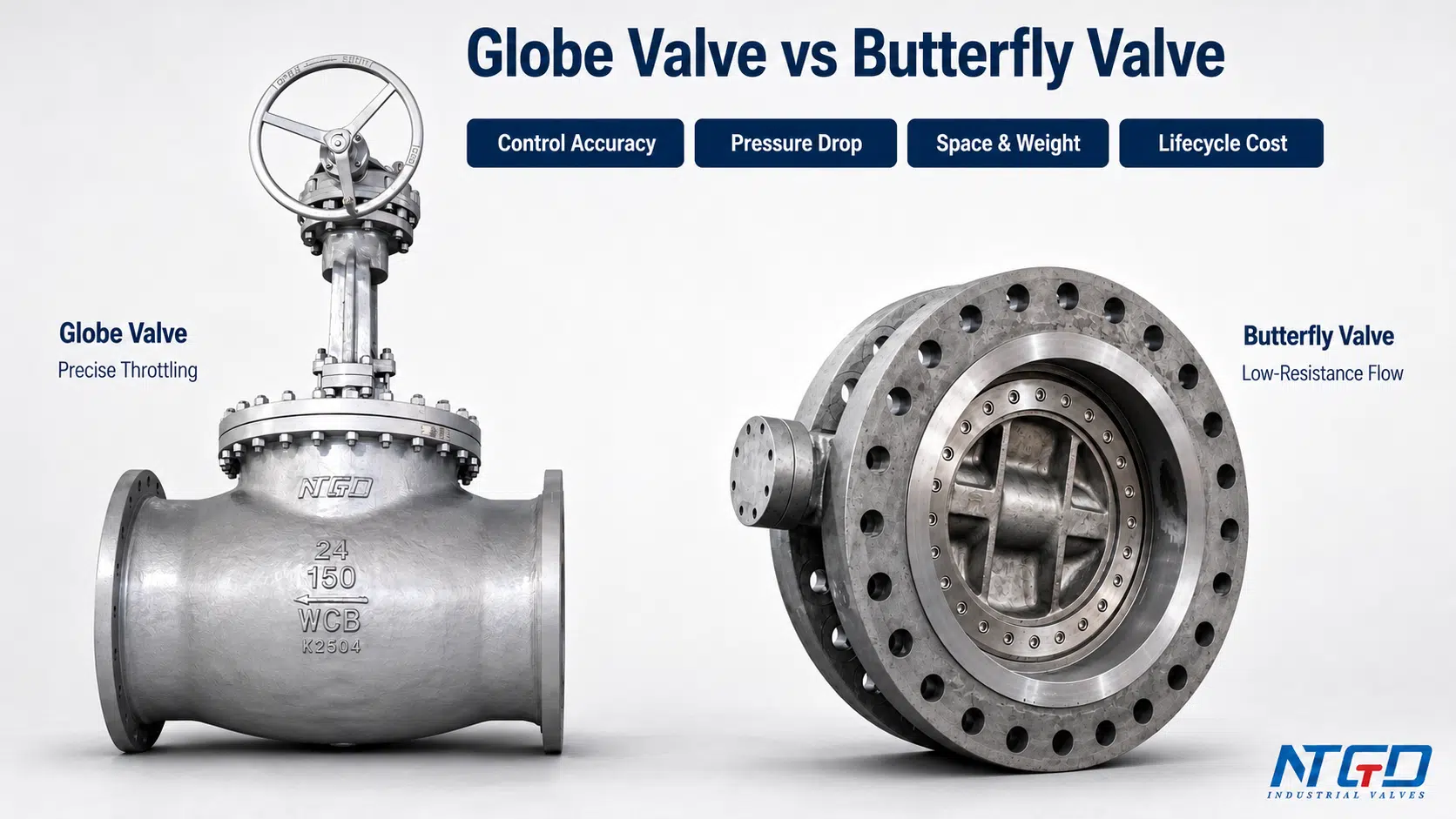
The table shows why a globe valve and a butterfly valve are rarely interchangeable in demanding applications. A globe valve creates a controlled restriction inside the valve body. That restriction is useful when the valve must regulate flow or absorb pressure drop, but it also increases resistance when the valve is fully open.
A butterfly valve keeps a simpler and more compact flow path. Even when fully open, the disc remains in the bore, but the overall resistance is usually lower than a globe valve in similar large-flow service. This makes butterfly valves attractive when the system needs flow capacity, space savings, and lower pressure loss more than fine control accuracy.
For this reason, the decision should be framed as an engineering trade-off:
- Need precise control? Start with a globe valve review.
- Need low pressure drop and compact large-diameter isolation? Start with a butterfly valve review.
- Need both control and low pressure drop? Review the service conditions, valve design, actuator, flow characteristic, allowable pressure drop, and manufacturer data before final selection.
When the duty is control or throttling, pressure drop across the valve may be part of the control function and should be checked as a required operating condition. When the duty is full-open isolation or large-flow transfer, unnecessary resistance can become a long-term pump load and operating cost issue.
How Globe Valves and Butterfly Valves Work Differently
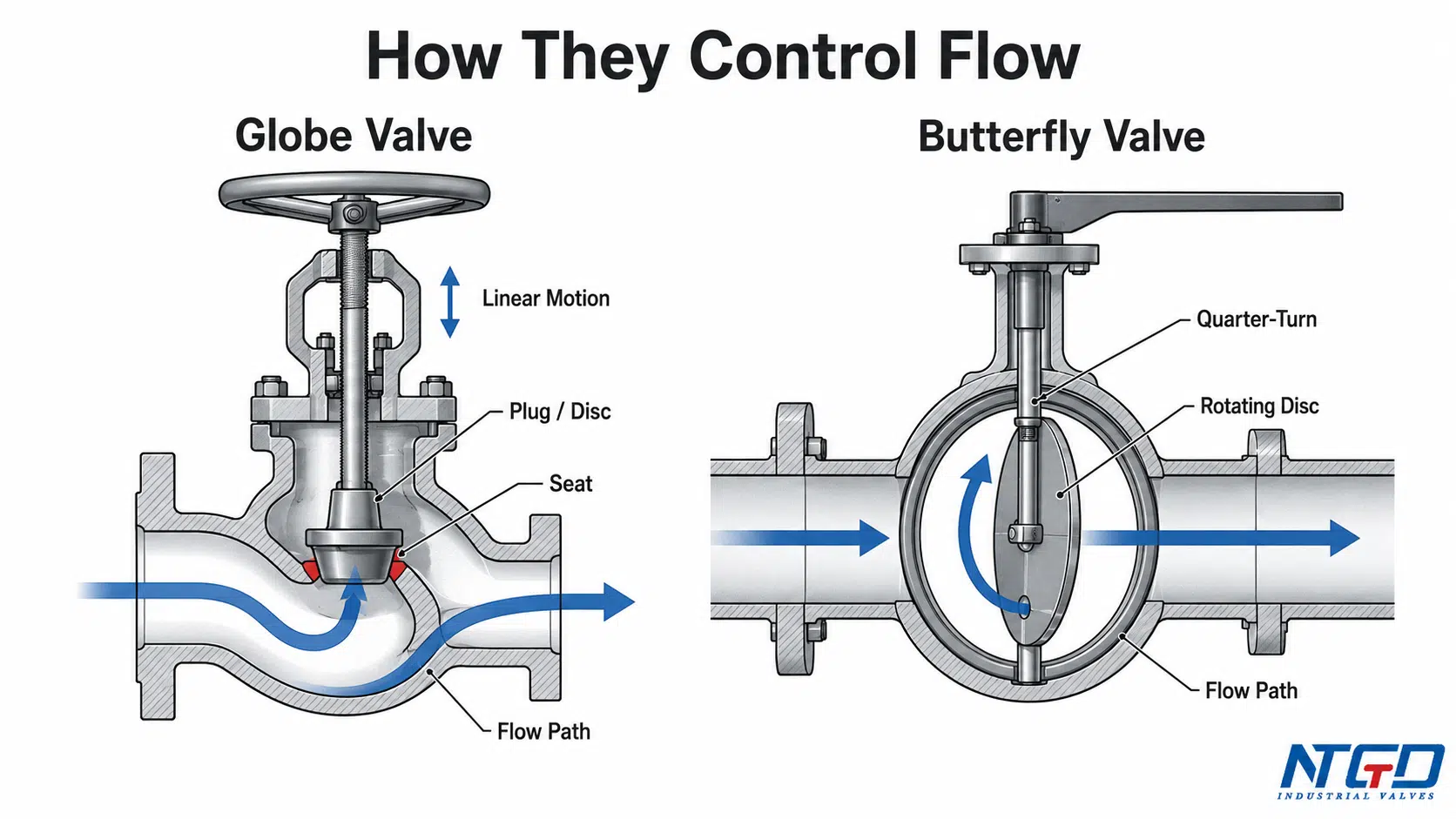
Globe Valve: Linear Plug or Disc Movement
A globe valve controls flow by moving a plug or disc in a linear direction toward or away from a seat. As the stem moves, the opening between the disc and seat changes. This controlled change in flow area allows the valve to regulate flow more gradually than many quarter-turn isolation valves.
The internal body path of a globe valve is not a straight-through full-bore path. Flow must pass through a shaped passage and around the seat area. This body geometry creates resistance, turbulence, and pressure drop. In throttling service, that pressure drop may be part of the intended control function. In simple full-open service, however, it can become an unnecessary energy loss.
Globe valves may be supplied in different body patterns and trim designs. The exact pressure drop, flow coefficient, control characteristic, and shutoff performance depend on the manufacturer’s design, body pattern, trim, seat, pressure class, and service conditions.
For readers who need a deeper explanation of internal flow path, disc-seat control and shutoff behavior, NTGD’s globe valve working principle guide provides a more focused technical overview.
Butterfly Valve: Quarter-Turn Disc Rotation
A butterfly valve controls flow with a disc mounted on a shaft. When the valve is open, the disc turns roughly parallel to the flow direction. When the valve is closed, the disc rotates across the bore to block the flow path. The operation is usually a quarter-turn motion, which makes butterfly valves fast to operate and easy to automate.
Because the body is compact and the flow path is relatively direct, a butterfly valve is commonly used where space, weight, and flow capacity matter. This is especially important in larger pipeline sizes, where a globe valve can become heavier, more expensive, and more difficult to support.
However, the disc is still inside the flow path. This means a butterfly valve is not a zero-resistance device. Disc shape, opening angle, seat type, offset design, shaft arrangement, and valve size all affect flow behavior, pressure drop, torque, and control stability.
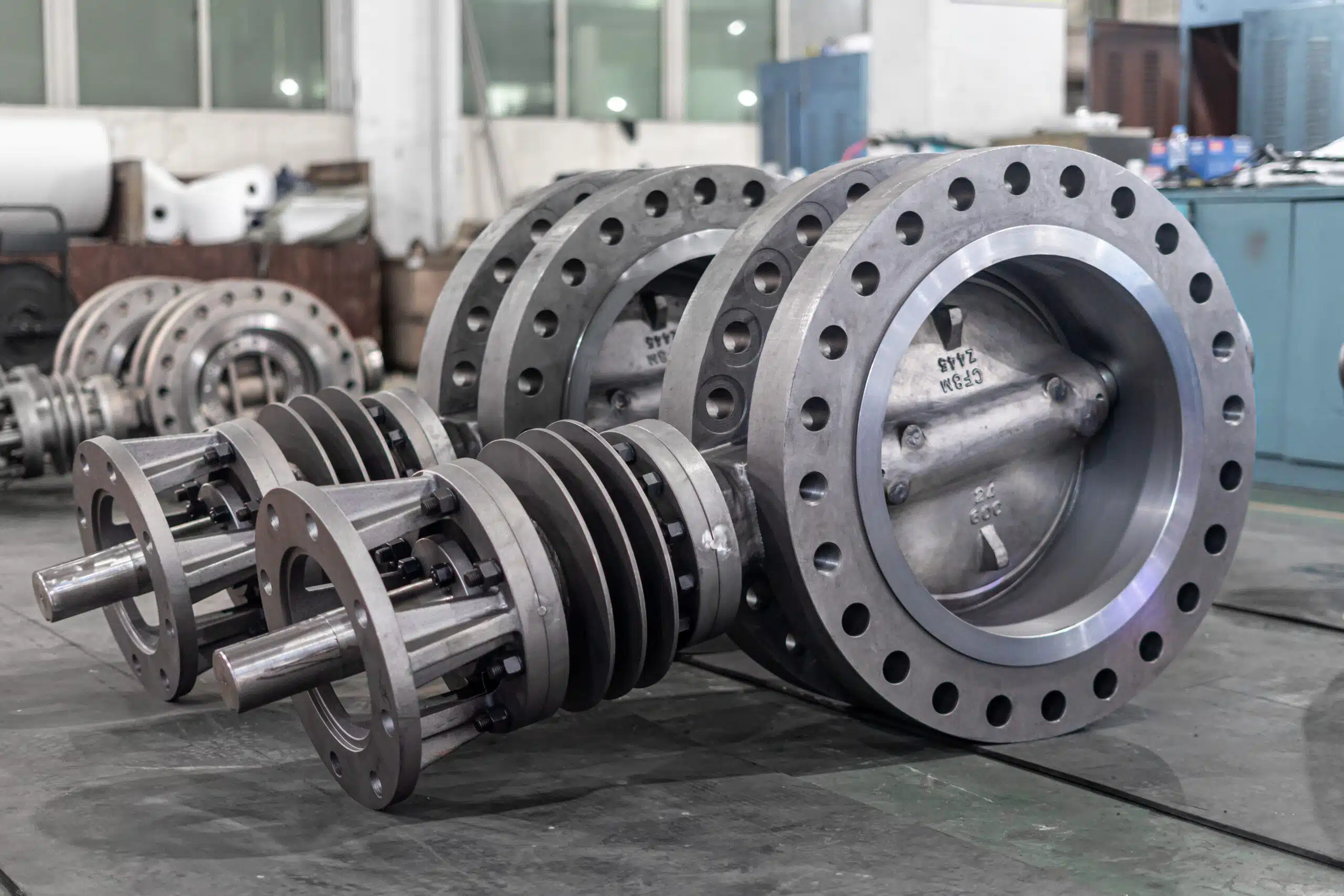
For projects where the butterfly valve will use a bolted flange-end connection, the flanged butterfly valve selection guide can be reviewed together with the seat, disc clearance, pressure class and actuator requirements.
Why Motion Type Changes Flow Control Behavior
The difference between linear motion and rotary motion directly affects valve selection.
A globe valve changes the flow opening at the seat in a more controlled way. This makes it easier to use for fine adjustment, especially when the process requires stable control over a range of valve positions.
A butterfly valve changes flow by rotating a disc in the pipeline. At some opening angles, small changes in disc position may create larger changes in flow. This can make precise control more difficult unless the valve, actuator, and control system are designed for the application.
This does not mean butterfly valves cannot be used for throttling. It means the application must be reviewed carefully. For basic isolation and large-flow service, a butterfly valve may be the more efficient choice. For precise continuous throttling, a globe valve is usually the stronger starting point. In practical terms, linear seat control is easier to review for stable modulation, while rotary disc control is usually stronger for quick operation and low-resistance flow unless the butterfly valve package is specifically engineered for modulating service.
The following video provides a visual overview of common valve types, including globe valves and butterfly valves, and can help readers understand why linear motion and quarter-turn disc movement lead to different control behavior.
Control Accuracy and Throttling
Why Globe Valves Are Usually Preferred for Precise Throttling
A globe valve is usually preferred for throttling because its plug or disc moves toward the seat in a controlled linear path. This gives the valve a more predictable relationship between stem travel and flow adjustment. In process systems where the valve may remain partially open, this control behavior is often more important than low full-open pressure drop.
Globe valve throttling is common in services such as:
- steam flow regulation;
- process water balancing;
- chemical dosing;
- bypass control;
- pressure reduction;
- flow control on smaller or medium line sizes;
- applications where stable modulation is more important than minimum energy loss.
The trade-off is that a globe valve normally creates higher resistance than a butterfly valve. This is not always a disadvantage. In control service, a controlled pressure drop across the valve may be required. The key is to make sure the valve is selected for the actual control duty, not simply installed because it is called a globe valve.
Can a Butterfly Valve Be Used for Throttling?
A butterfly valve can be used for throttling in some services, especially when the required control is not extremely precise and the pressure drop is relatively moderate. High-performance butterfly valves, triple-offset butterfly valves, special disc designs, and suitable actuators can expand the usable control range in certain applications.
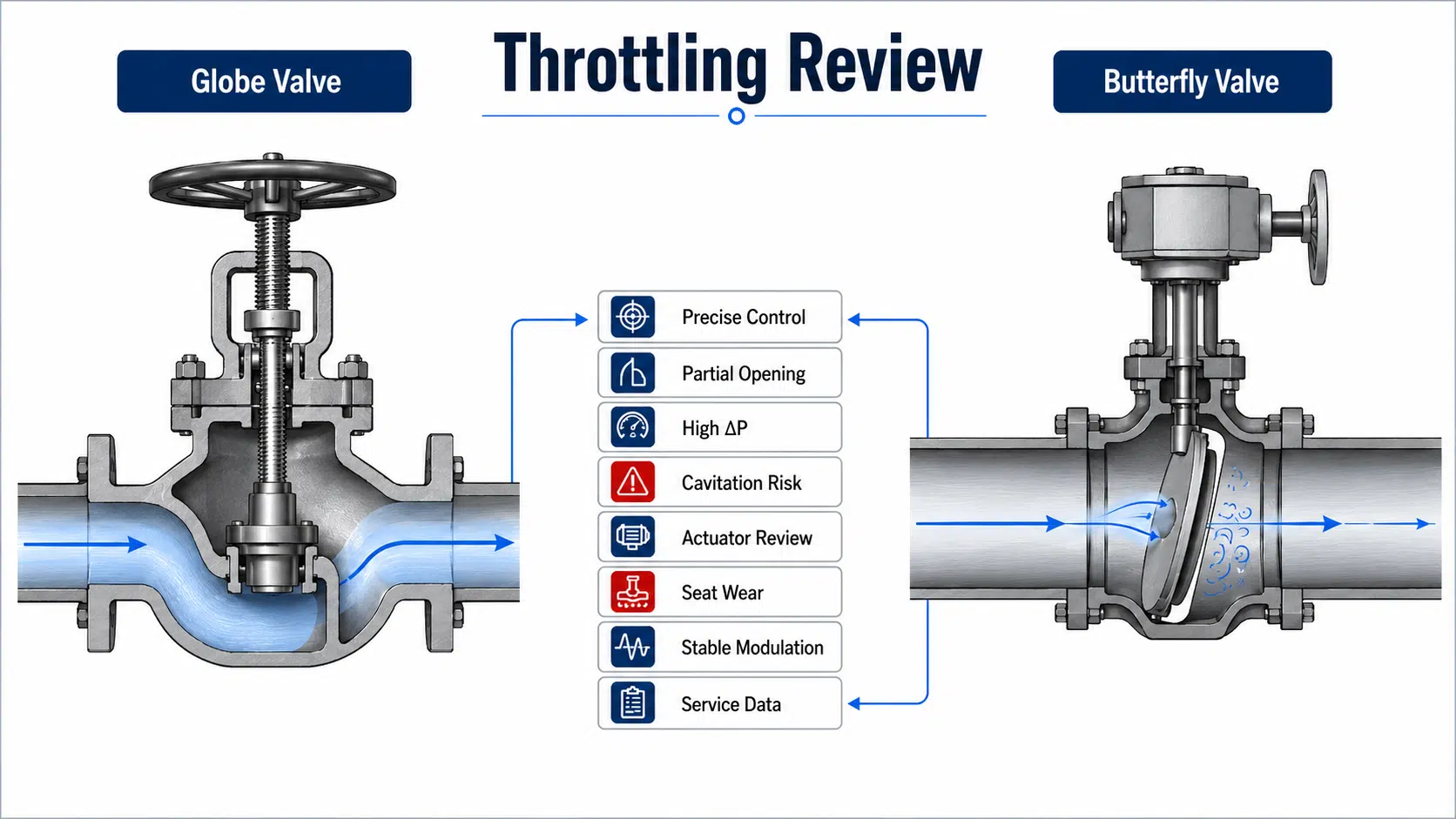
However, a butterfly valve should not be treated as a direct replacement for a globe valve in every throttling service. At partial opening, the disc can create turbulence, uneven flow distribution, vibration, noise, torque variation, or control instability. These risks depend on flow rate, pressure drop, media, valve size, disc design, actuator selection, and installation conditions.
When butterfly valve throttling is being considered, this butterfly valve Cv by opening position reference helps show why opening angle and manufacturer data should be checked before final use.
A standard butterfly valve should not be assumed suitable for high-accuracy continuous modulation, high differential pressure, flashing or cavitation risk, long-term low-opening throttling, or critical process control. In unsuitable throttling service, the result can be vibration, noise, accelerated seat wear, shaft or packing stress, unstable process response, and unplanned maintenance.
For rough regulation, balancing, or non-critical modulation, a butterfly valve may be acceptable. For precise continuous control, high differential pressure, severe throttling, flashing, cavitation, or critical process stability, the design review should be stricter.
Throttling Limits, High Differential Pressure and Special Design Review
The selection becomes more sensitive when differential pressure is high. A valve used for throttling must control flow without causing unacceptable noise, vibration, erosion, cavitation, seat damage, or unstable operation.
Before using a butterfly valve for throttling, check:
- whether the valve is designed for modulating service;
- the expected minimum, normal, and maximum flow rate;
- the pressure drop across the valve at different positions;
- disc and seat material compatibility;
- actuator torque margin;
- required control accuracy;
- expected operating frequency;
- whether the valve will stay partially open for long periods.
Before using a globe valve for throttling, also check:
- pressure drop and energy impact;
- trim suitability;
- erosion or cavitation risk;
- temperature and pressure limits;
- actuator force requirement;
- whether the body pattern fits the allowable pressure loss.
A valve type can suggest a starting direction, but the final decision must be verified against the project specification and manufacturer data.
Queda de pressão e eficiência de fluxo
Why Globe Valves Usually Create Higher Pressure Drop
A globe valve usually creates higher pressure drop because the fluid must pass through a more restrictive internal body path. The flow changes direction around the seat and plug area, which increases resistance compared with a more direct flow path.
This pressure drop is one reason globe valves are widely used for flow control. The valve is designed to create a controllable restriction. When the application needs regulation, this restriction helps the valve adjust flow. If a globe valve is used only for simple on-off isolation, the same internal restriction may become a continuous, unnecessary energy loss and increase the load on the pumping system.
Pressure drop through a globe valve depends on:
- padrão corporal;
- design de acabamento;
- tamanho da válvula;
- posição de abertura;
- taxa de fluxo;
- fluid density and viscosity;
- pressão e temperatura;
- upstream and downstream piping;
- manufacturer Cv data.
If body pattern is already a key concern in the project, the tee pattern and Y-pattern globe valve comparison can help explain why different globe valve body geometries may create different pressure-drop penalties.
For this reason, a globe valve should not be selected only by nominal pipe size. The allowable pressure drop and required flow capacity should be checked during specification.
Why Butterfly Valves Usually Have Lower Pressure Drop in Large-Flow Service
A butterfly valve usually has lower pressure drop than a globe valve when it is fully open in large-flow service. The body is shorter and the flow path is more direct. Although the disc remains in the bore, the total obstruction is often lower than the internal restriction of a globe valve.
This is why butterfly valves are frequently selected for:
- large-diameter water lines;
- cooling water systems;
- utility piping;
- pump discharge isolation;
- wastewater and general industrial service;
- applications where energy loss must be limited;
- systems where installation space and valve weight are major concerns.
Lower pressure drop can reduce pump load and improve flow efficiency. However, the valve still needs to meet shutoff, pressure, temperature, material, and seat requirements. A low pressure drop valve is not automatically the correct valve if the process requires precise control.
Cv, Opening Position and Fully Open vs Throttling Conditions
Cv is one of the values used to compare valve flow capacity. In general, a higher Cv indicates that a valve can pass more flow at a given pressure drop. But Cv must be taken from manufacturer data, not assumed only from the valve type.
| Pressure Drop Factor | Válvula globo | Válvula borboleta | Nota de seleção |
|---|---|---|---|
| Fully open resistance | Usually higher because of internal body path | Usually lower because of compact body and direct flow path | Important for energy efficiency and large-flow service. |
| Throttling behavior | Usually more stable for precise regulation | Can be less linear and more sensitive to opening angle | Important for control accuracy and process stability. |
| Cv / flow capacity | Must be checked by size, body pattern, and trim | Must be checked by size, disc design, and opening angle | Do not use generic assumptions for final sizing. |
| Energy implication | Higher pressure drop can increase pumping cost if not needed for control | Lower pressure drop can reduce energy loss in suitable service | Cost review should include OPEX, not only valve purchase cost. |
| Melhor ajuste | Control duty, pressure regulation, precise throttling | Large-flow, compact, low-loss isolation or coarse control | Final choice depends on service duty. |
For a case-based discussion of Cv, bypass valve selection and the trade-off between globe and butterfly valve behavior, see this bypass valve selection case study.
Cv should be verified for the exact body pattern, trim or disc design, opening position, and operating condition using manufacturer data. A generic valve-type comparison is useful for screening, but it is not a substitute for final sizing or specification review.
For the basic relationship between Cv, flow capacity and pressure drop, refer to this flow coefficient Cv reference before using manufacturer data for final sizing.
A useful rule is to separate two different questions:
- What is the pressure drop when the valve is fully open?
This matters for flow efficiency, pump load, and operating cost. - What pressure drop is required for control?
This matters for throttling, pressure regulation, and stable process operation.
The valve with the lowest pressure drop is not always the best control valve. If the duty is control, review controllable pressure drop, stability, and trim design first. If the duty is large-flow isolation or transfer, review low resistance, energy efficiency, and installation practicality first.
Size, Weight, Space and Cost
Large-Diameter Pipeline Considerations
In larger pipe sizes, butterfly valves often become more practical than globe valves because they are generally lighter, shorter, and easier to fit into limited spaces. A large globe valve may require more structural support, more installation room, and more operating force or actuator capacity.
This does not mean globe valves are never used in larger sizes. It means the project should have a strong control or process reason for selecting one. If the application is mainly isolation or low-resistance flow, a butterfly valve often offers a more practical layout.
Large-diameter selection should consider:
- espaço presencial disponível;
- pipe support and valve weight;
- actuator access;
- acesso para manutenção;
- lifting and installation method;
- queda de pressão permitida;
- desempenho de desligamento necessário;
- torque or operating force.
CAPEX, Installation Space and Support Requirements
Cost should not be reduced to purchase price. A valve selection affects several cost layers:
| Cost Layer | Globe Valve Consideration | Butterfly Valve Consideration |
|---|---|---|
| Custo inicial da válvula | May be higher, especially in larger sizes or control-grade designs | Often lower in larger sizes, but high-performance designs can increase cost |
| Espaço de instalação | Usually needs more space because of body shape and actuator arrangement | Usually more compact |
| Suporte para tubulação | Higher weight may require stronger support | Lower weight may reduce support burden |
| Atuação | Linear actuator or multi-turn operation may increase cost | Quarter-turn actuation is often simpler |
| Commissioning | Control service may require closer setup and verification of stable operating range | Isolation service is often simpler, but modulating use still needs control and torque review |
| Spare parts / maintenance | Trim, seat, and packing may need more detailed review | Seat, disc, shaft seals, and actuator torque remain important, especially in large sizes |
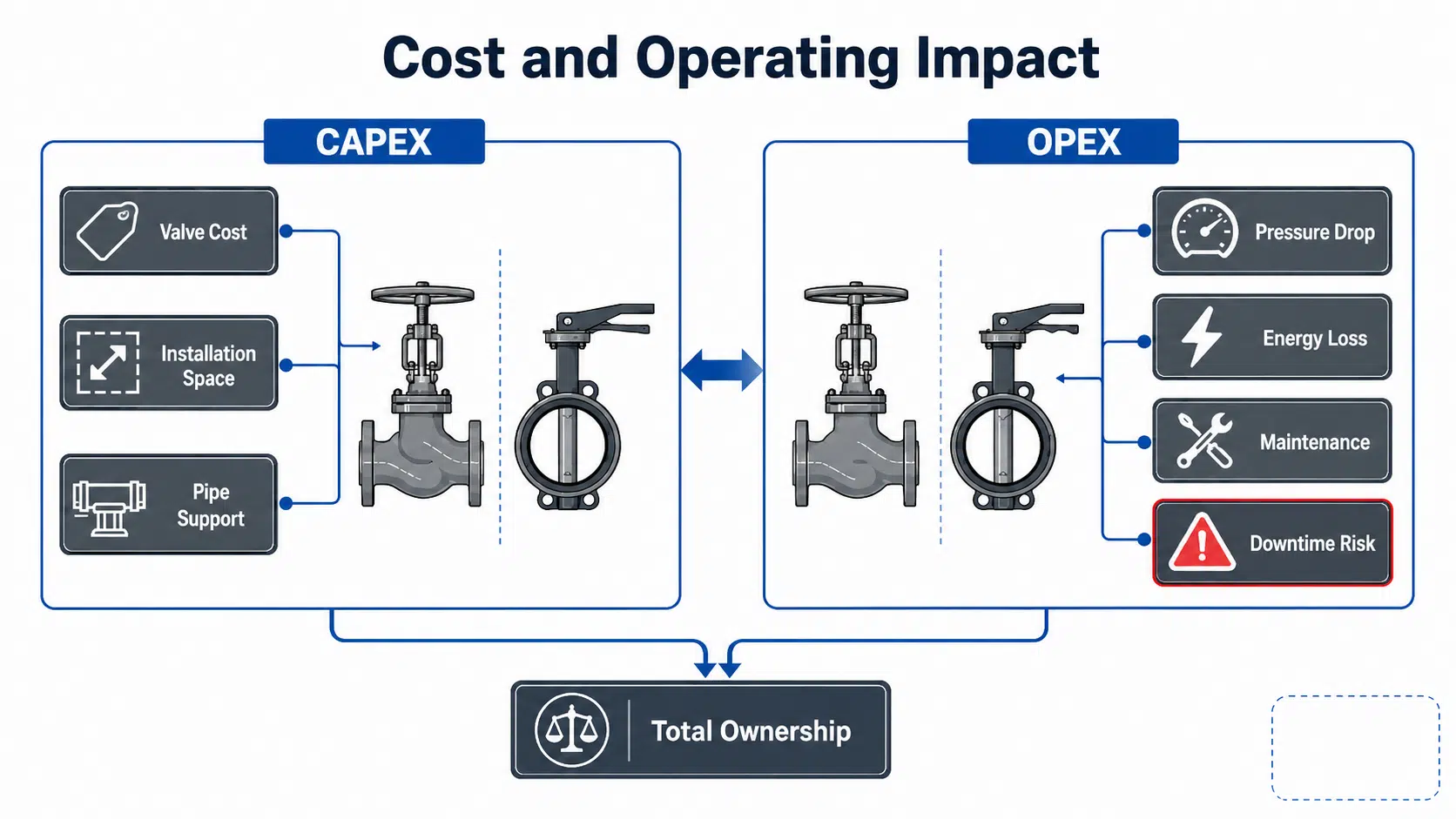
For a buyer, the lowest initial valve cost is not always the lowest project cost. If the valve causes unnecessary pressure loss, unstable control, difficult maintenance, or premature seat damage, total ownership cost can increase.
OPEX: Energy Loss, Maintenance and Downtime
Operating cost is strongly linked to pressure drop, control stability, and maintenance frequency. A globe valve that is necessary for precise control may justify its higher pressure drop. A globe valve used only for full-open isolation may waste energy in a system where a lower-resistance valve could perform the duty.
A butterfly valve can reduce pressure loss in the right service, but if it is used for unsuitable throttling, the system may experience unstable flow, vibration, seat wear, or poor control. Continuous throttling, long-term full-open isolation, and frequent cycling create different OPEX risks. The wrong valve type can shift an apparent purchase-cost saving into energy loss, maintenance work, actuator problems, or downtime over the service life.
A practical cost comparison should include:
- purchase cost;
- installation labor;
- valve weight and support;
- actuator cost;
- expected pressure drop;
- pump energy;
- acesso para manutenção;
- downtime risk;
- spare part availability;
- service life under the actual medium.
Sealing, Maintenance and Service Limits
Shutoff Expectations Depend on Seat and Design
Shutoff performance is controlled by seat design, sealing structure, pressure class, temperature, medium, cycling frequency, and leakage requirement. It is not safe to claim that one valve type always seals better than the other.
Globe valves can provide controlled closure against a seat and may be suitable for many isolation and control duties when correctly specified. Butterfly valves can also provide tight shutoff in many services when the seat and offset design match the application. For example, soft-seated butterfly valves may suit many clean, lower-temperature services that require tight shutoff, while metal-seated or high-performance butterfly valves and globe valve trim must be checked against temperature, pressure, media, cycling, and leakage expectation.
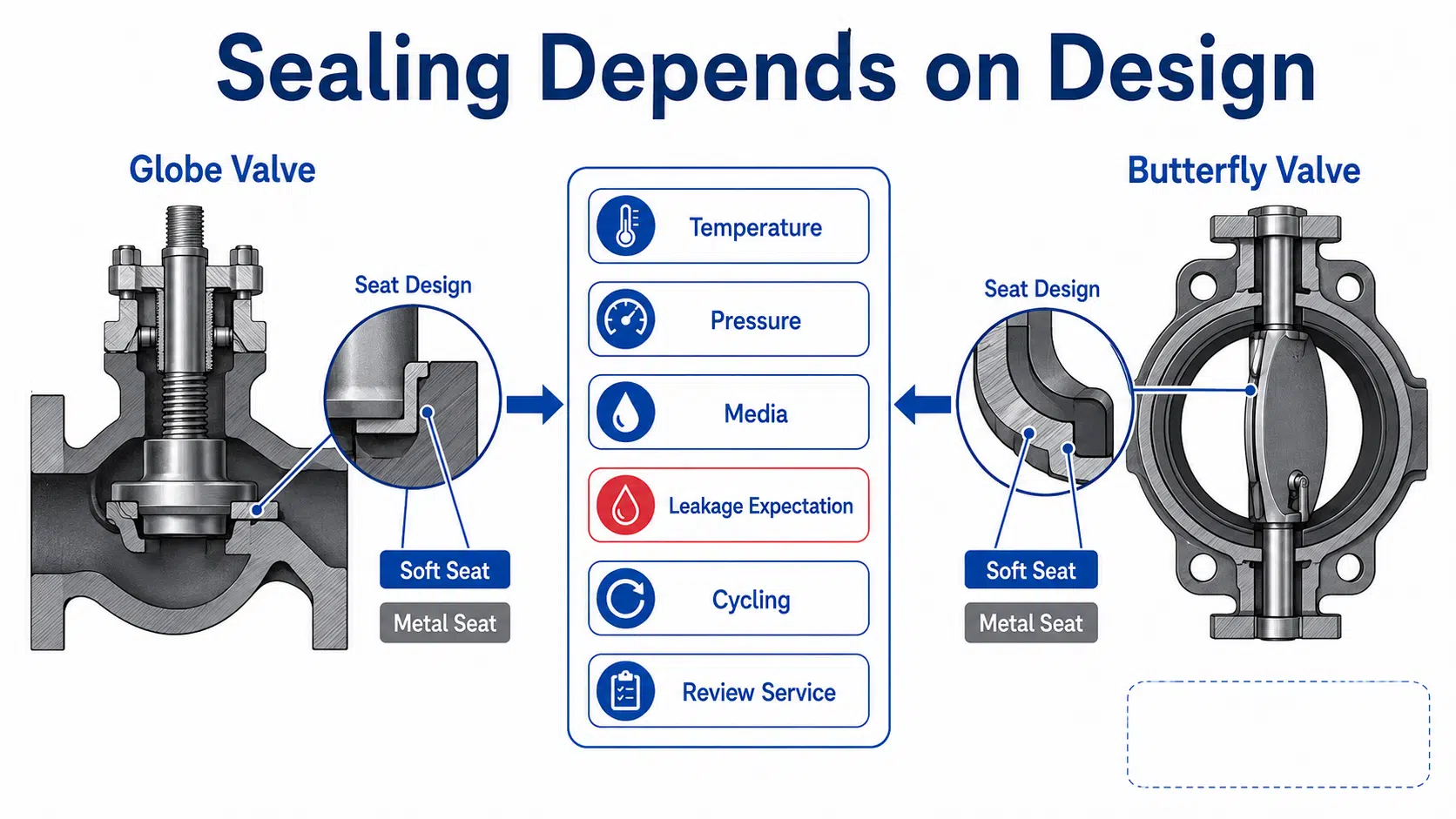
For both valve types, the leakage expectation should be stated in the project specification. If the service needs strict shutoff, high temperature, abrasive media, vacuum, hazardous media, or frequent cycling, the seat design and applicable test or leakage requirements should be confirmed before purchase.
Maintenance Access and Serviceability
Globe valves often have more internal control components, such as plug or disc, seat, stem, packing, and trim. This can make maintenance more detailed, but it may also provide repair and trim options depending on design.
Butterfly valves usually have simpler construction and fewer major internal parts. This can make them easier to handle, especially in larger sizes. However, the disc, shaft, seat, liner, and seals remain critical. If the seat is damaged or the shaft seal leaks, maintenance access and spare parts still matter.
Maintenance review should include:
- access around the valve;
- whether the valve can be removed without major piping changes;
- seat replacement method;
- packing or shaft seal maintenance;
- actuator access;
- frequência de operação;
- limpeza da mídia;
- spare parts and documentation.
Media, Solids, Temperature and Pressure Boundaries
The medium can change the selection. Clean fluids, steam, gas, corrosive service, slurry, viscous media, and fluids with suspended solids do not behave the same way.
A globe valve may not be ideal if the medium contains heavy solids that can collect around internal passages or damage the trim. A butterfly valve may be more open in the flow path, but disc edge, seat, liner, and shaft areas can still be affected by abrasive or corrosive media.
High temperature and high pressure also affect seat material and valve design. A soft seat that works well in water service may not fit high-temperature service. A metal seat may handle harsher conditions but may have different leakage expectations. These boundaries should be checked during RFQ and specification review.
When to Choose a Globe Valve or a Butterfly Valve
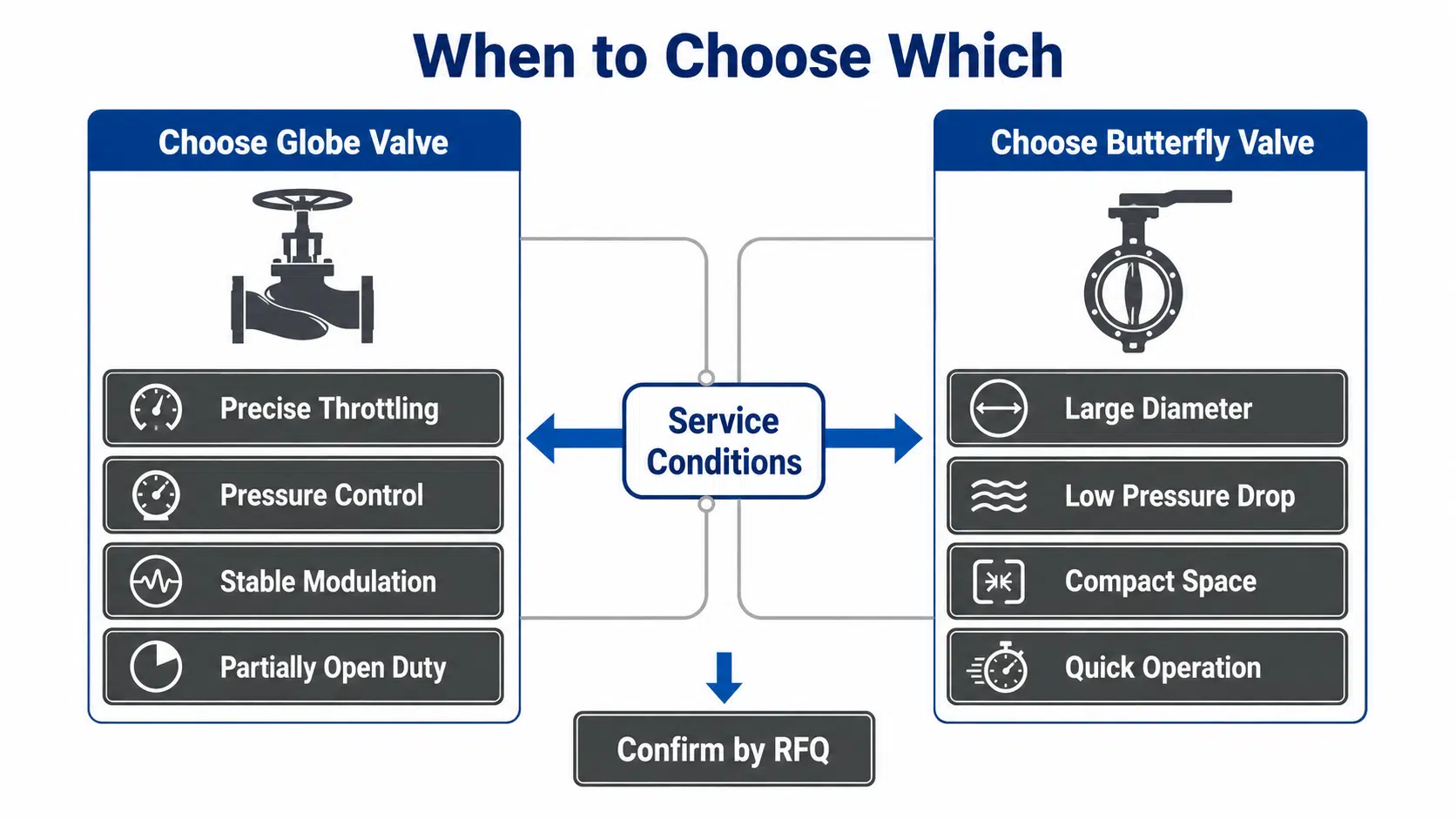
Choose a Globe Valve If…
Choose a globe valve when the service needs controlled regulation more than minimum pressure drop.
| Condição de serviço | Direção de seleção | Por que |
|---|---|---|
| Precise throttling is required | Válvula globo | Linear motion and seat control usually provide better modulation. |
| Flow must be adjusted frequently | Válvula globo | The valve is designed for controlled opening positions. |
| Pressure reduction is part of the process | Válvula globo | Higher pressure drop may be required for control. |
| Steam or process regulation is needed | Válvula globo | Stable control is often more important than compact size. |
| Smaller or medium line sizes need control | Válvula globo | Size and cost penalties may be acceptable for better control. |
| The valve will remain partially open | Válvula globo | Globe valves are generally more suitable for continuous throttling. |
A globe valve is not automatically the best valve for every service. It should be selected when its control advantage is actually needed.
Choose a Butterfly Valve If…
Choose a butterfly valve when the service needs compact design, quick operation, and lower pressure loss more than precise modulation.
| Condição de serviço | Direção de seleção | Por que |
|---|---|---|
| Large-diameter piping | Válvula borboleta | Short face-to-face design and lighter weight are practical advantages. |
| Low pressure drop is important | Válvula borboleta | Fully open resistance is usually lower than a globe valve. |
| Quick open-close operation is required | Válvula borboleta | Quarter-turn operation is fast and simple. |
| Space is limited | Válvula borboleta | Compact body helps reduce installation footprint. |
| General isolation service | Válvula borboleta | Suitable when precise throttling is not the main duty. |
| Utility water, cooling water or similar service | Válvula borboleta | Often practical for large-flow, low-resistance systems. |
A butterfly valve should still be reviewed for seat design, pressure rating, temperature, torque, media compatibility, and leakage expectation.
Review Carefully Before Final Specification
Some services require more careful review before selecting either valve type:
| Review Condition | Por que é importante |
|---|---|
| High differential pressure | Can increase noise, vibration, cavitation, erosion, actuator load, or unstable control. |
| Critical throttling | May require globe valve trim or a control-grade valve design. |
| Strict leakage requirement | Seat design and leakage expectation must be confirmed before purchase. |
| Abrasive or slurry service | Trim, disc, seat, liner, and body wear must be evaluated. |
| Alta temperatura | Seat, packing, body, and trim materials must be compatible. |
| Large actuator torque | Operation method and safety margin must be checked. |
| Espaço de instalação limitado | Face-to-face length, handwheel / actuator clearance, lifting access, and maintenance access matter. |
| Andar de bicicleta com frequência | Seat wear, packing wear, shaft sealing, and actuator life should be reviewed. |
A practical selection process starts with valve type, but it does not end there. If these conditions are not checked, the project may face control instability, excessive energy loss, seat or trim damage, actuator overload, or unplanned downtime. The RFQ checklist below should be used to confirm the service data before final valve selection.
RFQ Checklist Before Final Valve Selection
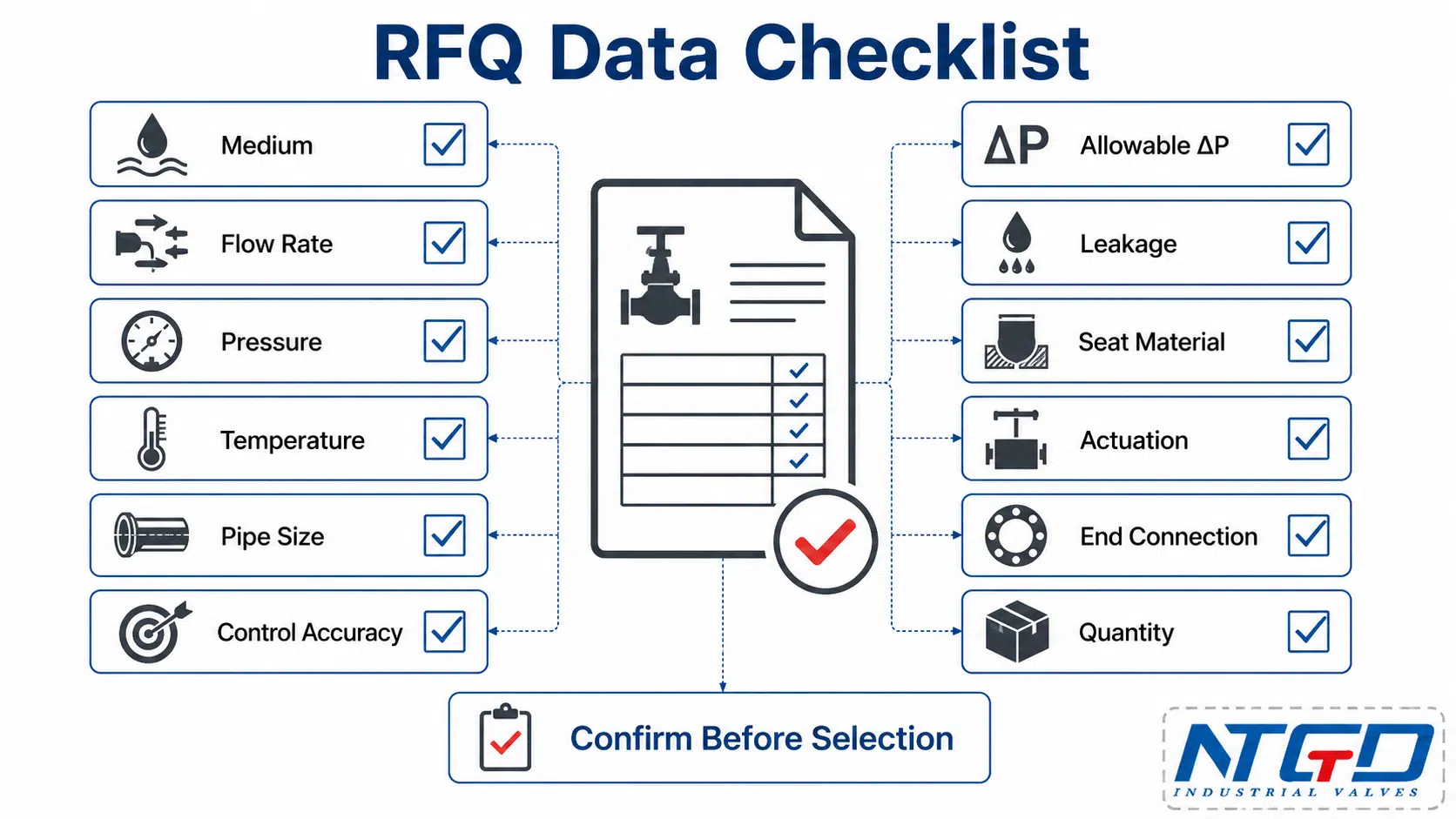
Process Data to Confirm
Before requesting a quotation or finalizing a valve type, prepare the process conditions. This helps avoid selecting a valve that looks correct in a general comparison but fails in the actual system.
For a broader valve-type screening process before RFQ, use NTGD’s Guia de seleção de válvulas industriais together with the service-specific checklist below.
| Dados da solicitação de cotação | Por que é importante |
|---|---|
| Médio | Determines material, seat, trim, and corrosion resistance. |
| Taxa de fluxo | Affects valve size, Cv, and pressure drop. |
| Pressão operacional | Determines pressure class and body design. |
| Temperatura operacional | Affects seat, packing, body, and trim material. |
| Tamanho do tubo | Influences valve type, weight, cost, and installation space. |
| Required control accuracy | Determines whether globe valve or control-grade butterfly design should be reviewed. |
| Queda de pressão permitida | Critical for pump load, control duty, and flow efficiency. |
| Solid content or slurry risk | Affects wear, blockage, and seat damage. |
| Previsão de vazamento | Determines seat design and shutoff requirements. |
| Frequência de operação | Affects seat wear, actuator selection, and maintenance. |
Valve Design and Operation Data to Confirm
After the process data is clear, confirm the valve-specific requirements.
| Dados da válvula | Por que é importante |
|---|---|
| Tipo de válvula | Confirms whether globe valve or butterfly valve is being reviewed. |
| Material da carroceria | Must match pressure, temperature, and corrosion conditions. |
| Material do assento | Controls shutoff, temperature range, and media compatibility. |
| Trim / disc / plug material | Affects erosion, corrosion, and control behavior. |
| Conexão final | Must match piping specification. |
| Classificação de pressão | Must match project pressure and temperature requirements. |
| Método de acionamento | Manual, gear, electric, pneumatic, or hydraulic operation affects control and cost. |
| Control requirement | On-off, throttling, or modulating duty must be clear. |
| Orientação da instalação | Must follow the manufacturer’s instruction and piping layout. |
| Inspection / testing requirement | Should be aligned with project specification and applicable standards. |
| Quantity and project schedule | Helps confirm production and delivery planning. |
| Requisito de documentação | Datasheet, drawing, material certificate, or test record may be required by the project. |
This checklist is especially important when comparing globe valve vs butterfly valve options for the same service. The wrong valve type may still fit the pipe size but fail the operating requirement.
PERGUNTAS FREQUENTES
Qual é a principal diferença entre uma válvula de esfera e uma válvula borboleta?
Uma válvula de esfera utiliza o movimento linear do obturador ou do disco contra uma sede, por isso é mais adequada para o controle de vazão. Uma válvula borboleta utiliza a rotação do disco em um quarto de volta, por isso é mais rápida de operar, mais compacta e, geralmente, mais adequada para serviços com grande vazão e menor queda de pressão.
Qual válvula apresenta menor queda de pressão?
A butterfly valve usually has lower pressure drop than a globe valve when fully open, especially in large-flow service. A globe valve usually creates higher pressure drop because the flow path is more restrictive. Actual pressure drop still depends on valve size, body design, opening position, flow rate, and manufacturer Cv data.
Is a globe valve better for throttling?
For many industrial duties that require continuous modulation and stable flow control, a globe valve is usually the better first review choice. Its linear movement gives more controlled adjustment at the seat. High differential pressure, cavitation risk, flashing, erosion, or severe service still require trim and design review.
Can a butterfly valve be used for throttling?
Yes, a butterfly valve can be used for throttling in some applications when the required control accuracy and pressure drop are acceptable. It should be reviewed carefully for partial-opening stability, actuator control, torque, seat wear, vibration, and media conditions. It should not be assumed to replace a globe valve in critical continuous control service.
When should I choose a globe valve instead of a butterfly valve?
Choose a globe valve when the service needs precise flow control, frequent throttling, pressure regulation, stable modulation, or a controlled pressure drop. It is often a stronger option for process control, steam regulation, chemical dosing, and smaller or medium control lines.
When should I choose a butterfly valve instead of a globe valve?
Choose a butterfly valve when the service needs compact installation, quick operation, lower pressure drop, large-flow capacity, or a practical valve for larger pipe sizes. It is often suitable for water, cooling water, utility lines, wastewater, and general isolation service.
Is a globe valve more expensive than a butterfly valve?
A globe valve is often more expensive than a butterfly valve in larger sizes because it is usually heavier, longer, and more complex. However, cost depends on pressure class, material, seat design, trim, actuator, and service requirements. The better comparison is total ownership cost, including pressure drop, energy use, maintenance, and downtime.
How is a gate valve different from globe and butterfly valves?
A gate valve is mainly used for fully open or fully closed isolation with low flow resistance. It is not normally selected for precise throttling. This article focuses on globe valve vs butterfly valve selection; gate valve comparisons should be reviewed separately when the project is choosing among multiple valve types.
For that separate boundary, see NTGD’s gate valve vs globe valve comparison before expanding the decision into a three-valve review.
Conclusão
Globe valves and butterfly valves are both used in industrial piping systems, but they solve different selection problems. A globe valve is usually the better starting point when the application needs precise throttling, stable regulation, or controlled pressure drop. A butterfly valve is usually the better starting point when the application needs low pressure drop, compact installation, fast operation, and practical large-diameter service.
The key difference is not only valve shape. It is the relationship between flow control, pressure drop, space, cost, maintenance, and service condition. A globe valve can provide better control, but it usually creates more resistance. A butterfly valve can reduce weight and pressure loss, but it may not provide the same throttling stability unless the design is selected for that duty.
As a practical selection summary: review a globe valve first when the process depends on fine control or pressure regulation; review a butterfly valve first when the line needs compact, low-resistance flow handling; use the RFQ checklist when the service includes high pressure drop, strict leakage, high temperature, slurry, frequent cycling, or uncertain control requirements.
The correct selection should be confirmed with project data, including medium, pressure, temperature, flow rate, pipe size, allowable pressure drop, required control accuracy, leakage expectation, seat material, actuation, and installation conditions.
Suporte a aplicativos/especificações
If you are comparing globe valve and butterfly valve options for an industrial project, prepare the service data before final selection. NTGD Valve can review the valve type, size, pressure rating, material, seat design, actuation method, and application conditions based on your RFQ requirements.
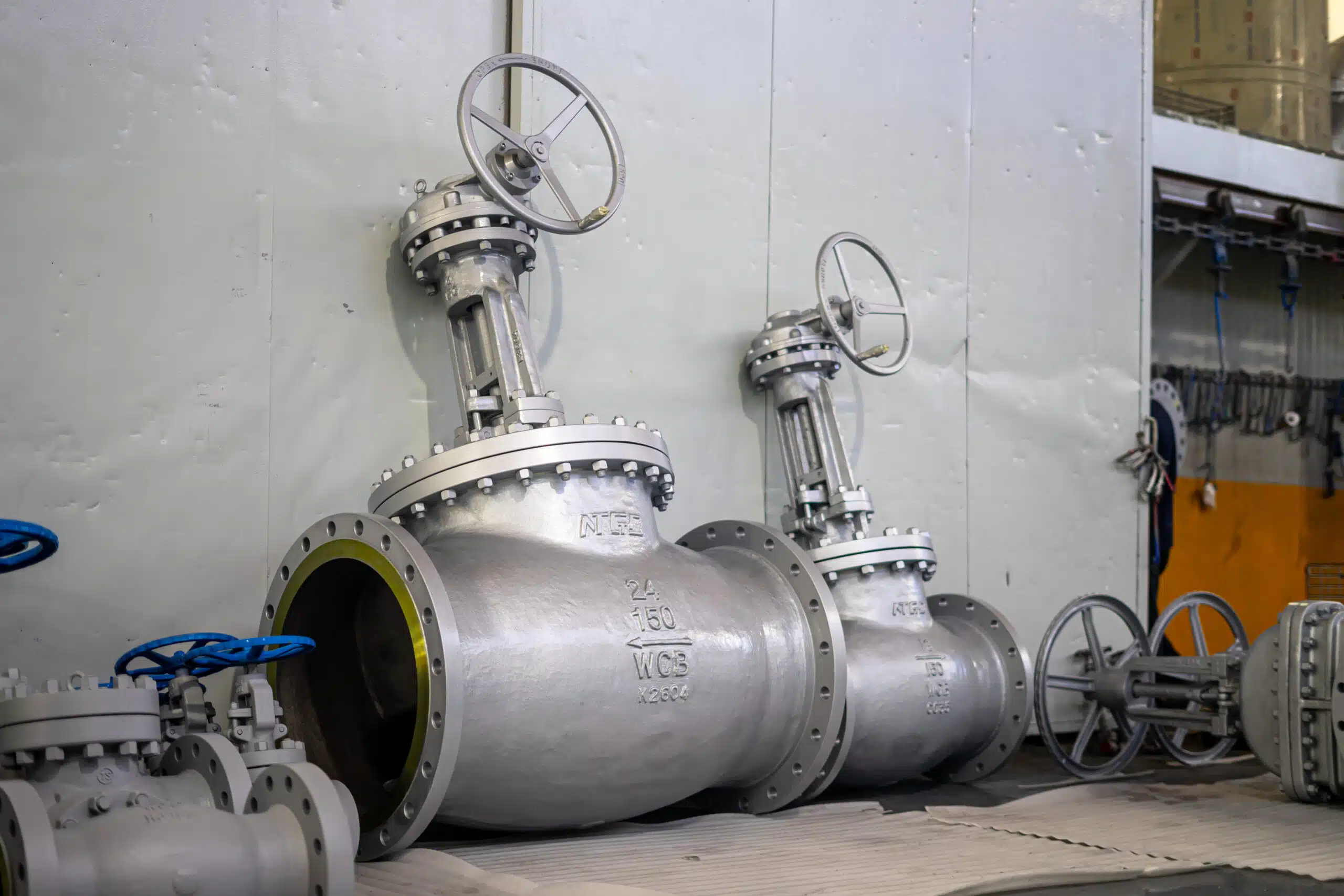
If the first review points toward globe valve regulation duty, the flange globe valve product page can support the next specification check for body material, pressure rating, end connection and operation requirements.
Complete operating data helps the engineering review focus on the correct valve fit rather than only the valve name. It can also reduce the risk of selecting a valve that fits the pipe but fails the control, pressure drop, shutoff, or maintenance requirement.
For a faster technical review, provide the medium, pressure, temperature, pipe size, flow rate, required control accuracy, allowable pressure drop, end connection, operation method, and any leakage or documentation requirements.
