
Nome do autor: Bruce Zheng
Função do autor: Cofundador e engenheiro de válvulas da NTGD Valve
Biografia do autor: Bruce Zheng é cofundador e engenheiro de válvulas da NTGD Valve, com foco na seleção de válvulas industriais, aplicação e conteúdo técnico para compradores B2B globais.
Última atualização: 24 de junho de 2026
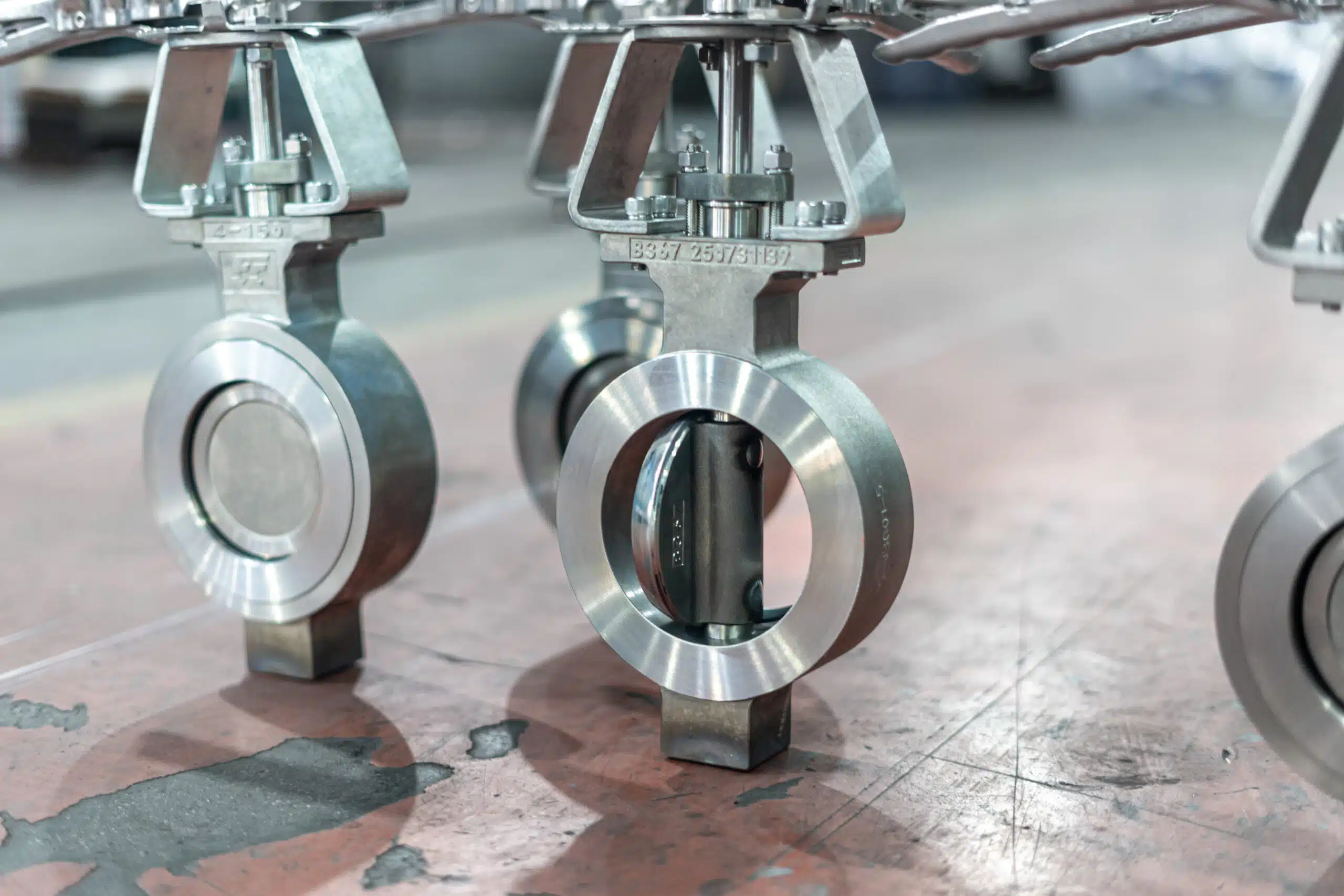
Uma válvula borboleta tipo wafer é uma válvula compacta de um quarto de volta instalada entre dois flanges de tubulação. O corpo da válvula não possui flanges completos próprios. Em vez disso, ele é centralizado entre os flanges da tubulação e mantido no lugar por parafusos ou pinos longos que passam pelos orifícios de fixação dos flanges e prendem o corpo da válvula na posição correta.
Na linguagem dos compradores, uma válvula borboleta tipo wafer também pode ser chamada de válvula borboleta do tipo wafer, válvula borboleta tipo waferou válvula borboleta com corpo tipo wafer. Esses termos geralmente se referem ao mesmo conceito de conexão: um corpo fino de válvula borboleta instalado entre flanges, em vez de ser aparafusado com suas próprias flanges integradas.
As válvulas borboleta tipo wafer são comumente escolhidas para tratamento de água, sistemas de climatização (HVAC), serviços públicos e tubulações industriais em geral, onde a instalação compacta, o baixo peso, a operação rápida de um quarto de volta e o fechamento econômico são fatores importantes. No entanto, o modelo tipo wafer também apresenta limitações. Ele depende do alinhamento adequado dos flanges, do aperto uniforme dos parafusos, da seleção correta da sede e do apoio de ambos os flanges da tubulação. Para serviços no final da linha, manutenção unilateral, estrangulamento severo, meios abrasivos, alta temperatura ou alta pressão diferencial, o projeto deve ser analisado cuidadosamente antes da seleção.
O que é uma válvula borboleta tipo wafer?
Resposta rápida
Uma válvula borboleta tipo wafer é uma válvula borboleta com corpo fino, projetada para ser instalada entre dois flanges de tubulação. O disco gira dentro do trajeto do fluxo para abrir, regular ou fechar a linha. A válvula é fixada por meio de parafusos ou pinos de flange, e a vedação depende da compressão correta da sede da válvula ou do revestimento entre as faces dos flanges.
| Pergunta | Resposta curta |
|---|---|
| O que é isso? | Uma válvula borboleta com corpo tipo wafer instalada entre dois flanges de tubulação. |
| Por que se chama “wafer”? | O corpo da válvula é fino e compacto em comparação com os modelos com saliências ou flangeados. |
| Como se instala? | Ele fica posicionado entre os flanges dos tubos e é fixado por meio de parafusos ou pinos longos. |
| Para que serve? | Ele permite o fechamento e, dependendo do projeto e da aplicação, uma regulação limitada do fluxo. |
| Uso mais adequado | Tubulação na linha central, onde são necessárias instalação compacta, operação rápida e fechamento econômico. |
| Limite principal | Normalmente, não é a primeira opção para serviços de fim de linha ou manutenção unilateral, a menos que o projeto e a classificação sejam confirmados. |
Uma válvula borboleta tipo wafer não deve ser considerada como uma válvula borboleta genérica sem verificar o tipo de conexão. O corpo tipo wafer afeta a instalação, a vedação, o acesso para manutenção e a possibilidade de a válvula permanecer em serviço quando um dos lados da tubulação for removido. Na prática, ela costuma ser uma excelente opção para serviços compactos em meio à tubulação, mas normalmente requer apoio e compressão de ambos os flanges da tubulação.
Terminologia relacionada a tipo, estilo e corpo de wafer
Os termos válvula borboleta do tipo wafer, válvula borboleta tipo wafere válvula borboleta com corpo tipo wafer são frequentemente usados de forma intercambiável em solicitações de cotação e discussões com fornecedores. Na maioria dos casos, todos se referem a um corpo de válvula borboleta montado entre dois flanges de tubulação.
A palavra bolacha descreve o corpo e o tipo de conexão. Não define o material da válvula, o material do disco, o material da sede, a classe de pressão, o tipo de acionamento nem a adequação ao serviço. Uma válvula tipo wafer pode ser manual, acionada por engrenagem, acionada eletricamente, acionada pneumaticamente, com corpo de plástico, de aço inoxidável, de ferro dúctil, com sede macia ou de alto desempenho, dependendo do projeto.
Na maioria das solicitações de cotação (RFQs), os termos “tipo de wafer” e “estilo de wafer” referem-se ao mesmo conceito de conexão. No entanto, o termo “estilo” também é utilizado em comparações, como “estilo wafer” versus “estilo lug”; portanto, deve-se verificar o requisito real de conexão, em vez de basear-se apenas no nome.
Para maior clareza na solicitação de cotação, é recomendável especificar “válvula borboleta tipo wafer”, juntamente com o tamanho, a classe de pressão, a norma de flange, o material do corpo, o material do disco, o material da sede e o modo de operação.
Método de conexão da válvula borboleta tipo wafer
Como o corpo da pastilha se encaixa entre as flanges
A característica mais importante de uma válvula borboleta tipo wafer é a forma como ela se conecta à tubulação. O corpo da válvula fica posicionado entre dois flanges da tubulação. A válvula em si normalmente não possui flanges totalmente integrados. Em vez disso, são os flanges da tubulação que fornecem a força de fixação que mantém a válvula no lugar.
Alguns corpos de válvula possuem orifícios de alinhamento, orifícios-guia ou saliências para auxiliar no posicionamento da válvula durante a instalação. Essas características auxiliam na centralização, mas não devem ser confundidas com as saliências roscadas do tipo “lug”. Uma válvula borboleta do tipo “lug” utiliza saliências roscadas ou encaixe por parafusos separados para permitir uma lógica diferente de instalação e manutenção.
Uma conexão tipo wafer é compacta, mas também é sensível à qualidade da instalação. Se as flanges não estiverem paralelas, se a válvula não estiver centralizada ou se os parafusos forem apertados de forma desigual, a sede pode ficar deformada, podendo ocorrer vazamentos ou um alto torque de operação.
Parafusos de passagem, compressão da flange e vedação da sede
Em uma instalação típica de válvula borboleta tipo wafer, parafusos ou pinos longos passam pelas flanges da tubulação e ao redor do corpo da válvula. Quando apertados corretamente, as faces das flanges comprimem a sede da válvula ou a área do revestimento e ajudam a criar a interface de vedação.
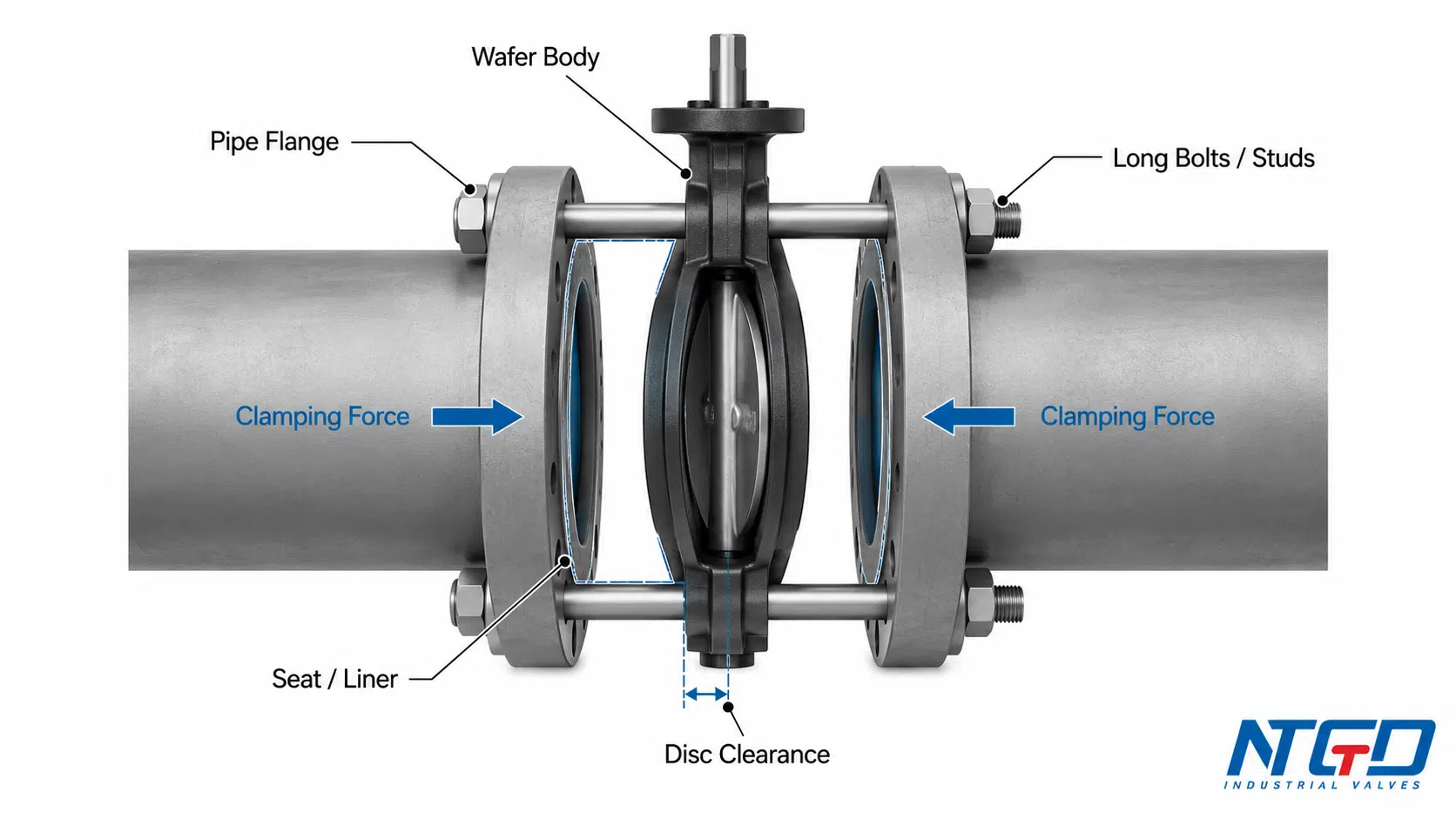
Esses parafusos normalmente não são aparafusados diretamente nos flanges integrados da válvula. Em vez disso, eles passam pelos flanges dos tubos correspondentes e ao redor do corpo da válvula tipo wafer para gerar a força de fixação. Essa é uma diferença visual e de engenharia fundamental em relação às conexões das válvulas borboleta com terminais ou flanges.
É por isso que a conexão do wafer deve ser avaliada como um sistema, e não apenas como o corpo da válvula. A condição final de vedação depende de:
| Fator de conexão | Por que é importante |
|---|---|
| Padrão de flange | Confirma se o corpo da válvula e o padrão de fixação são compatíveis com os flanges da tubulação. |
| Condição da face da flange | As faces das flanges danificadas ou sujas podem causar vazamentos externos. |
| Centralização da válvula | Um mau alinhamento pode causar compressão irregular ou interferência no disco. |
| Design do assento / forro | A sede costuma formar a interface de vedação contra a face do flange. |
| Sequência de aperto dos parafusos | Um aperto desigual pode deformar o assento ou a estrutura. |
| Diâmetro interno do tubo | É preciso verificar a folga do disco para evitar contato durante a operação. |
Em muitas válvulas borboleta de assento com mola, o assento ou o revestimento podem funcionar como interface de vedação. Não se deve presumir a presença de juntas adicionais. O uso de juntas deve ser verificado com base no projeto da válvula, na face do flange, no manual de operação e manutenção (IOM) do fabricante e nas especificações do projeto.
Por que o alinhamento das flanges é importante
O alinhamento das flanges tem um efeito direto no desempenho da válvula. Se as flanges estiverem desalinhadas, inclinadas ou forçadas à posição correta pelos parafusos, o corpo da válvula pode sofrer tensão antes mesmo de a linha ser pressurizada. Isso pode causar deformação da sede, vedação irregular, dificuldade de operação ou atrito do disco dentro do tubo.
Uma válvula borboleta tipo wafer não deve ser utilizada para corrigir o desalinhamento da tubulação. A tubulação deve ser alinhada e apoiada antes da instalação da válvula. A válvula deve estar centralizada entre os flanges, e o disco deve ter espaço livre suficiente para girar sem entrar em contato com a tubulação ou com a área da junta.
Na análise de engenharia, o desalinhamento da flange costuma estar relacionado a sintomas de falhas que surgem posteriormente. A compressão irregular da sede pode se manifestar como vazamento externo, alto torque operacional, fechamento incompleto ou danos na borda do disco após a partida.
Principais componentes de uma válvula borboleta de disco
Uma válvula borboleta tipo wafer possui menos características externas significativas no corpo do que uma válvula flangeada, mas cada componente ainda assim influencia a seleção e a confiabilidade operacional. Para solicitações de cotação e análises técnicas, o ponto-chave não é apenas identificar as peças, mas compreender como cada uma delas afeta a aplicação.
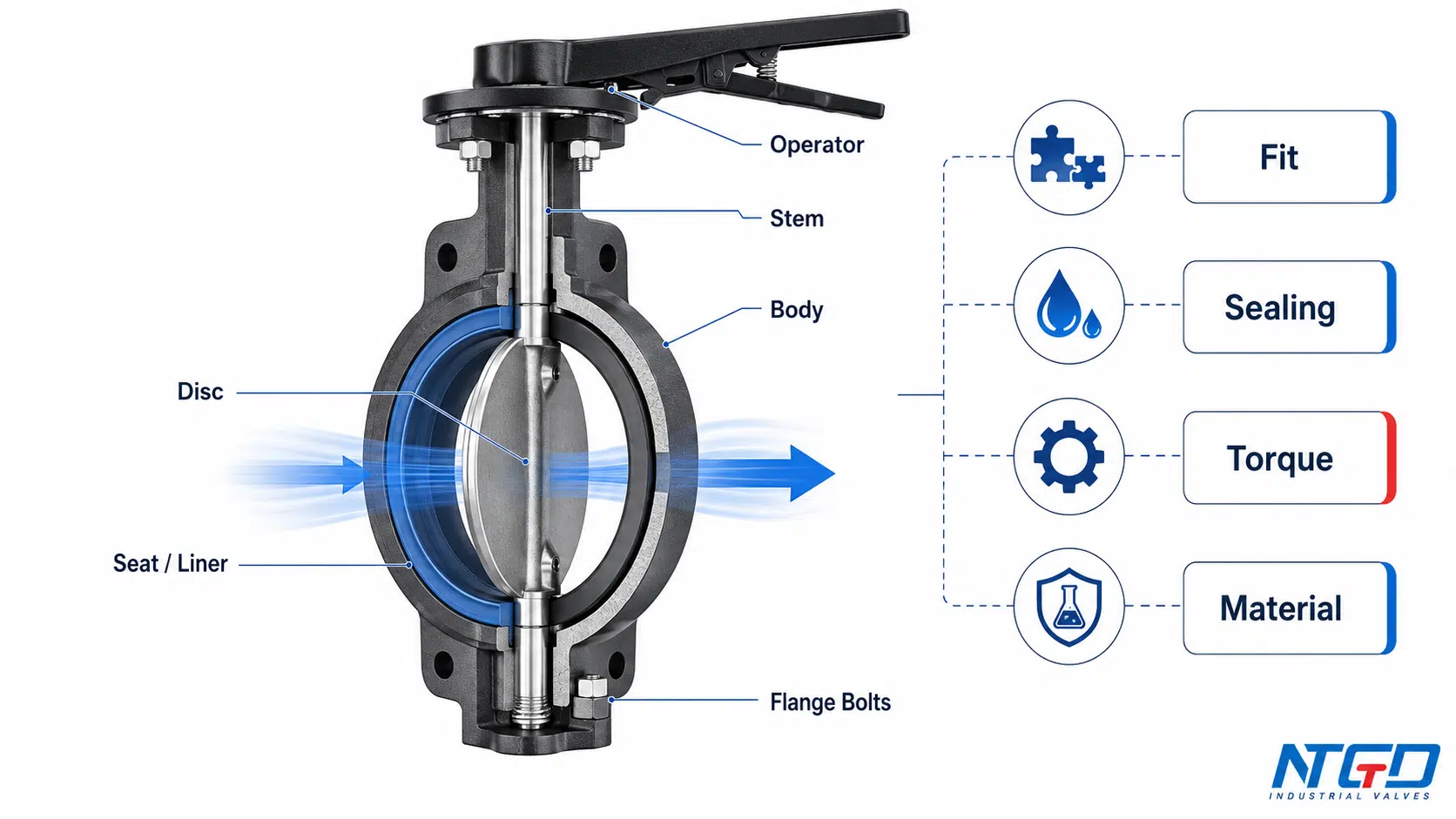
| Componente | Função | O que os compradores devem verificar | Seleção / Impacto da falha |
|---|---|---|---|
| Corpo | Sirve de suporte para a instalação da placa entre as flanges. | Material do corpo, perfil da pastilha, compatibilidade das flanges, comprimento entre faces. | Afeta o ajuste, o peso, a resistência à corrosão e a estabilidade da instalação. |
| Disco | Gira dentro do trajeto do fluxo para abrir, regular ou fechar a válvula. | Material do disco, revestimento, condição da borda, conexão com o eixo. | Afeta o fechamento, a resistência ao desgaste, a resistência à corrosão e a restrição do fluxo. |
| Assento / forro | Proporciona a interface de vedação entre o disco, o corpo e a área do flange. | EPDM, NBR, PTFE, sede metálica ou outro material compatível com a aplicação. | Influencia o risco de vazamento, a compatibilidade química, os limites de temperatura e o torque de operação. |
| Haste/eixo | Transfere o torque do operador para o disco. | Material da haste, conexão entre a haste e o disco, resistência à corrosão. | Afeta a confiabilidade operacional e o dimensionamento do atuador. |
| Interface operador/atuador | Abre, fecha ou regula a válvula. | Alavanca, engrenagem, atuador elétrico, atuador pneumático ou atuador hidráulico. | Afeta a automação, a margem de torque, a velocidade de operação e o método de controle. |
| Parafusos / interface da flange | Proporciona força de fixação por meio dos flanges do tubo. | Padrão de fixação, norma de flange, alinhamento, sequência de aperto. | Afeta a vedação externa, o alinhamento da carcaça e a confiabilidade da instalação. |
| Interface de vedação: sede / revestimento vs. junta adicional | Defines whether sealing is handled by the valve seat / liner, an extra gasket, or a project-specific arrangement. | Seat design, flange face, IOM requirement, and gasket compatibility if used. | Wrong gasket use can cause over-compression, leakage, high torque, or disc interference. |
For a deeper breakdown of body, disc, stem, seat, seals and actuator functions, see NTGD’s butterfly valve parts and components guia.
Observação sobre o contato entre a junta e a sede
Treating the gasket as a standard component of every wafer butterfly valve can create installation errors. In many resilient seated wafer butterfly valves, the seat or liner extends to the flange face and performs the flange sealing function.
Adding extra gaskets without checking the valve design may over-compress the seat, increase operating torque, reduce disc clearance, or create leakage paths. The safer approach is to verify the seat / liner design, flange face condition, and manufacturer IOM before adding any gasket.
Como funciona uma válvula borboleta tipo wafer?
Posições abertas, com limitação e fechadas
A wafer butterfly valve works by rotating a disc through a quarter turn. The disc is connected to a stem or shaft, and the stem is operated by a lever, gear, electric actuator, pneumatic actuator, or hydraulic actuator.
In the open position, the disc turns roughly in line with the flow path, allowing media to pass through the valve. In the closed position, the disc rotates across the flow path and presses against the seat or liner to shut off the line. Between fully open and fully closed, the disc can restrict flow and provide limited throttling, depending on the design and service conditions.
A wafer butterfly valve can be suitable for on-off service and some flow regulation duties, but it should not automatically be treated as a precision control valve. Throttling performance depends on disc design, seat material, actuator control, flow velocity, pressure differential, and whether the service creates vibration, cavitation, erosion, or seat wear.
Considerações sobre a lógica de vedação e o trajeto do fluxo
The disc of a butterfly valve remains inside the flow path even when the valve is open. This creates a different flow profile from full-bore ball valves or gate valves. For most general shutoff applications, this is acceptable. For severe throttling, slurry, high velocity, or high-pressure differential service, the flow path and disc exposure should be reviewed more carefully.
Sealing depends on the relationship between the disc, seat, body, and flange compression. If the seat is damaged, chemically incompatible, swollen, over-compressed, or misaligned, the valve may leak internally or become hard to operate. If the disc contacts the pipe or flange area, the valve may fail to close fully or the disc edge may be damaged.
This working principle also explains why disc clearance, seat condition, and actuator torque directly affect shutoff reliability, operating effort, and troubleshooting results.
Tipos, materiais e opções de operação
Wafer butterfly valves can be classified by body and seat design, operation method, and material combination. The connection style is only one part of the specification.
Por design da carroceria/banco
| Rota de Design | Typical Role | Limite de seleção |
|---|---|---|
| Concentric / resilient seated wafer butterfly valve | Common choice for water, HVAC, and general utility shutoff. | Seat material must match medium and temperature. |
| Soft-seated wafer butterfly valve | Provides sealing with elastomer or polymer seat materials. | Not all soft seats are suitable for high temperature, chemicals, or abrasive media. |
| PTFE-lined or chemically resistant design | Used where corrosion resistance is important. | Liner, disc, stem, and body compatibility must be checked against medium concentration and temperature range. |
| High performance wafer butterfly valve | May be used for higher duty or more demanding applications. | Review pressure differential, required shutoff performance, temperature, seat design, actuator torque, and whether a válvula borboleta de alto desempenho route is more suitable before selection. |
| Metal-seated or offset design | Used where soft seats are not suitable. | Requires careful review of leakage requirement, temperature, and pressure differential. |
This article does not replace a full butterfly valve types guide. The purpose here is to show which design routes may appear inside a wafer butterfly valve specification.
Por método de operação
| Operation Option | Uso típico | Nota de seleção |
|---|---|---|
| Manual lever wafer butterfly valve | Smaller sizes or simple manual operation. | Check handle clearance, locking position, and operator access. |
| Gear-operated butterfly valve | Larger sizes or higher operating torque. | Check gearbox torque, handwheel clearance, and operating frequency. |
| Válvula borboleta com acionamento elétrico | Automated on-off or remote operation. | Check voltage, torque output, duty cycle, enclosure, and control signal. |
| Válvula borboleta pneumática | Fast actuation or plant automation. | Check air supply, actuator sizing, fail position, and accessories. |
| Válvula borboleta wafer hidráulica | Special applications requiring high actuation force. | Usually reserved for high-force applications where pneumatic or electric actuation is not practical or sufficient. |
For actuator selection, the key issue is not only whether the valve is electric or pneumatic. The actuator must match valve torque, seat material, pressure differential, operating frequency, safety position, and control logic.
Por tipo de material e condição do serviço
| Material / Seat Route | Where It May Fit | Limite |
|---|---|---|
| Ductile iron or cast iron body | Water, HVAC, and general service. | Check coating, pressure rating, and water quality. |
| Carbon steel body | Industrial utility or general process service. | Check corrosion allowance and temperature range. |
| Válvula borboleta wafer de aço inoxidável | Corrosive, cleaner, or stainless piping systems. | For stainless construction routes, compare the broader válvula borboleta de aço inoxidável requirements with the wafer body and seat design. |
| Válvula borboleta de wafer de plástico | Corrosive or lightweight piping systems. | Check pressure, temperature, flange compatibility, and mechanical strength. |
| Assento de EPDM | Water and some utility services. | Not suitable for every chemical or oil service. |
| NBR seat | Some oil or air services. | Check temperature and chemical compatibility. |
| PTFE seat / liner | Chemical resistance applications. | Check temperature, pressure, concentration, and mechanical loading. |
| Assento de metal | Higher temperature or severe service review. | Check leakage requirement, operating torque, and pressure differential. |
Material selection should always be service-based. A material that works well in clean water may fail quickly in abrasive slurry, high-temperature steam, aggressive chemicals, or dry powder service.
For broader engineering context, material selection for valves should consider pressure, temperature, media corrosiveness and erosive properties, rather than body material alone.
Vantagens, adequação à aplicação e condições ideais de uso
Vantagens de engenharia
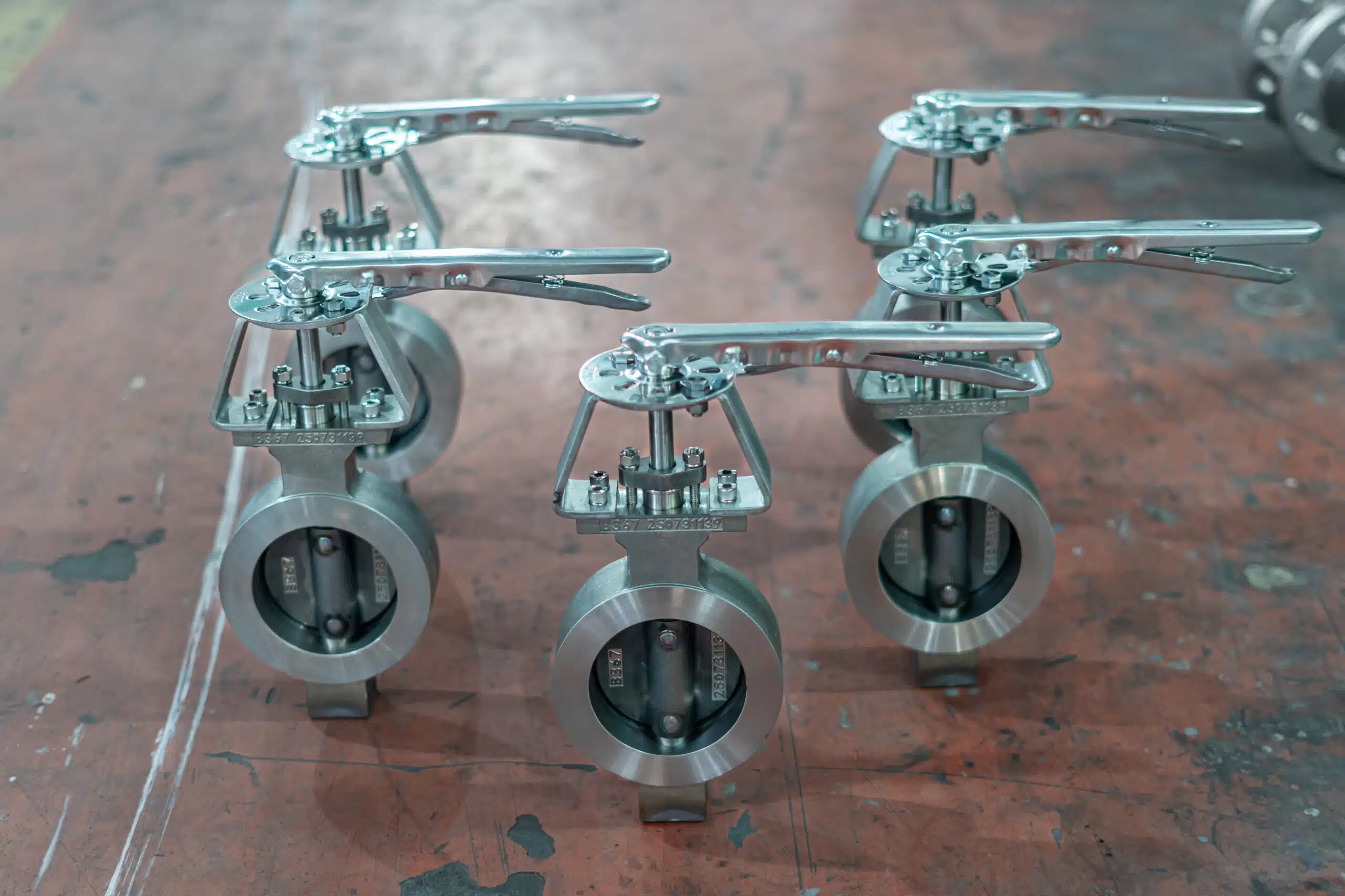
Wafer butterfly valves are popular because they solve several practical piping problems with a compact body style.
| Vantagem | Significado de engenharia | Limite |
|---|---|---|
| Compact body | Shorter and lighter than many flanged valve bodies. | Still requires flange and operator clearance. |
| Lower weight | Easier to handle and install in many pipe sizes. | Piping support may still be required. |
| Cost-effective body style | Uses less body material than many lug or flanged designs. | Lowest initial body cost does not guarantee the lowest lifecycle cost if seat replacement, actuator oversizing, or installation rework becomes necessary from misapplication. |
| Operação rápida com um quarto de volta | Abre e fecha rapidamente. | Fast operation may not be suitable for every system condition. |
| Simple mid-line installation | Fits between two pipeline flanges. | Alignment and tightening quality are critical. |
| Multiple operation options | Can be manual, gear-operated, electric, pneumatic, or hydraulic. | Actuator sizing must match torque and service. |
| Broad material options | Can be configured for many clean or moderately demanding services. | Material and seat compatibility must be checked against medium, temperature, and operating duty. |
The main advantage of a wafer butterfly valve is not that it is “best” for every system. Its value is strongest where compact installation, simple shutoff, moderate cost, and quick operation fit the service conditions.
Aplicação típica
| Aplicativo/serviço | Fit Level | Notas |
|---|---|---|
| Tratamento de água | Alta | Common where seat and coating match the water quality. |
| HVAC / chilled water | Alta | Check temperature, insulation space, and actuator clearance. |
| General industrial utilities | Médio a alto | Define pressure, temperature, medium, and operation frequency. |
| Air or low-pressure gas service | Conditional | Check sealing requirement, seat compatibility, and leakage tolerance. |
| Serviço químico | Conditional | May require PTFE lining, stainless components, or other compatible materials depending on medium concentration and temperature. |
| Food or sanitary service | Conditional | Requires sanitary design, surface finish, and documentation if applicable. |
| Lama ou mídia abrasiva | Cuidado | Disc, seat, solids content, velocity, and wear pattern must be reviewed. |
| Utilização em altas temperaturas | Cuidado | May require metal-seated or high-performance design review rather than a standard soft seat. |
| Severe throttling | Cuidado | May require high-performance, control-focused, or alternative valve design review. |
Wafer butterfly valves are most straightforward in clean or moderately demanding services. As the medium becomes more corrosive, abrasive, hot, viscous, or unstable, the selection path moves from simple product choice to material, seat, velocity, and maintenance review.
Limitações e quando avaliar alternativas
Limite tipo wafer vs. tipo lug vs. tipo flangeado
A wafer valve is often compared with lug and flanged butterfly valves. The comparison matters, but it should not take over the current page. The key boundary is how the valve is supported and maintained in the pipeline.
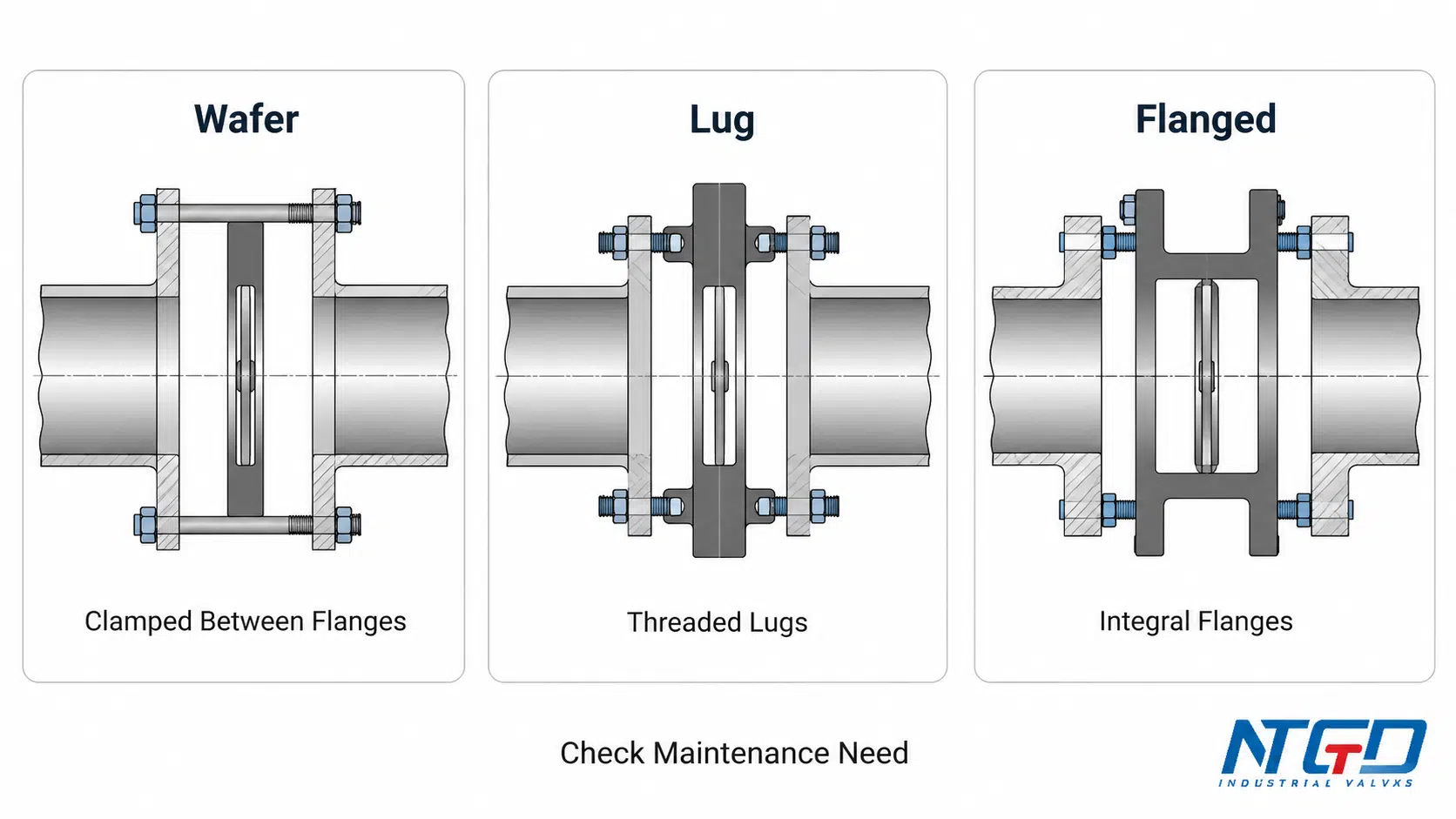
| Tipo de conexão | Como funciona | Strength / Maintenance Boundary | Nota de seleção de engenharia |
|---|---|---|---|
| Válvula borboleta wafer | Clamped between two pipe flanges by long bolts or studs. | Usually depends on both flanges for support and sealing. | Strong fit for compact mid-line service when both flanges remain in place. |
| Válvula borboleta de encaixe | Uses body lugs, often with threaded bolt engagement. | May support one-side isolation or end-of-line service if designed and rated for it. | Review when one-side maintenance, section isolation, or dead-end duty is required. |
| Válvula borboleta flangeada | Has integral body flanges bolted directly to pipe flanges. | Heavier body and more direct piping connection. | Review when a more rigid flanged connection or project flange requirement is specified. |
For a deeper connection-specific comparison, use the dedicated Válvula borboleta de encaixeUses body lugs, often with threaded bolt engagement.May support one-side isolation or end-of-line service if designed and rated for it.Review when one-side maintenance, section isolation, or dead-end duty is required.Válvula borboleta flangeadaHas integral body flanges bolted directly to pipe flanges.
<valve.com/comparison-wafer-type-butterfly-valve-vs-flanged-butterfly-valve/”>wafer-type vs flanged butterfly valve guide
rather than expanding the comparison inside this wafer valve article.
If the project requires one side of the piping to be removed while the valve remains installed, a wafer body may not be the right choice unless the valve design and rating specifically support that duty. Lug or flanged designs are often reviewed for those maintenance conditions.
Removing one flange while an unrated wafer valve remains under pressure or without verifying its support condition can lead to loss of flange support, loss of sealing, leakage, or media release.
Limites de fim de linha, manutenção e condições severas de operação
A wafer butterfly valve is not automatically suitable for every installation. The following cases require additional review:
| Condição | Why It Needs Review |
|---|---|
| Serviço de fim de linha | A wafer valve usually needs support from both flanges unless specifically designed and rated otherwise. |
| One-side maintenance | Removing one side of the line may remove the clamping support needed for sealing. |
| Severe throttling | Disc exposure may increase vibration, noise, wear, or instability. |
| Abrasive slurry | Disc edge and seat wear can increase leakage and torque. |
| Alta temperatura | Soft seat materials may not be suitable. |
| Aggressive chemicals | Body, disc, stem, and seat materials must all be compatible with the medium and temperature range. |
| High differential pressure | Seat load, actuator torque, and shutoff reliability must be checked. |
| Misaligned piping | The valve should not be used to pull flanges into position. |
The correct decision is not “wafer or not wafer” in isolation. It is whether the wafer body style matches the service, maintenance method, flange standard, seat material, actuator, and project specification.
Verificações de seleção, solicitação de cotação e instalação
Lista de verificação para a seleção de válvulas borboleta tipo wafer
Before selecting a wafer butterfly valve, first check whether the service includes end-of-line duty, one-side maintenance, severe throttling, abrasive media, high temperature, or high differential pressure. If any of these conditions apply, the wafer body style should be reviewed before moving into routine material and actuator selection.
| Verificar item | Por que é importante |
|---|---|
| Médio | Determines body, disc, stem, and seat material compatibility. |
| Pressão e temperatura | Confirms whether the valve rating and seat material are suitable. |
| Pipe size / DN / NPS | Determines valve size, disc clearance, and actuator torque. |
| Padrão de flange | Confirms whether the wafer body fits the pipeline flanges. |
| Função de corte ou regulação | Affects disc design, seat selection, and actuator control. |
| Material do assento / forro | Affects leakage, temperature, chemical resistance, swelling risk, and operating torque. |
| End-of-line or maintenance requirement | May require review of lug or flanged alternatives. |
| Espaço de instalação | Confirms lever, gear, actuator, and handwheel clearance. |
| Modo de operação | Manual, gear, electric, pneumatic, or hydraulic operation changes torque and control. |
| Test and certificate requirements | Affects inspection, documentation, and project acceptance. |
A clear selection checklist reduces the risk of ordering a valve that fits the flange but fails the service.
For broader body-style and RFQ decision logic, the Guia de seleção de válvulas borboleta can help compare wafer, lug, flanged and other butterfly valve routes before final specification.
Lista de verificação das especificações da solicitação de cotação
For a wafer butterfly valve manufacturer or supplier to review the request accurately, the RFQ should include enough technical data. A short description such as “wafer butterfly valve, 6 inch” is usually not enough for engineering selection.
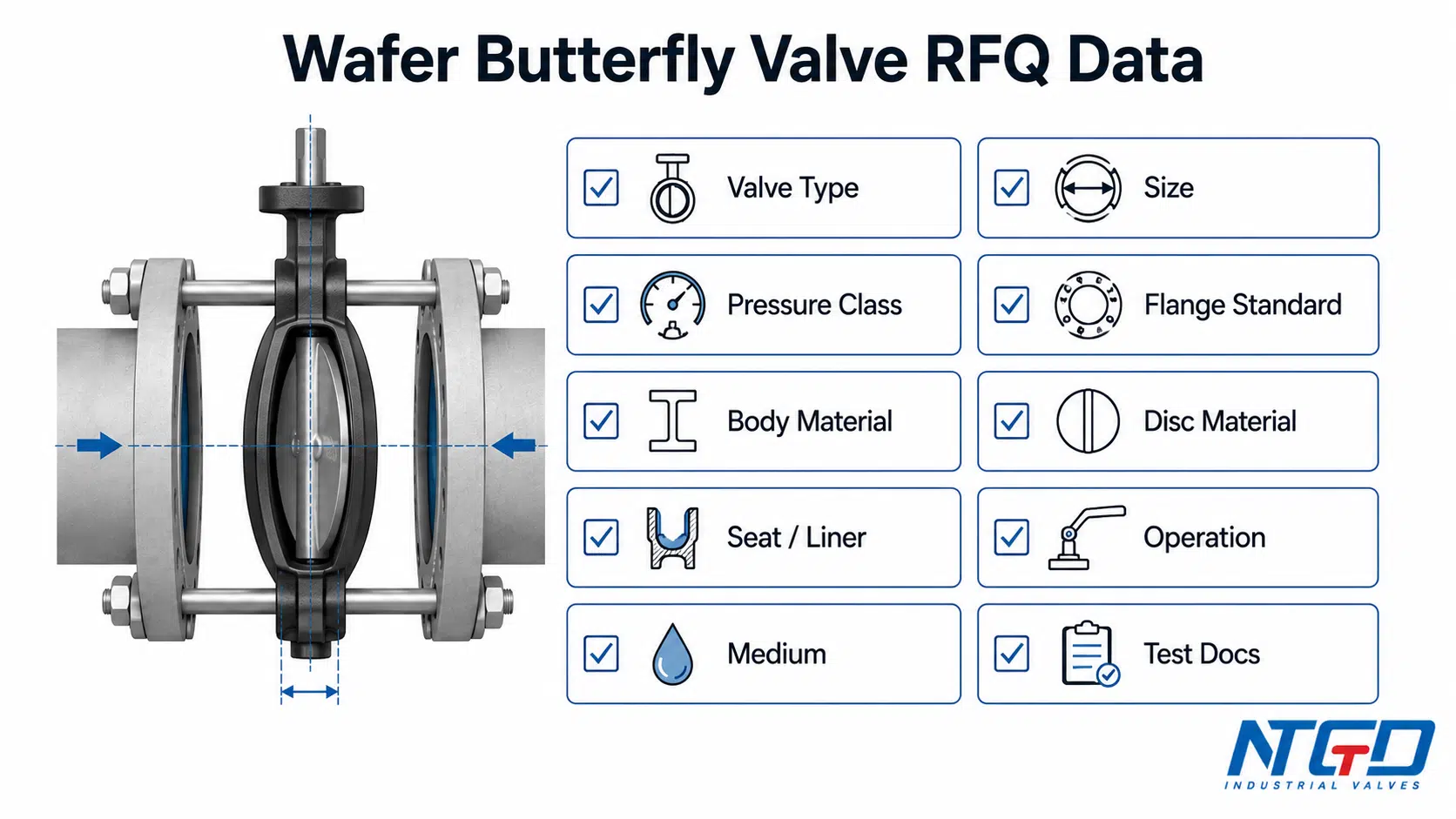
| Dados da solicitação de cotação | O que fornecer |
|---|---|
| Tipo de válvula | Wafer butterfly valve or wafer type butterfly valve. |
| Tamanho | DN / NPS and pipe schedule if relevant. |
| Classe de pressão | PN, Class, or project pressure rating. |
| Padrão de flange | Applicable flange standard or project flange requirement, such as ASME B16.5 when the project uses ASME pipe flanges. |
| Material da carroceria | Ductile iron, carbon steel, stainless steel, plastic, or other specified material. |
| Material do disco | Stainless steel, coated disc, lined disc, or project-specified material. |
| Material do assento / forro | EPDM, NBR, PTFE, sede metálica ou outro material compatível com a aplicação. |
| Material da haste | Required stem material if specified. |
| Operação | Alavanca, engrenagem, atuador elétrico, atuador pneumático ou atuador hidráulico. |
| Médio | Water, air, chemical, slurry, powder, or other service. |
| Temperatura | Normal and maximum operating temperature. |
| Quantidade | Project quantity and spare requirement. |
| Test / inspection | Pressure test, inspection record, certificates, or document package. |
| Tag data | Line number, project tag, or datasheet reference. |
| Condições de instalação | End-of-line, buried service, outdoor service, actuator clearance, or special mounting notes. |
If the RFQ still lacks service-condition data, NTGD’s Guia de seleção de válvulas industriais can help organize medium, pressure, temperature, connection, material, sealing and actuation data before inquiry.
If dimensions are important, include the required face-to-face, flange standard, actuator envelope, and any drawing requirement in the RFQ. Do not assume that every wafer butterfly valve with the same size has the same dimensional envelope.
Notas de instalação e erros comuns
This section is not a full installation procedure. The final installation should follow the manufacturer IOM, project specification, and applicable site requirements. The notes below highlight common checks that affect sealing and operation.
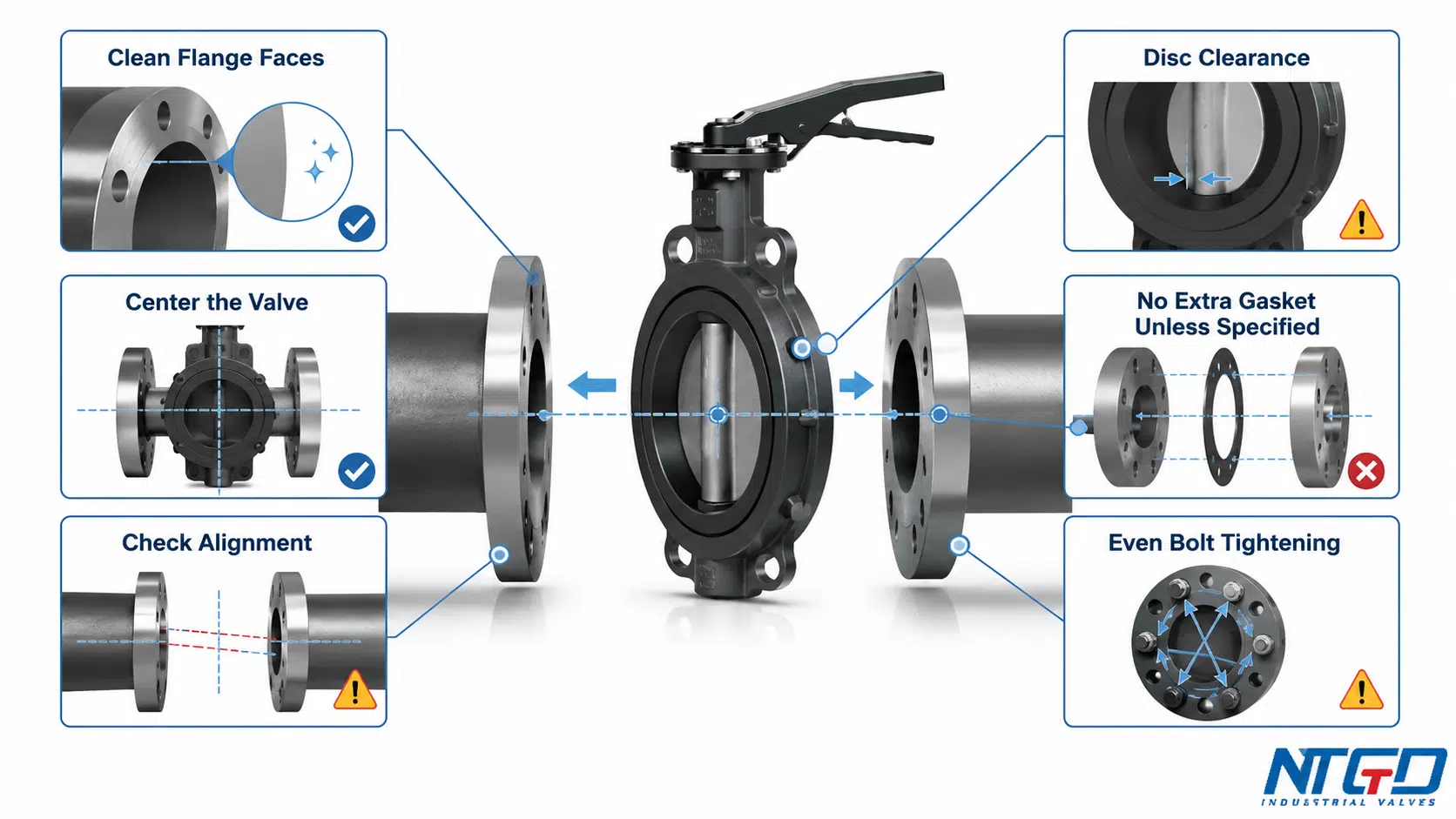
| Ponto de instalação | Por que é importante | Evitar |
|---|---|---|
| Clean pipe and flange faces | Dirt, weld slag, or scale can damage the seat or cause leakage. | Installing against dirty flange faces and then treating leakage as a valve defect. |
| Confirm flange alignment | Misalignment can distort the seat and body. | Pulling the pipe into position with bolts, which may lead to uneven compression or hard operation. |
| Center the valve between flanges | Correct centering supports even compression and disc clearance. | Leaving the valve offset in the flange gap, which may cause disc rubbing. |
| Follow the IOM for disc position | Disc position during installation can affect seat protection and clearance. | Applying one universal disc angle to all designs. |
| Avoid extra gaskets unless specified | Many resilient seated designs use the seat / liner as the sealing interface. | Adding gaskets without checking the IOM, which may cause over-compression, high torque, or leakage. |
| Tighten bolts gradually and evenly | Even compression reduces seat distortion and leakage risk. | Fully tightening one side first, which may deform the seat or body. |
| Check disc clearance | The disc must rotate without contacting the pipe or flange area. | Forcing the valve open or closed when disc interference is present. |
| Cycle the valve after installation | Confirms smooth operation before startup. | Skipping operational checks and discovering torque or closure issues during commissioning. |
| Check for leakage after startup | Early leakage may indicate alignment, seat, or bolt compression issues. | Assuming all leakage is caused by valve quality alone. |
Many wafer butterfly valve problems start with installation conditions rather than valve design. Flange alignment, seat compression, and disc clearance should be checked before blaming the actuator or replacing the valve.
Solução de problemas e perguntas frequentes
Matriz de resolução de problemas
For wafer butterfly valves, start troubleshooting with flange alignment, bolt compression, seat condition, and disc clearance before assuming the valve body or actuator is defective.
| Problema | Causa provável | O que verificar | Ação recomendada |
|---|---|---|---|
| A válvula não fecha completamente | Disc interference, seat damage, actuator travel stop, debris in the line. | Pipe ID, disc edge, seat condition, actuator limit setting. | Inspect clearance, clean the line, check seat and operator setting. |
| Hard operation or high torque | Over-compressed seat, flange misalignment, swollen seat, wrong actuator sizing. | Flange alignment, bolt compression, seat material, actuator output. | Recheck installation, review seat compatibility, resize actuator if needed. |
| Vazamento externo | Uneven bolt tightening, damaged seat face, dirty flange surface, misalignment. | Flange faces, bolt pattern, liner edge, body centering. | Clean and realign, tighten evenly, inspect seat / liner condition. |
| Vazamento interno | Worn seat, damaged disc edge, incompatible seat material, incomplete closure. | Disc edge, seat surface, actuator travel, medium compatibility. | Replace damaged sealing parts and review material selection. |
| Stem or packing leakage | Packing wear, stem corrosion, improper adjustment. | Stem area, packing condition, operating frequency. | Adjust or replace packing according to valve design. |
| Actuator mismatch | Insufficient torque, wrong fail position, incorrect control setup. | Valve torque data, actuator output, air supply or voltage. | Review actuator sizing and control requirements. |
| Seat swelling or degradation | Chemical or temperature incompatibility. | Medium, temperature, seat material, exposure time. | Select a compatible seat material. |
| Ruído ou vibração | Poor throttling condition, high velocity, unstable flow, wrong valve position. | Operating angle, flow condition, pressure differential, piping support. | Review service conditions and valve sizing. |
| Disc damage after installation | Pipe interference, forced operation, wrong gasket use. | Pipe bore, flange gap, gasket thickness, disc edge. | Stop operation and inspect clearance before reuse. |
Troubleshooting should start with the installation and service data. If the same problem repeats after replacing parts, the root cause may be flange alignment, seat selection, actuator sizing, or unsuitable service conditions.
Perguntas frequentes
O que é uma válvula borboleta do tipo wafer?
Uma válvula borboleta tipo wafer é uma válvula borboleta com um corpo compacto do tipo wafer, projetada para ser encaixada entre dois flanges de tubulação. Ela é fixada por meio de parafusos ou pinos de flange, em vez de ser aparafusada com seus próprios flanges integrados.
Uma válvula borboleta tipo wafer é a mesma coisa que uma válvula borboleta no estilo wafer?
In most buyer and supplier discussions, yes. “Wafer butterfly valve,” “wafer type butterfly valve,” and “wafer style butterfly valve” usually refer to the same connection style. The exact design still depends on body material, seat material, disc design, pressure class, and operator type.
Qual é a diferença entre uma válvula borboleta do tipo wafer e uma do tipo lug?
A wafer butterfly valve is clamped between two flanges by shared bolts or studs that run through the mating flanges and around the valve body. A lug butterfly valve has body lugs or threaded inserts that allow each flange side to be bolted more independently.
This structural difference affects maintenance and end-of-line capability. Wafer designs are usually stronger for compact mid-line service, while lug designs are often reviewed when one-side isolation or end-of-line service is required.
Uma válvula borboleta tipo wafer pode ser usada para serviços de fim de linha?
A wafer butterfly valve is usually not the default choice for end-of-line service because it often depends on support and compression from both pipe flanges. If one flange is removed and the valve is not rated for that condition, sealing support may be lost and leakage or media release may occur.
End-of-line use should be checked against the valve rating, manufacturer instructions, and project specification before selection.
As válvulas borboleta de disco precisam de juntas?
Not always. Many resilient seated wafer butterfly valves use the seat or liner as the sealing interface against the flange faces. Extra gaskets can over-compress the seat or reduce disc clearance if the valve is not designed for them.
Gaskets should only be used if the valve design, flange condition, and manufacturer IOM require them.
A válvula borboleta de disco deve estar aberta ou fechada durante a instalação?
The correct disc position depends on the manufacturer’s installation instructions and valve design. The disc should be positioned so that the seat and disc are protected while enough clearance remains for the disc to rotate without contacting the pipe or flange area.
Do not rely on one universal open-or-closed rule for every wafer butterfly valve.
O que causa vazamentos após a instalação de uma válvula borboleta tipo wafer?
As causas mais comuns incluem superfícies das flanges sujas, desalinhamento das flanges, aperto irregular dos parafusos, uso incorreto da junta, danos na sede, material inadequado da sede ou interferência do disco. O vazamento deve ser verificado levando em consideração tanto o estado da válvula quanto as condições de instalação.
As válvulas borboleta de disco podem ser usadas para regulação de vazão?
Algumas válvulas borboleta tipo wafer podem ser utilizadas para regulação limitada, mas nem toda válvula wafer é adequada para serviços que envolvam regulação severa ou controle. A regulação limitada pode ser aceitável em serviços moderados, enquanto a regulação severa, alta velocidade, alta pressão diferencial, vibração ou meios abrasivos podem exigir uma revisão do projeto voltada para alto desempenho ou controle.
Como devo especificar uma válvula borboleta tipo wafer para uma solicitação de cotação?
Forneça o tipo da válvula, tamanho, classe de pressão, norma de flange, material do corpo, material do disco, material da sede ou do revestimento, material da haste, método de operação, meio, temperatura, quantidade, requisitos de teste, certificados e dados da etiqueta. Inclua os requisitos de instalação ou manutenção caso a utilização no final da linha, a folga do atuador ou condições especiais de flange sejam relevantes.
Verificação final de adequação antes da consulta
Before sending an RFQ, confirm these items:
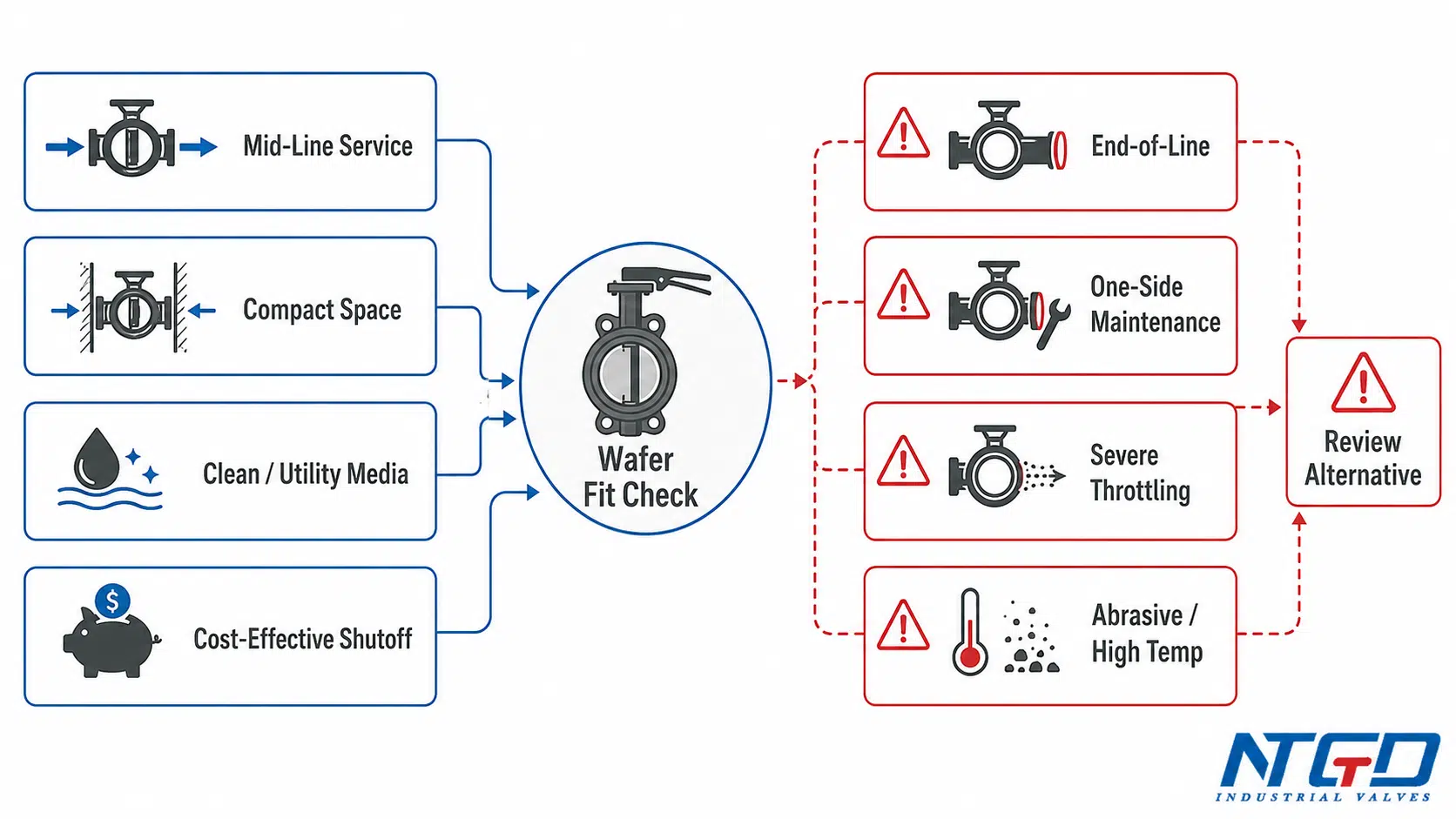
| Item de verificação de ajuste | Confirmado? |
|---|---|
| Wafer body style is suitable for the piping layout. | |
| Both flanges support the intended installation condition. | |
| End-of-line or one-side maintenance requirements are known. | |
| Medium, pressure, and temperature are defined. | |
| Body, disc, stem, and seat materials are selected for the service. | |
| Flange standard and face-to-face requirements are confirmed. | |
| Manual, gear, electric, pneumatic, or hydraulic operation is specified. | |
| Installation space and actuator clearance are checked. | |
| Testing, inspection, and certificate requirements are listed. | |
| Tag data and project documents are ready. |
Conclusão
A wafer butterfly valve is a compact and practical choice when the piping system needs a lightweight quarter-turn valve installed between two flanges. Its value comes from simple mid-line installation, broad material options, and efficient shutoff in suitable services.
The same compact body style also creates important selection boundaries. Wafer valves depend on flange alignment, correct seat compression, suitable material selection, proper actuator sizing, and clear maintenance requirements. For end-of-line service, severe throttling, abrasive media, high temperature, aggressive chemicals, or one-side maintenance, the wafer design should be checked against the project specification and manufacturer data before approval.
Overall, a wafer butterfly valve is a cost-effective compact solution for suitable mid-line piping, but severe service and maintenance-sensitive installations require focused review of structure, material, seat design, and support conditions.
If the fit-check items above are not fully confirmed, or if the service falls into the caution zones described in this guide, provide the medium, size, pressure class, flange standard, body / disc / seat material, operation method, quantity, maintenance requirement, and testing requirements. NTGD Valve can review the wafer butterfly valve specification and help confirm whether a wafer, lug, or flanged butterfly valve design is more suitable for the service.
